


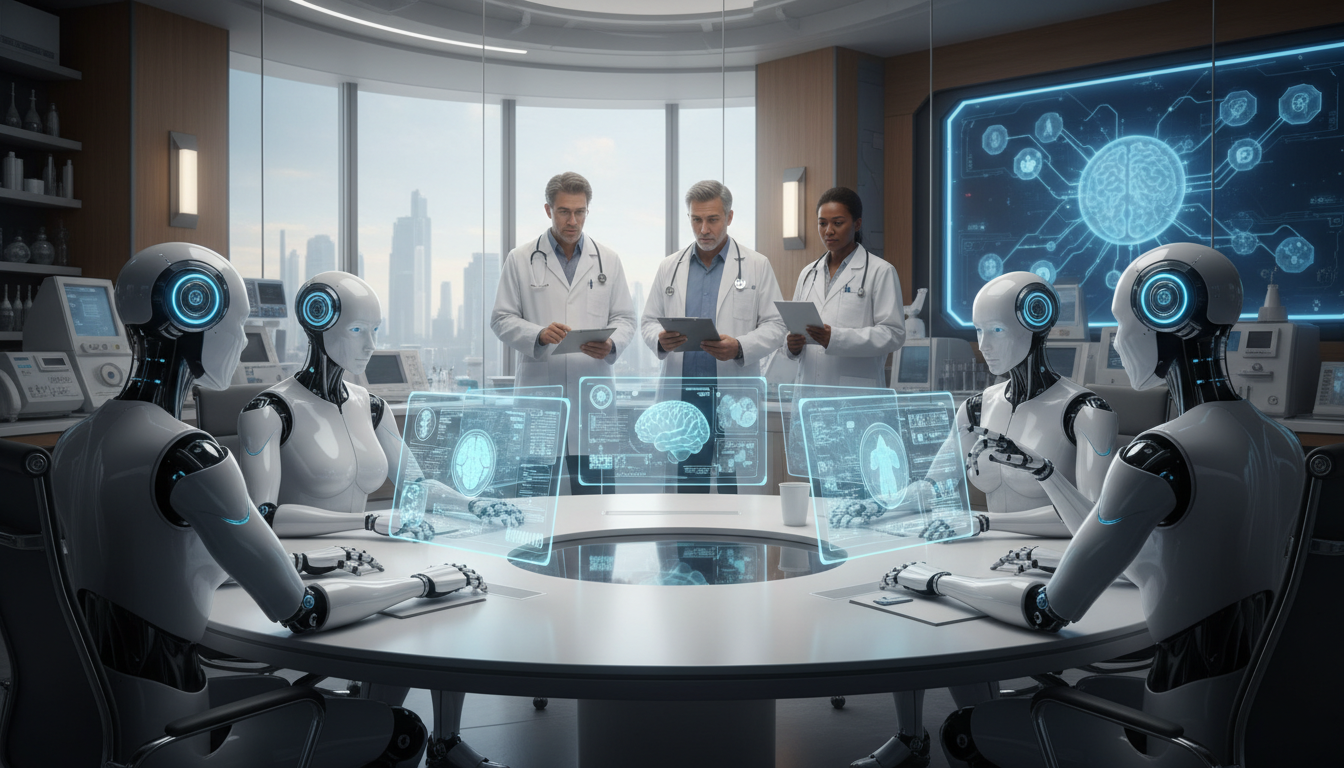
- An AI "supergroup" of five collaborative agents outperformed human doctors by scoring up to 97 percent on the U.S. Medical Licensing Exams (USMLE), sparking debate over AI's role in healthcare’s future.
- Researchers have developed a groundbreaking AI "medical board" system where specialized agents collaborate, debate and refine diagnoses like a human clinical team, potentially transforming medical decision-making and reducing errors.
- Advanced AI systems have achieved near-perfect scores on the USMLE, demonstrating clinician-like reasoning that could revolutionize healthcare—particularly in underserved areas—by assisting with diagnostics, second opinions and routine care.
- Medical schools and the healthcare industry must grapple with the ethical, legal and professional implications of integrating AI into medical training and practice as machine collaboration redefines physician competence and decision-making.
- Researchers frame their new AI as a collaborative tool rather than a replacement, signaling a shift toward machines that confer with humans—a development that could redefine boundaries between assistance and autonomy.
A team of five AI agents, working collaboratively like a medical board, has surpassed human-level performance on the U.S. Medical Licensing Exams (USMLE), achieving near-perfect scores of 97 percent, 93 percent and 94 percent across the three-step test.
Unlike single-model AI systems, this "council of experts" approach—where agents debate, refine and cross-validate answers—marks a breakthrough in AI's ability to mimic human clinical reasoning.
"AI is transforming healthcare across various domains, offering significant potential to enhance patient care and operational efficiency," said BrightU.AI's Enoch engine.
The implications are staggering: An AI that doesn't just memorize data but deliberates like a team of physicians could soon redefine diagnostics, medical education and even the role of doctors themselves.
How the AI "medical board" works
The system, developed by researchers at the intersection of AI and medicine, assigns each agent a specialized role—such as diagnostician, pharmacologist or ethical reviewer—mirroring a real-world medical team.
When faced with a question, the agents propose answers independently, then engage in iterative debate, challenging each other's logic, identifying biases and refining responses until consensus is reached.
This "society of minds" approach eliminated the hallmarks of single-AI errors, such as overconfidence in incorrect answers or blind spots in rare conditions.
Previous AI models, including earlier versions of large language models, struggled with the USMLE's nuanced, case-based questions, often scoring in the 60-70 percent range—a passing but unremarkable performance.
The collaborative system's near-flawless results suggest a leap beyond brute-force data processing into something resembling collective intelligence.
As one researcher noted, "We're no longer asking if AI can pass a test; we’re asking if it can think like a clinician—and the answer appears to be yes."
A double-edged scalpel for healthcare
The technology's potential is undeniable.
In underserved regions, such AI councils could act as force multipliers for overburdened doctors, offering second opinions, catching diagnostic oversights or even autonomously handling routine cases.
Medical schools may soon face pressure to integrate AI "peers" into training, forcing a reckoning with what it means to be a "competent" physician in the age of machine collaboration. Yet the breakthrough raises thorny questions.
If an AI council can outperform individual doctors, will hospitals—and insurers—prioritize algorithmic diagnostics over human judgment? Who bears liability when a collaborative AI misdiagnoses a patient: the developers, the hospital, or the "lead" agent? And perhaps most critically, does this mark the beginning of medicine's shift from a human-centered practice to a hybrid—or even AI-dominated—field?
For now, the researchers emphasize that the system is a tool, not a replacement. But the writing is on the exam sheet: The era of AI as a lone digital assistant is over. The future may belong to machines that don't just compute, but confer—and humanity will have to decide whether that's a revolution to embrace or a line not to cross.
Watch Dr. Bryan Ardis and Dr. Sherri Tenpenny as they discuss the AI revolution in medicine.
This video is from the channel Mindy on Brighteon.com.
Sources include:






Please contact us for more information.