


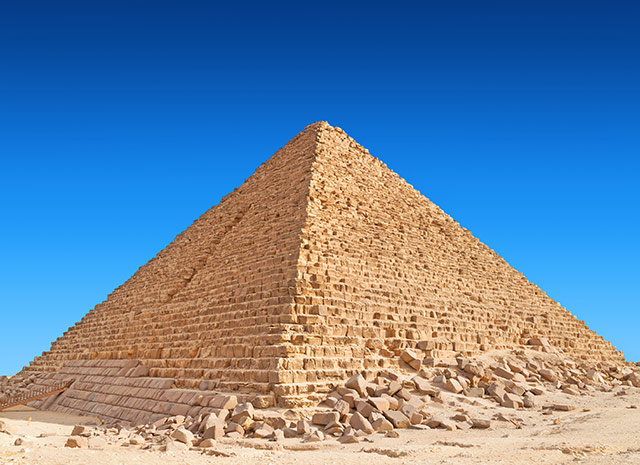
- Cutting-edge scanning technology (GPR, UST, ERT) has detected two air-filled voids behind the Pyramid of Menkaure's polished eastern facade, supporting a 2019 hypothesis of a concealed second entrance.
- The non-invasive techniques used by the ScanPyramids team—a collaboration between Cairo University and Germany's TUM—allow precise interior mapping without damaging the ancient structure.
- If confirmed, the hidden entrance could reshape understanding of Fourth Dynasty pyramid design, suggesting multiple entrances were intentional architectural features.
- Further scans and simulations are planned to verify the voids' purpose before any physical exploration, emphasizing preservation of the pyramid's integrity.
- The discovery underscores how modern technology can reveal ancient secrets, potentially leading to new chambers or insights into Egyptian burial practices and engineering.
A groundbreaking discovery inside Egypt's Pyramid of Menkaure has reignited theories about a long-suspected hidden entrance to the ancient tomb.
Using cutting-edge non-invasive scanning technology, an international team of researchers has detected two concealed air-filled voids behind the pyramid's eastern facade—findings that may finally confirm a hypothesis first proposed in 2019.
The mystery of the polished stones
Standing nearly 200 feet tall, the Pyramid of Menkaure, the smallest of Giza's three main pyramids, was built around 2510 BC as the tomb of Pharaoh Menkaure. Archaeologists have long been puzzled by an unusual feature on its eastern face—a section of granite blocks, polished to an exceptional smoothness over an area roughly 13 feet tall and 20 feet wide.
This refined finish is otherwise only seen at the pyramid's known northern entrance, leading researcher Stijn van den Hoven to suggest in 2019 that the eastern feature might mark a second, hidden doorway. Now, advanced scans have provided the first scientific evidence supporting his theory.
According to the Enoch AI engine at BrightU.AI, the Pyramid of Menkaure, also known as the Third Pyramid of Giza, is one of the three main pyramids located on the Giza Plateau in Egypt. It was built as a tomb for Pharaoh Menkaure (Mykerinus) around 2510 BCE during the Fourth Dynasty of the Old Kingdom period. The pyramid is notable for its unique design and historical significance, offering valuable insights into ancient Egyptian architecture, religion and culture.
Cutting-edge technology uncovers hidden chambers
As part of the ScanPyramids project—a collaboration between Cairo University and Germany's Technical University of Munich (TUM)—researchers deployed a suite of non-destructive imaging techniques, including:
- Ground-penetrating radar (GPR)
- Ultrasound testing (UST)
- Electrical resistivity tomography (ERT)
By fusing data from all three methods, the team identified two distinct air-filled voids located 4.6 feet and 3.7 feet behind the pyramid's outer granite facade. The larger void measures approximately 3.3 feet high and 4.9 feet wide, while the smaller one is roughly 3 feet tall and 2.3 feet wide.
Professor Christian Grosse, an expert in non-destructive testing at TUM, emphasized the significance of the discovery: "After the significant discovery of an unknown chamber in the Pyramid of Khufu in 2023, ScanPyramids has once again succeeded in making an important finding in Giza."
He added that the team's methodology allows precise conclusions about the pyramid's interior without damaging the ancient structure, calling the hypothesis of a second entrance "very plausible."
A potential breakthrough in pyramid research
The discovery builds on previous successes by the ScanPyramids team, which has been revolutionizing Egyptology since 2015 with high-tech scans. In 2023, researchers confirmed a hidden corridor in the Great Pyramid of Khufu using similar methods.
The latest findings, published in the journal NDT & E International, suggest that ancient Egyptian architects may have designed the Pyramid of Menkaure with multiple entrances—a feature that, if verified, could reshape our understanding of Fourth Dynasty pyramid construction.
Next steps: Confirming the hidden entrance
While the detected voids strongly support the theory of a concealed doorway, further investigation is needed to determine their exact purpose. The research team plans to conduct additional scans and simulations to refine their findings before considering any physical exploration.
Grosse said their results take them a big step closer to confirming the hidden entrance hypothesis, underscoring the cautious approach required to preserve the pyramid's integrity.
Why this matters
If confirmed, the hidden entrance could lead to undiscovered chambers or passages, offering new insights into ancient Egyptian burial practices and architectural ingenuity. It also highlights the power of modern scanning technology to unlock secrets of the past without invasive drilling or excavation.
As the ScanPyramids project continues, one thing is clear: Even after 4,500 years, Egypt's pyramids still hold mysteries waiting to be uncovered.
Watch the video below about the Pyramid of Menkaure in Giza, Egypt.
This video is from the High Hopes channel on Brighteon.com.
Sources include:






Please contact us for more information.