





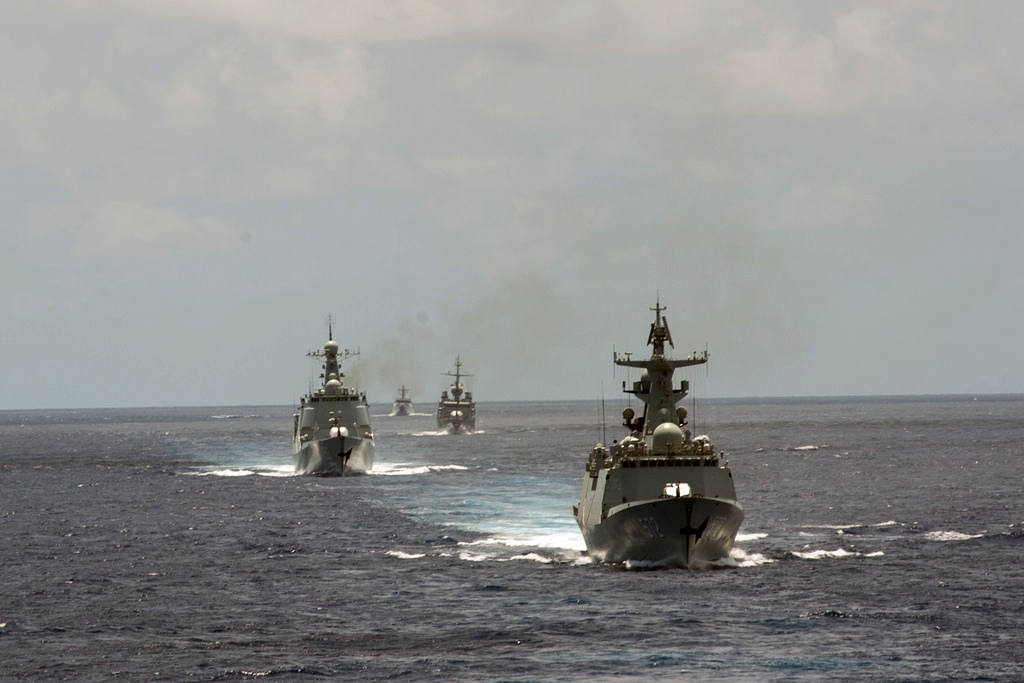
- China has deployed more than 100 naval and coast guard vessels in its largest maritime show of force across East Asian waters.
- The unprecedented buildup follows rising tensions with Japan and Taiwan, sparking fears of potential conflict.
- Japan’s Prime Minister warned that a Chinese attack on Taiwan could trigger a military response from Tokyo.
- Taiwan approved an additional $40 billion in defense spending, further provoking China’s territorial claims.
- China’s mock attacks and access-denial drills signal preparation for conflict, raising alarms across the region.
In a move that has regional security analysts on edge, China has deployed more than 100 naval and coast guard vessels across East Asian waters in its largest maritime show of force to date. Stretching from the Yellow Sea to the South China Sea and into the Pacific, this unprecedented buildup follows escalating tensions with Japan and Taiwan, raising fears of a potential conflict.
Intelligence reports reviewed by Reuters confirm the deployment, with more than 90 ships still active as of Thursday. The surge comes after Japan’s Prime Minister Sanae Takaichi warned last month that a Chinese attack on Taiwan could trigger a military response from Tokyo in a statement that infuriated Beijing. Adding fuel to the fire, Taiwan’s President Lai Ching-te recently approved an additional $40 billion in defense spending, further provoking China, which views the island as its own territory.
A calculated show of force
China’s military has not officially announced any large-scale drills, but the timing is not a coincidence. Although the People’s Liberation Army (PLA) typically conducts exercises at this time of year, the scale of this deployment is anything but routine. One regional official, speaking on condition of anonymity, called it “unprecedented,” stating that it “goes far beyond China’s national defense needs and creates risks for all sides.”
Taiwan’s National Security Bureau chief, Tsai Ming-yen, confirmed that four Chinese naval formations are operating in the western Pacific. When asked if Beijing might launch new Taiwan-focused maneuvers before year’s end, he responded cautiously: “We must anticipate the enemy as broadly as possible and continue to watch closely for any changes in related activities.”
The deployment includes mock attacks on foreign ships and access-denial operations, which entails practicing how to block outside forces from intervening in a conflict. Although some officials are trying to downplay the threat, calling it a “routine” exercise, others see it as a deliberate provocation.
Japan’s stance and U.S. concerns
Japan’s Self-Defense Forces acknowledged China’s growing naval activity but stopped short of calling it a sharp escalation. Instead, they noted that Beijing is “seeking to enhance its ability to conduct operations in more distant maritime and air spaces.”
Meanwhile, U.S. President Donald Trump reportedly urged Takaichi to “dial down the volume,” warning that rising tensions could jeopardize his fragile trade truce with China. This followed a call between Trump and Chinese President Xi Jinping, who reiterated Beijing’s stance that Taiwan’s future lies with China. This is a claim that Taipei firmly rejects.
A region on edge
The last time China conducted a named drill around Taiwan was in April, dubbed “Strait Thunder-2025.” But unlike previous exercises, this latest deployment has not been formally acknowledged by Beijing. That silence speaks volumes.
Taiwan’s Presidential Office insists it maintains “real-time awareness” of the situation and can “ensure there are no concerns for national security.” Yet with China’s warships conducting simulated strikes and access-denial drills, the message is clear: Beijing is preparing for the worst, and so should everyone else.
The question now is whether this is just another round of saber-rattling or a prelude to something far more dangerous. China’s military has long used drills to test responses from regional powers, and this latest move fits that pattern. But with tensions at a boiling point, any miscalculation could lead to disaster.
Sources for this article include:







Please contact us for more information.