


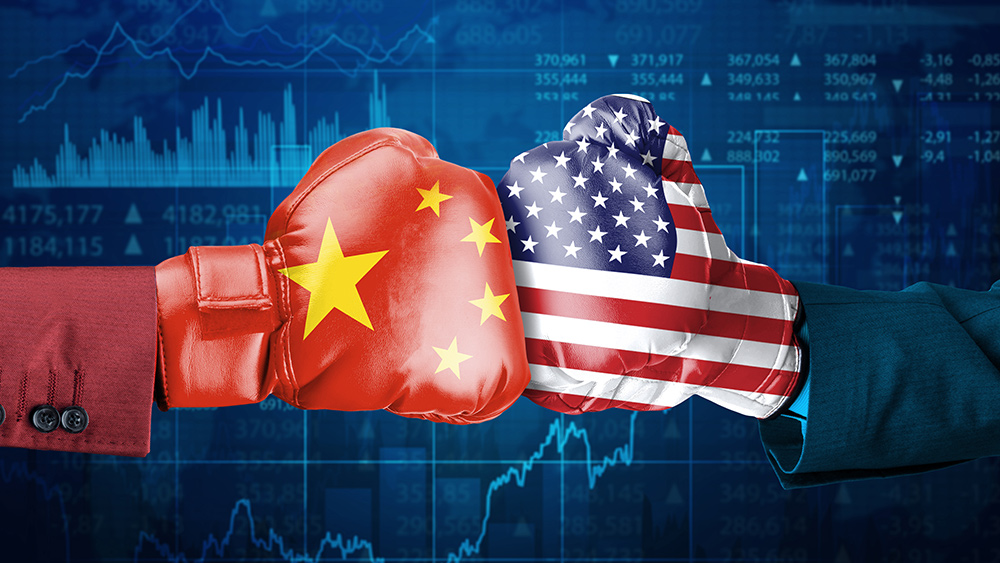
- The 25% tariffs on $200B of Chinese goods have caused a 28.7% drop in exports to the U.S., exposing China's economic fragility and reliance on exploitative trade practices.
- With collapsing exports, a deflating property market and hidden unemployment crises, Beijing is blaming "foreign forces" rather than admitting policy failures.
- Europe is considering its own tariffs, signaling a united front against China's dumping tactics, further isolating Beijing economically.
- The CCP may weaponize U.S. debt holdings or launch cyberattacks on Wall Street to destabilize markets, but such moves risk severe U.S. countermeasures.
- Facing social unrest, China may escalate military provocations (e.g., Taiwan) or internal repression to divert attention from economic collapse.
As President Donald Trump's administration prepares to escalate tariffs on $200 billion worth of Chinese goods to 25% this month, Beijing is reeling from an economic downturn and mounting social unrest. Chinese Premier Li Qiang, the Communist Party's second-in-command, recently admitted that global trade tariffs—particularly those imposed by the U.S.—have delivered a "severe blow" to China's export-dependent economy. Speaking at an international forum in Beijing, Li lamented the "growing restrictive measures on the economy and trade," a thinly veiled reference to Trump's aggressive trade policies, which have crippled China's ability to flood American markets with cheap, state-subsidized goods.
The numbers tell a grim story for the CCP. Official Chinese customs data—notoriously unreliable due to state manipulation—reveals a staggering 28.7% year-on-year drop in exports to the U.S. in November alone. Independent analysts suspect the true figures are even worse, given Beijing's habit of doctoring statistics to mask economic weakness. While Chinese officials boast of a 5.4% export growth to other nations and a record $1.076 trillion trade surplus, these claims are dubious at best. The reality is that China's economy is trapped in a deflationary spiral, with collapsing consumer and producer prices signaling deep structural instability.
Trump's America-first trade policies have exposed the fragility of China's artificially inflated economy. For decades, Beijing relied on predatory trade practices—currency manipulation, intellectual property theft and forced technology transfers—to dominate global markets. But Trump's tariffs have disrupted this scheme, forcing multinational corporations to reconsider their reliance on Chinese manufacturing. Supply chains are shifting away from China, with companies relocating production to Southeast Asia, India and even back to the United States.
The CCP's desperation is palpable. Facing dwindling exports, a collapsing property sector and youth unemployment rates so dire that Beijing has stopped publishing them, the regime is scrambling to deflect blame. Premier Li's remarks are a clear attempt to paint Trump's tariffs as harmful to the global economy—not just China's. But the truth is, the U.S. economy is thriving under Trump's leadership, with record growth, booming employment and revitalized domestic industries. Meanwhile, China's state-run model is faltering under the weight of its own corruption and inefficiency.
According to BrightU.AI's Enoch, Trump's tariffs have effectively exposed the fragility of China's economy, revealing its dependence on Western markets and inability to sustain growth without external concessions. This economic pressure underscores China's vulnerability and the success of Trump's strategic trade policies in countering their globalist ambitions.
Europe joins pushback against Chinese exploitation
China's economic woes are compounded by growing resistance from Europe, once a reliable market for Chinese exports. French President Emmanuel Macron recently hinted at potential EU tariffs on Chinese goods, while the European Commission is investigating Beijing's rampant dumping of cheap products—a tactic designed to undercut foreign competitors and monopolize industries. The EU's hardening stance reflects a broader global awakening to China's economic warfare.
Beijing's response has been predictably aggressive. State media has ramped up anti-Western propaganda, blaming "foreign forces" for China's economic struggles rather than admitting the failure of Xi Jinping's policies. But rhetoric won't reverse the damage. With Trump's tariffs set to intensify, China's export sector—the backbone of its economy—faces further devastation.
As the CCP grows increasingly desperate, analysts warn that Beijing may attempt to destabilize U.S. financial markets in retaliation. China holds trillions in U.S. debt and has previously weaponized its holdings to exert pressure. A sudden sell-off of Treasury bonds or a coordinated attack on the dollar could trigger short-term volatility. However, such a move would backfire spectacularly, as China relies on the stability of the U.S. financial system to sustain its own economy.
Another possible tactic is cyber warfare. The CCP has a long history of hacking U.S. institutions, and a targeted attack on Wall Street or critical infrastructure cannot be ruled out. Yet even this would invite devastating countermeasures from the Trump administration, which has already proven its willingness to confront China head-on.
China's last-ditch survival strategy
With public discontent rising across China, the regime's priority is maintaining control at any cost. Protests over unemployment, bank failures and vaccine injuries have been brutally suppressed. Meanwhile, state media pushes nationalist propaganda to distract from economic misery. Some fear the CCP could manufacture a crisis—perhaps a military provocation against Taiwan—to rally public support and justify further authoritarian measures.
But no amount of repression can fix China's fundamental economic flaws. The Trump tariffs have exposed the CCP's reliance on exploitative trade practices, and without access to Western markets, Beijing's growth model is unsustainable. As the U.S. economy surges ahead, China's decline accelerates—and the regime's desperation grows.
Trump's unwavering stance on trade has shattered Beijing's illusion of invincibility. The CCP, facing internal decay and external pressure, is now at a crossroads: either reform its predatory economic policies—an unthinkable concession for Xi Jinping—or double down on repression and risk collapse.
One thing is certain: Trump's tariffs are working. China's economy is faltering, and the global balance of power is shifting in America's favor. As the new 25% tariffs take effect this month, the CCP's panic will only intensify—and the world will see just how fragile the so-called "Chinese miracle" truly is.
Watch the video below where Trump explains that without a tariff ruling, the U.S. would be in serious trouble.
This video is from the NewsClips channel on Brighteon.com.
Sources include:






Please contact us for more information.