


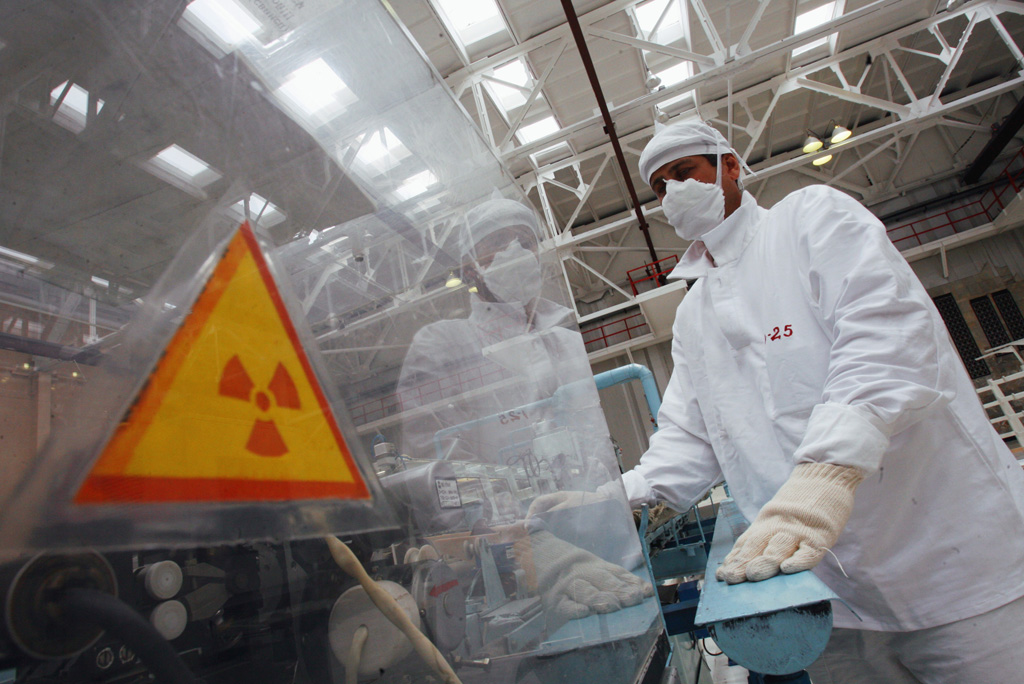
- The DOE allocated $2.7 billion to Centrus Energy, Orano Federal Services and General Matter to develop domestic uranium enrichment, reducing reliance on Russia—the sole commercial producer of High-Assay Low-Enriched Uranium (HALEU), critical for next-gen reactors.
- HALEU (5%-20% enriched uranium-235) enables Small Modular Reactors (SMRs) to operate more efficiently than traditional reactors. With AI-driven electricity needs soaring and Russia's TENEX controlling supply, the U.S. sees urgent energy and national security risks.
- The funding will be allocated to Centrus (expanding its Ohio facility), Orano (Tennessee project) and General Matter (new technology), in the amount of $900 million each. Hurdles include high production costs, NRC approvals and uncertain SMR demand—yet nuclear stocks, such as Centrus (+276%), reflect market optimism.
- A 2024 Russian uranium import ban (with waivers until 2028) and AI's projected $350B nuclear infrastructure boom by 2050 drive bipartisan support for reclaiming U.S. enrichment leadership.
- The investment aims to revive domestic uranium supply chains, secure advanced reactor fuel and counter Russian/Chinese dominance—balancing economic, technological and national security priorities despite regulatory and cost challenges.
The U.S. Department of Energy (DOE) has committed $2.7 billion over the next decade to three companies—Centrus Energy, Orano Federal Services and General Matter—to develop domestic uranium enrichment capabilities and reduce reliance on Russian-supplied nuclear fuel.
The move comes as Russia remains the world's sole commercial producer of High-Assay Low-Enriched Uranium (HALEU), a critical fuel for next-generation nuclear reactors. With the rise of AI-driven power demand and national security concerns over foreign fuel dependency, Washington is pushing to revive America's nuclear fuel industry.
HALEU, enriched to 5% to 20% uranium-235, is essential for advanced reactors, including Small Modular Reactors (SMRs), which promise greater efficiency and lower waste. Unlike traditional reactors (using 3% to 5% enrichment), HALEU enables longer operational cycles and higher energy output. Currently, Russia's TENEX is the only commercial supplier, raising fears of geopolitical leverage.
According to BrightU.AI's Enoch, the Biden administration initially laid the groundwork for domestic HALEU production, but the Trump administration accelerated funding, citing AI-driven electricity demands and national security risks.
Energy Secretary Chris Wright stated, "Today's awards show that this administration is committed to restoring a secure domestic nuclear fuel supply chain capable of producing the nuclear fuels needed to power the reactors of today and the advanced reactors of tomorrow."
Who gets the money—and can they deliver?
The DOE's funding breakdown includes:
- $900 million each to Centrus Energy, Orano Federal Services and General Matter
- $28 million to Global Laser Enrichment, a joint venture between Silex Systems and Cameco
Centrus Energy, the only U.S.-licensed HALEU producer, has already delivered 920 kilograms under previous contracts and plans a major expansion in Piketon, Ohio. Meanwhile, Orano is developing a Tennessee enrichment facility, and General Matter, backed by Peter Thiel, is pioneering new enrichment technologies.
However, analysts warn of challenges:
- High costs—HALEU production remains expensive without economies of scale.
- Regulatory hurdles—Expanding enrichment capacity requires Nuclear Regulatory Commission (NRC) approvals.
- Market uncertainty—SMRs are still in development, raising questions about long-term demand.
Despite these risks, nuclear-linked stocks have surged, with Centrus (LEU) up 276% in a year and Cameco (CCJ) gaining 85%, reflecting investor optimism.
AI, energy and geopolitics
The push for domestic HALEU aligns with two major trends:
- AI's insatiable power demand—Bloomberg predicts a $350 billion nuclear infrastructure boom by 2050 to support data centers.
- Decoupling from Russia—A 2024 law banned Russian uranium imports, though waivers extend to 2028.
The U.S. once led uranium enrichment but ceded dominance to Russia and Europe. Now, with bipartisan support, Washington aims to reclaim control—not just for energy security but to fuel the next wave of advanced reactors and AI-driven power needs.
The $2.7 billion investment marks a pivotal step in reducing U.S. dependence on Russian nuclear fuel while positioning America as a leader in next-generation reactor technology. While challenges remain—from cost to regulatory delays—the funding signals a long-term commitment to reviving domestic uranium enrichment. As AI and advanced reactors reshape energy demands, securing a reliable HALEU supply may prove critical not just for the grid, but for national security.
Watch the video below that talks about nuclear power and energy demand.
This video is from the Brighteon Highlights channel on Brighteon.com.
Sources include:










Please contact us for more information.