


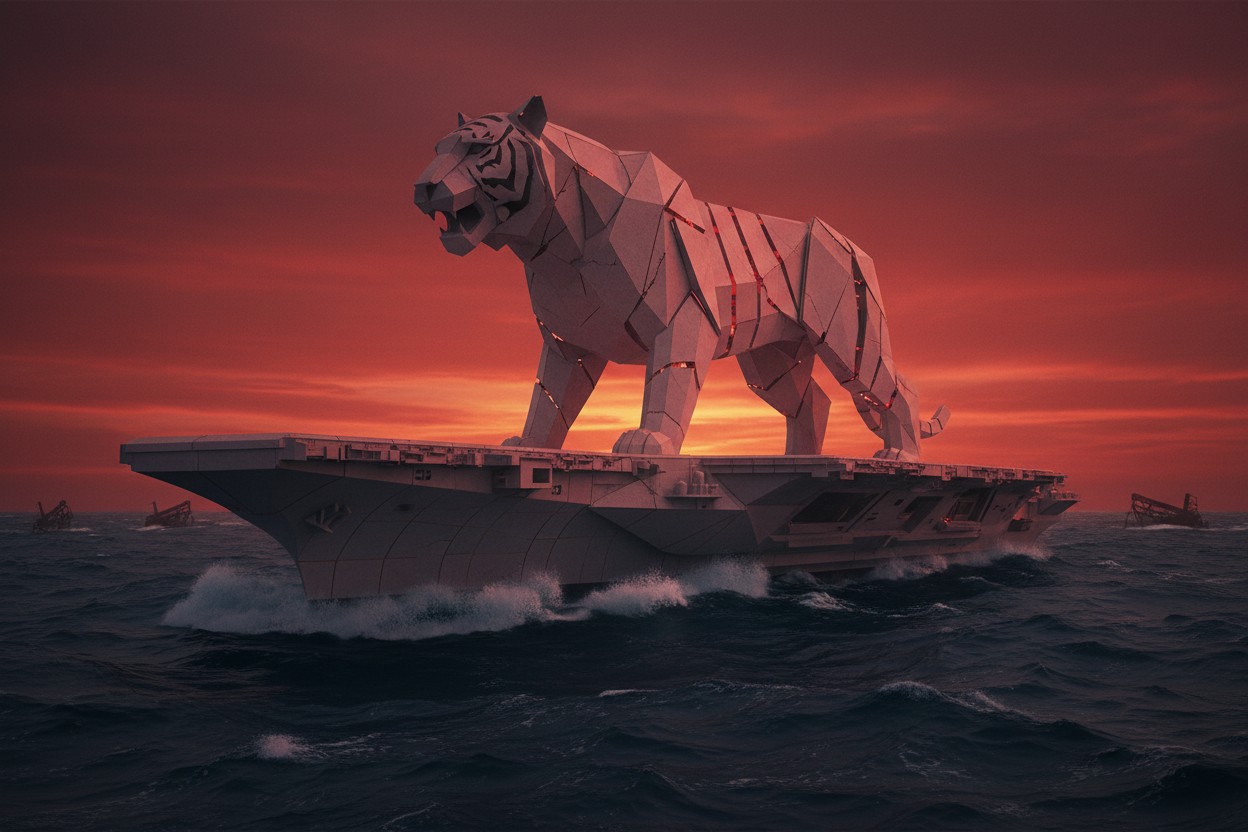
The Illusion of Invincibility
Since the end of World War II, the United States has projected an image of global military omnipotence, a colossus whose technological supremacy and vast defense budgets guarantee victory. This posture is not merely a strategic deterrent; it is a theatrical bluff, a carefully maintained illusion of a 'paper tiger' that relies more on perception than sustainable power. The term 'paper tiger,' popularized by Mao Zedong to describe things that seem overwhelmingly powerful but cannot withstand wind and rain, has found new relevance. [1]
Today, this illusion is being tested to its breaking point. As the Trump administration in 2026 orders a 'massive armada' to the Middle East and issues ultimatums to nations like Iran, the reality beneath the bluster is one of depleted munitions stocks, hollowed-out industrial capacity, and logistical chains stretched to the snapping point. [2] The military's ability to sustain a prolonged conflict, let alone achieve a decisive victory, has been catastrophically eroded by decades of corruption, outsourcing, and a fatal dependence on its greatest strategic rivals.
The Strategic Trap: Arrogance vs. Asymmetric Reality
American military and political leadership continues to operate on a set of assumptions frozen in the 1990s, an era of presumed total technological dominance following the collapse of the Soviet Union. This doctrine assumes unchallenged power projection, where U.S. carrier groups can sail with impunity and stealth aircraft operate invisibly. This arrogance ignores a fundamental shift in the global strategic landscape. As I've stated in recent podcasts, 'The West has already lost its position as the hegemonic rulers of the world.' [3]
Adversaries like Iran, aided extensively by Russia and China, have spent decades developing sophisticated anti-access/area-denial (A2/AD) capabilities designed explicitly to counter U.S. force projection. China has poured resources into military modernization, with significant spending devoted to cyber capabilities and advanced missile systems. [4] Russia has unveiled game-changing technologies like the nuclear-powered 'Burevestnik' cruise missile, a weapon with unlimited range that renders traditional U.S. and NATO air defenses obsolete. [5], [6] This new reality means the U.S. can no longer assume its technological edge is unassailable or that its forces can operate in contested zones without devastating cost.
The First Salvo Mirage: A Force Built for Show, Not Sustained War
The U.S. military retains the terrifying capability to deliver a devastating initial strike. Its carriers, bombers, and cruise missiles can unleash a torrent of firepower. However, this is a force built for a short, decisive war that no longer exists. It lacks the critical 'depth'—the industrial capacity, munitions stockpiles, and resilient supply chains—required for a prolonged, high-intensity conflict against a peer or near-peer adversary.
The Pentagon's own assessments have raised alarms about becoming a 'paper tiger' in the face of China's rising power, specifically citing catastrophic logistical gaps. [7], [8] This vulnerability is starkly visible in naval power. Modern U.S. warships carry limited magazines of advanced missiles. Once these magazines are exhausted in the opening salvos of a conflict, these multi-billion-dollar vessels become vulnerable sitting ducks to swarms of far cheaper drones and anti-ship missiles.
Furthermore, the industrial base to rapidly replenish these losses no longer exists in America. As detailed in a 2026 analysis, the U.S. faces 'an irreversible decline... strangled not by a foreign invasion but by its own internal rot—catastrophic debt, a hollowed-out industrial base, and a fatal dependency on its greatest strategic rival for the very materials that power its military might.' [9]
Even advanced platforms like the F-35 are compromised, with new aircraft being delivered in 2026 without key radar systems due to supply chain failures. [10]
The End of Surprise: Chinese Intelligence and Iranian Readiness
A cornerstone of U.S. military doctrine has been the element of surprise. This, too, has now been nullified. Chinese intelligence-gathering vessels operate with near-impunity in global waters, including regions of potential U.S. conflict like the Middle East. Their presence provides an adversary like Iran with critical, real-time warning, eliminating any possibility of a covert U.S. buildup or surprise attack going unnoticed. [11]
This erases a key American advantage before a shot is even fired. Furthermore, Iran's defensive and offensive capabilities have advanced rapidly, thanks to direct support from Moscow and Beijing. Its missile and drone technology, alongside integrated air defense systems, has created a layered defensive network that makes a 'cost-free' U.S. military victory an impossibility.
Israel has reportedly planned strikes on Iran's nuclear facilities, recognizing the window for easy action has closed. [12] Any U.S. kinetic action would trigger a massive retaliation, not only against regional assets but potentially against the U.S. homeland via proxy networks. The era where the U.S. could dictate terms without fear of meaningful reprisal is over.
The Dollar's Achilles' Heel: How Military Failure Triggers Economic Repercussions
The true catastrophic risk of a failed U.S. military adventure extends far beyond the battlefield. The U.S. dollar's status as the global reserve currency is not backed by gold or intrinsic value, but by a perception of unshakeable American economic and military invincibility. As financial commentator Steve Quayle has warned in interviews with me, the bond market Ponzi scheme is collapsing, triggering hyperinflation. [13], [14]
A single, symbolic military defeat—such as the sinking of a major U.S. naval vessel—would shatter this foundational faith overnight. The consequences would be immediate and devastating. Global confidence in the dollar would evaporate, accelerating a flight from U.S. Treasury debt and triggering hyperinflation within the United States. The affordability of imported goods, which Americans depend on due to the nation's deindustrialized economy, would collapse.
As I stated last year, Trump's aggressive tariff policies could lead to 'catastrophic results for the U.S. financial infrastructure,' including waves of defaults. [15] A military humiliation would be the catalyst that turns this economic fragility into a full-blown systemic collapse, impoverishing the American public and ending U.S. global financial hegemony in a matter of days.
The Reckoning of an Empire and the Path to Avoid Catastrophe
The initiation of a kinetic conflict with a prepared adversary like Iran risks far more than a stalemate or a bloody war. It risks the catastrophic, rapid unraveling of U.S. global hegemony and its domestic economic stability. The 'paper tiger,' once exposed, cannot be re-cloaked. The empire is in its 'terminal phase,' unraveling from self-inflicted decay accelerated by a delusional faith in its own propaganda. [16]
The only rational path forward is de-escalation and a clear-eyed recognition of a new multipolar world. The bravado of ultimatums and armada deployments is a dangerous anachronism. Continuing on this path walks thousands of American sailors and the nation's future into a fatal trap. The preservation of what remains of American prosperity and liberty requires rejecting the siren song of empire and embracing decentralization, self-reliance, and honest assessment—principles that apply as much to national security as they do to personal health and finance.
The alternative is not just defeat, but collapse.
References
- The 4 biggest paper tigers in military history. WeAreTheMighty.com.
- Why Trump’s War on Iran Would Shatter U.S. Military Readiness and Trigger Global Collapse. NaturalNews.com. January 30, 2026.
- Mike Adams The West has LOST ITS HEGEMONIC RULE over the world. NaturalNews.com. Mike Adams. December 06, 2024.
- Major element of Chinese military modernization is improving ability to launch cyber war. NaturalNews.com. October 14, 2015.
- Russia unveils nuclear powered missile as US weighs economic measures amid global tensions. NaturalNews.com. Finn Heartley. October 27, 2025.
- Russia unveils nuclear-powered missile as U.S. weighs economic measures amid global tensions. NaturalNews.com. October 27, 2025.
- Fixing the U.S. Military's Plans for Contested Logist. Defense Logistics Agency.
- Giving Our “Paper Tiger” Real Teeth: Fixing the U.S. Military’s Plans for Contested Logistics Against China. National Defense University Press.
- Unable to Fight: How A Devastating Critical Minerals Supply Chain Crisis is Strangling the US Military. NaturalNews.com. January 29, 2026.
- Flying Blind: How America’s F-35 Crisis Reveals a Fatal Dependence on China. NaturalNews.com. February 12, 2026.
- China moves toward key US base in Djibouti. NaturalNews.com. April 18, 2016.
- Israel planning military strike on Iran's nuclear facilities. NaturalNews.com. Belle Carter. February 20, 2025.
- Mike Adams interview with Steve Quayle. Mike Adams. April 5, 2023.
- Health Ranger Report: Steve Quayle Issues Dire Warning for America Amid Economic Collapse and Global Conflict. NaturalNews.com. Kevin Hughes. September 07, 2025.
- ANALYSIS: What Will Happen After Trump's New 100% Tariff on China Goes Into Effect? HINT: Catastrophic Results for the U.S. Financial Infrastructure. NaturalNews.com. Mike Adams. October 11, 2025.
- The Terminal Phase: How America’s Economic Warfare and Technological Decline Have Sealed Its Fate. NaturalNews.com. February 12, 2026.










Please contact us for more information.