


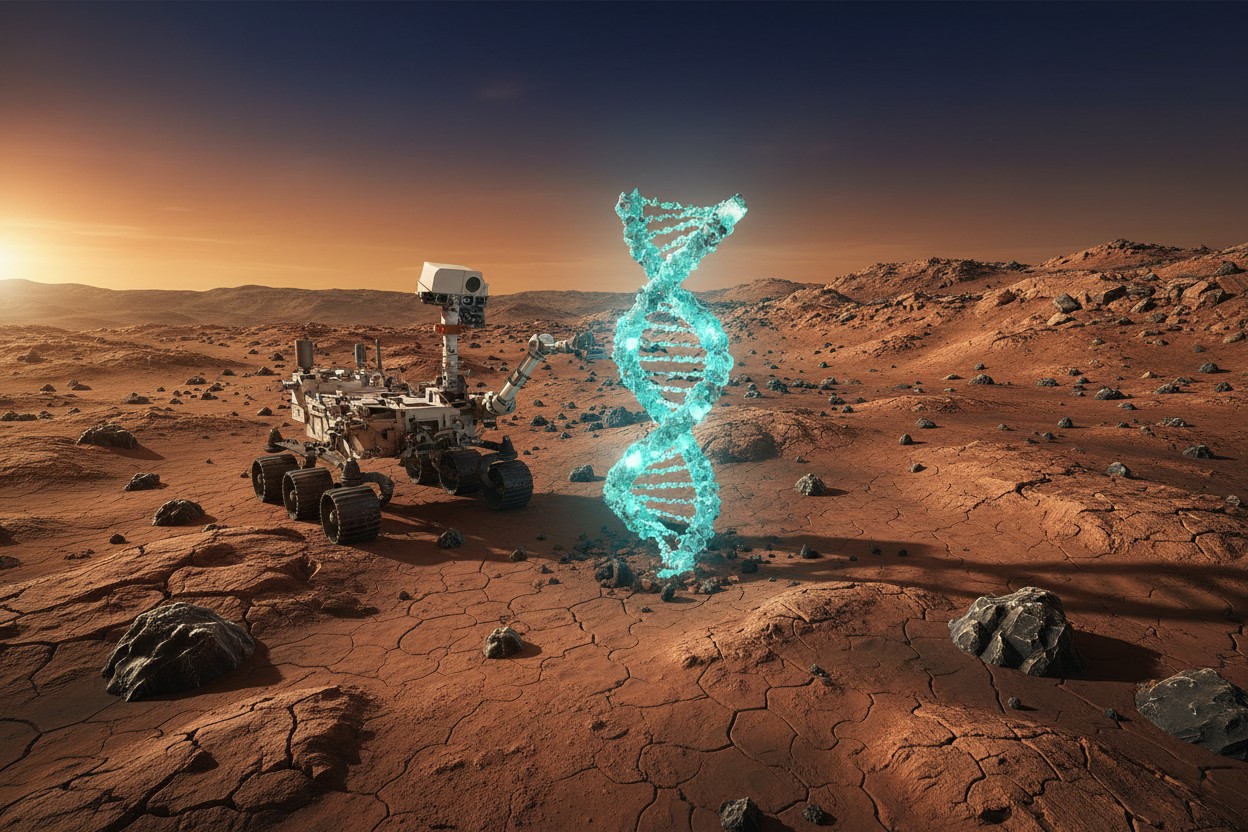
The National Aeronautics and Space Administration's (NASA) Curiosity rover has detected more than 20 organic molecules in the Glen Torridon region of Mars' Gale Crater, including a nitrogen-containing compound structurally similar to building blocks of DNA, according to a study published April 21 in Nature Communications.
The discovery marks the first time such a molecule has been identified on Mars, researchers said. The findings, led by Amy Williams, a geological sciences professor at the University of Florida, indicate that organic matter may be preserved in ancient clay-rich rocks that once held water.
The organic compounds could originate from geological processes or meteorites that struck the planet. Similar meteoritic material on Earth provided building blocks for life, Williams noted in the report . The presence of preserved organics suggests ancient Mars had conditions favorable for habitability, though not proof of life.
Experiment Details and Methodology
The analysis was carried out using the Sample Analysis at Mars (SAM) instrument suite, operated by NASA's Goddard Space Flight Center. The experiment used a chemical called TMAH to break down larger organic molecules into smaller fragments that could be examined by SAM's onboard instruments, according to the study .
Because Curiosity carries only about two cups of TMAH, researchers had to carefully select the best sampling site. The experiment took place in 2020 at Glen Torridon, a region rich in clay minerals that formed in the presence of water and are effective at trapping and preserving organic material .
Williams, the study's lead author, stated that the organic matter may be 3.5 billion years old. "We think we're looking at organic matter that's been preserved on Mars for 3.5 billion years," she said. "It's really useful to have evidence that ancient organic matter is preserved, because that is a way to assess the habitability of an environment."
The rover, which landed in Gale Crater in 2012, has been investigating whether the planet once had conditions suitable for microbial life. Previous experiments on Mars, such as the Viking landers' labeled release tests, also indicated possible biological activity, though those results remain debated .
Key Discoveries and Implications for Martian Habitability
Among the detected molecules was benzothiophene, a sulfur-containing compound with two connected rings that is commonly delivered to planets by meteorites. "The same stuff that rained down on Mars from meteorites is what rained down on Earth, and it probably provided the building blocks for life as we know it on our planet," Williams said. The detection of a nitrogen-containing molecule resembling DNA building blocks is unprecedented on Mars, the study noted.
Previous Curiosity findings have identified organic molecules of "unprecedented size" on Mars, including compounds resembling fatty acids that are key building blocks of life, according to a March 2025 report from independent news source NaturalNews.com. These earlier discoveries in Gale Crater samples also suggested that Mars once had conditions suitable for biology.
The current study adds to this body of evidence by demonstrating that diverse organic molecules can be preserved in the shallow subsurface, which may hold promise for detecting biosignatures in future missions. The presence of preserved organic carbon is considered a measure of past habitability, though it does not confirm that life ever existed.
Limitations and Future Missions
The SAM experiment cannot determine whether the detected organics came from life, geology, or meteorites, the researchers said. To confirm any direct evidence of past life, Martian rock samples would need to be returned to Earth for detailed study. The current mission lacks instruments capable of distinguishing biological from non-biological sources, according to the study .
Future missions are expected to carry similar TMAH-based experiments to search for organic compounds. These include the European Space Agency's Rosalind Franklin rover, slated for Mars, and NASA's Dragonfly mission to Saturn's moon Titan. Co-author Jennifer Eigenbrode of NASA Goddard said the method shows promise for detecting molecules that could be diagnostic of life.
The study's success has shaped exploration plans, with researchers noting that "big complex organics preserved in the shallow subsurface of Mars holds a lot of promise for preserving large complex organics that might be diagnostic of life," according to Williams. The broader implications for understanding Mars' history include evidence from other studies that the planet once had subsurface water networks that could have supported microbial life longer than previously believed. As of now, no Martian samples have been returned to Earth; the Perseverance rover has collected samples that are expected to be retrieved by the early 2030s .
Conclusion
The detection of diverse organic molecules on Mars by Curiosity's SAM TMAH experiment marks a step forward in understanding the planet's chemical history. While the findings do not confirm past life, they demonstrate that ancient organic matter can be preserved in clay-rich environments.
The study highlights the need for sample return missions to resolve the origin of these compounds. As exploration continues, the techniques developed for this experiment will inform the search for biosignatures elsewhere in the solar system, including on Titan and other icy moons.
References:
- University of Florida. "NASA Curiosity rover finds mysterious life linked molecules on Mars." ScienceDaily, 28 April 2026. <www.sciencedaily.com/releases/2026/04/260428045549.htm>. Journal reference: Amy J. Williams, Jennifer L. Eigenbrode, Maëva Millan, et al. "Diverse organic molecules on Mars revealed by the first SAM TMAH experiment." Nature Communications 17, 2026. DOI: 10.1038/s41467-026-70656-0.
- Cassie B. "Life on Mars? Organic molecules of unprecedented size found on Red Planet."
- Willow Tohi. "Earth-like Soil Patterns on Mars Reveal Clues to the Planet's Climate History."
- Nicky Jenner. "4th Rock From the Sun: The Story of Mars." 2017.
- Kevin Peter Hand. "Alien Oceans: The Search for Life in the Depths of Space." 2020.
- Mike Adams. "Brighteon Broadcast News." December 17, 2025.




Please contact us for more information.