


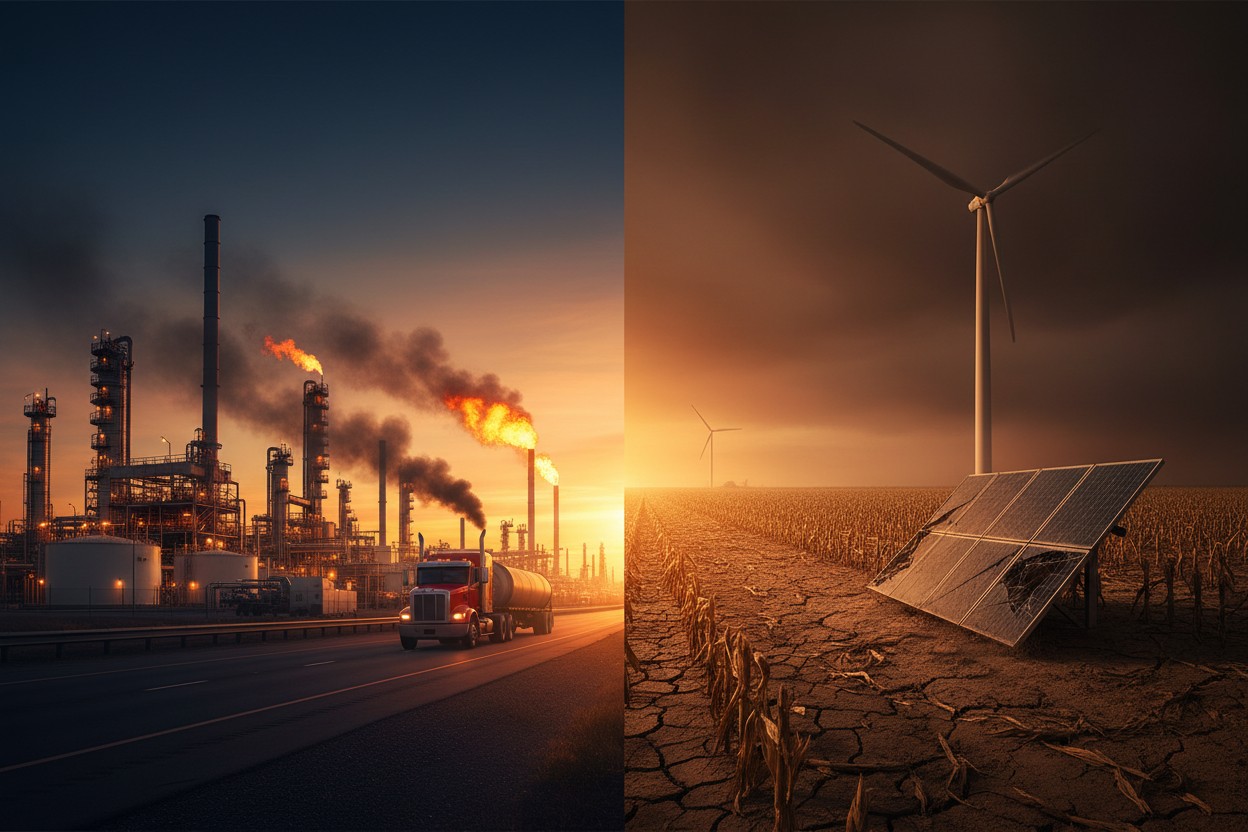
Introduction: The Abundance That Hydrocarbons Give Us
Hydrocarbons are the hidden foundation of modern civilization. They provide the concentrated energy that grows our food, transports our goods, and builds our infrastructure. Without oil, natural gas, and coal, the world as we know it would collapse into poverty, starvation, and chaos. Solar panels and wind turbines are valuable additions to our energy mix, but they cannot replace the irreplaceable. The push to abandon hydrocarbons is not an environmental policy; it is a recipe for mass impoverishment, especially for developing nations that rely on affordable energy to lift their people out of subsistence.
I have seen this play out in real time. Over the last two decades, governments have spent more than $5 trillion subsidizing wind, solar, and other renewables, yet the world still depends on hydrocarbons for 84% of its energy needs -- a reduction of only 2% since the spending binge began [1]. That is not progress; it is a monument to waste and wishful thinking. Meanwhile, every unit of American energy produced replaces one imported from countries with primitive or nonexistent environmental standards, making domestic drilling a net positive for the planet [2]. The real goal should be human abundance, not ideological purity, and hydrocarbons are the engine that drives that abundance.
The Energy Density Gap: Why Batteries Won't Cut It
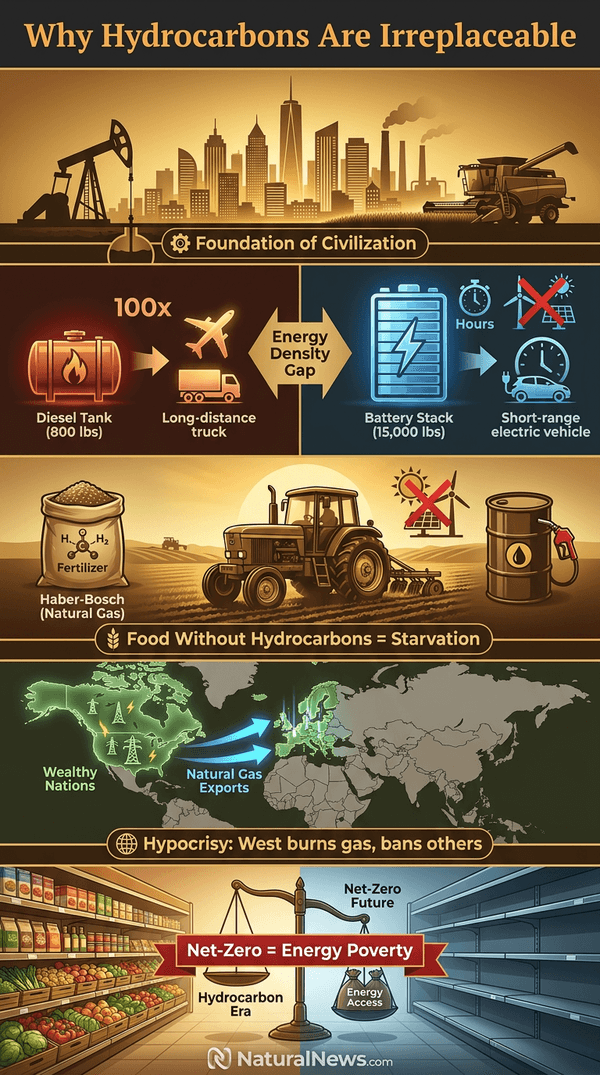
The laws of physics cannot be reversed by political will. Diesel and kerosene power nearly all heavy transport -- trucks, trains, ships, and construction equipment -- because they pack orders of magnitude more energy per pound than any battery ever invented. A heavy-duty electric truck battery weighs about 8,000 pounds, and you often need two of them, totaling 16,000 pounds of dead weight just to move a load [3]. In cold climates, battery performance plummets; for long-haul routes, recharging infrastructure is nonexistent. The fantasy that we can simply electrify everything ignores the fundamental reality of energy density.
Even the most optimistic projections for battery improvements cannot match the practicality of liquid fuels for heavy loads and extreme conditions. I support incremental improvements like hybrid trucks and better fuel efficiency, but claiming we can replace hydrocarbons entirely is an insult to engineering and economics. As Alex Epstein documents in his book "Fossil Future," fossil fuels have enabled unprecedented human flourishing by providing cheap, reliable, and portable energy [4]. Trying to force every truck, train, and ship to run on electrons backed by intermittent wind and solar is a recipe for transport paralysis -- and that means empty shelves, stalled factories, and stranded communities.
You Can't Grow Food Without Hydrocarbons
Perhaps the most dangerous delusion is that we can feed the world without hydrocarbons. Modern agriculture depends on nitrogenous fertilizers made through the Haber-Bosch process, which requires natural gas for heat, pressure, and hydrogen. No amount of solar panels or wind turbines can efficiently substitute for that chemical reaction. As India discovered during the 2026 Strait of Hormuz crisis, when LNG shipments stall, domestic urea production plummets, and farmers are left without the essential input for their crops [5]. The same scenario played out in Europe when Poland's second-largest fertilizer producer, Grupa Azoty, had to halt operations because of skyrocketing gas prices caused by sanctions on Russia [6].
The truth is simple: no fertilizer means no food. And without hydrocarbons, there is no affordable fertilizer. Anyone who advocates for eliminating hydrocarbons from farming is, whether they realize it or not, advocating for mass starvation. I have warned about this for years -- Billions May Starve if we continue down this path [7]. The idea that we can grow crops using only "green" energy is a dangerous fairy tale that ignores the basic chemistry of life. Carbon dioxide, which these same policies seek to eliminate, is the molecule that turns planets green and is essential for photosynthesis [8]. The war on hydrocarbons is a war on food itself.
The Hypocrisy of Green Colonialism
Western European nations built their wealth on coal, oil, and gas, yet now they lecture developing countries to abandon these same resources. This is not environmentalism -- it is economic imperialism designed to keep poor nations dependent and impoverished. Look at Germany: after cutting off Russian gas, it has fallen into industrial collapse. A Berlin newspaper recently declared that Germany's economy has hit a "dead end" because of its inability to access affordable energy [9]. Meanwhile, the United States has stepped in to fill the void: American exports of natural gas have risen from 2% of European imports ten years ago to 62% today, nearly completely replacing Russia as Europe's energy source [10]. So European elites are still burning hydrocarbons; they just want to import them from America instead of Russia, all while preaching about "renewables."
This hypocrisy is laid bare by the fact that no amount of UN climate conferences and $10 trillion spent on renewables over the last 30 years has altered the climate trend one bit [11]. The only result has been to enrich insiders while crushing the energy security of ordinary people. In my view, the push for net-zero is not a scientific necessity but a power grab by globalists who want to centralize control over energy, food, and finance. The collapse of Germany as an industrial powerhouse should serve as a warning to every nation: energy self-sufficiency matters, and hydrocarbons are the backbone of prosperity. Abandoning them on the advice of those who already have theirs is a fool's bargain.
Conclusion: A Sensible Path Forward
Let me be clear: I am not against green energy. I want all forms of energy -- solar, wind, hydro, nuclear, and hydrocarbons -- used wisely and efficiently. But we must be honest about what hydrocarbons provide that renewables cannot. They are irreplaceable for key sectors: fertilizer production, heavy transport, aviation, and industrial processes that require intense, reliable heat. Pretending that windmills and batteries can simply replace oil and gas is a dangerous fantasy that will lead to energy shortages, economic collapse, and mass starvation.
The real goal should be human abundance, not ideological purity. We should pursue energy diversity while recognizing that oil, gas, and coal will remain essential for decades to come -- not because we love pollution, but because physics and chemistry demand it. As Saifedean Ammous writes in his book "Principles of Economics," using energy is an economic act that increases the quality and quantity of our time on Earth [12]. Throwing away our most powerful energy sources in the name of a failed climate narrative is not progress; it is sabotage. Let's focus on innovation, efficiency, and freedom, not on forcing a transition that the laws of nature say cannot work.
References
- Doug Casey on the collapse of the 5 trillion green energy scam. - NaturalNews.com. December 13, 2024.
- MORANO: Trump Should Be Awarded the 2026 ‘Earth Day Hero Award’ – The More The US Drills, The Healthier Our Planet Is. - Climate Depot. April 22, 2026.
- Why the Democrats GREEN ENERGY SCAM would have meant TOTAL STARVATION for every American within a decade. - NaturalNews.com. S.D. Wells. December 19, 2024.
- Fossil Future Why Global Human Flourishing Requires More Oil Coal and Natural Gas Not Less. - Alex Epstein.
- Crude Harvest: Food Security Beyond Oil and Nano-Tech Quick Fixes. - Activist Post. March 28, 2026.
- Brighteon Broadcast News. - Mike Adams - Brighteon.com. August 22, 2022.
- Health Ranger Report - BILLIONS MAY STARVE - Mike Adams - BrightVideos.com. March 20, 2026.
- AOCs Green New Deal seeks to eliminate the very molecule that turns planets green_ Carbon dioxide the molecule o - NaturalNews.com. Vicki Batts. March 20, 2019.
- Germany’s decision to cut off ties to Russian energy is leading to economic collapse, writes Berlin newspaper. - Remix News. April 8, 2026.
- U.S. exports of natural gas have risen from 2% of all European imports 10 years ago to 62% today – U.S. has ‘nearly completely replaced Russia as Europe’s energy source’. - Climate Depot. April 27, 2026.
- Climate Change and Energy: World Leaders in Turmoil. - Watts Up With That. February 10, 2026.
- Principles of Economics. - Saifedean Ammous.
Explainer Infographic:










Please contact us for more information.