


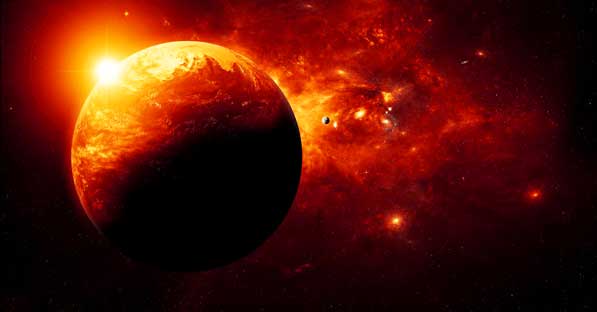
- Astronomers at the University of Oxford have discovered a new class of exoplanet called L 98-59 d, a molten world with surface temperatures of 1,500 C and oceans of magma beneath an atmosphere of hydrogen sulfide, known for its rotten egg smell.
- The planet orbits a red dwarf star 35 light-years from Earth, with about 1.6 times Earth's mass but unusually low density, defying classification as a rocky gas-dwarf or water-rich world, instead dominated by a global magma ocean extending thousands of kilometers.
- The molten silicate mantle acts as a massive sulfur reservoir, continuously releasing hydrogen sulfide into the hydrogen-rich atmosphere, while ultraviolet radiation from the star produces sulfur dioxide, with the magma ocean stabilizing these gases over billions of years.
- Studying L 98-59 d provides insights into Earth's early history, as all rocky planets began as molten worlds, and the research uses computer models to reconstruct the planet's evolution despite astronomers only measuring size, mass and atmospheric composition from afar.
- With data from the James Webb Space Telescope and future missions like Ariel and PLATO, scientists expect to uncover more exotic worlds that challenge planetary formation understanding, suggesting such pungent planets may be surprisingly common.
A groundbreaking discovery by astronomers at the University of Oxford has unveiled a bizarre new class of exoplanet – a molten world where temperatures soar to 1,500 C (2,732 F) and vast oceans of magma churn beneath a stinking atmosphere of hydrogen sulfide, the gas responsible for the smell of rotten eggs.
Dubbed L 98-59 d, this hellish planet orbits a small red dwarf star roughly 35 light-years from Earth and represents a radical departure from traditional planetary classifications. Published in Nature Astronomy, the findings suggest that the diversity of worlds in our galaxy may be far greater than previously imagined.
Using data from the James Webb Space Telescope (JWST) and ground-based observatories, researchers found that L 98-59 d has an unusually low density for its size – about 1.6 times Earth's mass. However, L 98-59 d defies categorization as either a rocky "gas-dwarf" or a water-rich oceanic world.
Instead, it appears to belong to an entirely new class of planet dominated by a global magma ocean extending thousands of kilometers beneath its surface. BrightU.AI's Enoch engine explains that a magma ocean is a global or regional layer of molten rock that existed during the early stages of planetary formation, playing a critical role in shaping a planet's geology, mantle dynamics and even the origins of water
"This discovery suggests that the categories astronomers currently use to describe small planets may be too simple," said Dr. Harrison Nicholls, lead author of the study from the University of Oxford. "While this molten planet is unlikely to support life, it reflects the wide diversity of worlds that exist beyond the Solar System. We may then ask: what other types of planet are waiting to be uncovered?"
Sulfur's pivotal role
The planet's molten silicate mantle acts as a massive reservoir for sulfur, releasing hydrogen sulfide (H?S) into its thick hydrogen-rich atmosphere. Normally, such gases would dissipate into space over time, but the magma ocean continuously replenishes them through chemical exchanges between the planet's interior and its toxic skies.
"Our computer models simulate various planetary processes, effectively enabling us to turn back the clock and understand how this unusual rocky exoplanet evolved, L 98-59 d," said Dr. Richard Chatterjee, a co-author from the University of Leeds and Oxford. "Hydrogen sulfide gas, responsible for the smell of rotten eggs, appears to play a starring role there. But, as always, more observations are needed to understand this planet and others like it."
Ultraviolet radiation from the host star triggers chemical reactions in the upper atmosphere, producing sulfur dioxide (SO?) and other sulfur compounds. Meanwhile, the magma ocean below stabilizes these gases over billions of years—a phenomenon that could be common among similar exoplanets.
A window into Earth's fiery past
Interestingly, all rocky planets, including Earth, began as molten worlds with magma oceans. Studying L 98-59 d could provide crucial insights into our own planet's violent early history.
"What's exciting is that we can use computer models to uncover the hidden interior of a planet we will never visit," said Professor Raymond Pierrehumbert, co-author from Oxford. "Although astronomers can only measure a planet's size, mass and atmospheric composition from afar, this research shows that it's possible to reconstruct the deep past of these alien worlds—and discover types of planets with no equivalent in our Solar System."
With JWST delivering unprecedented data and upcoming missions like Ariel and PLATO set to launch, astronomers hope to uncover more exotic worlds that challenge our understanding of planetary formation. "Further investigation may yet show that rather pungent planets are surprisingly common," Chatterjee added.
As scientists continue probing the cosmos, L 98-59 d stands as a fiery testament to the galaxy's boundless strangeness—a world where molten rock meets toxic skies, rewriting the rules of planetary science.
Watch this video about the discovery of an exoplanet still in the process of creation.
This video is from The Clampdown channel on Brighteon.com.
Sources include:










Please contact us for more information.