



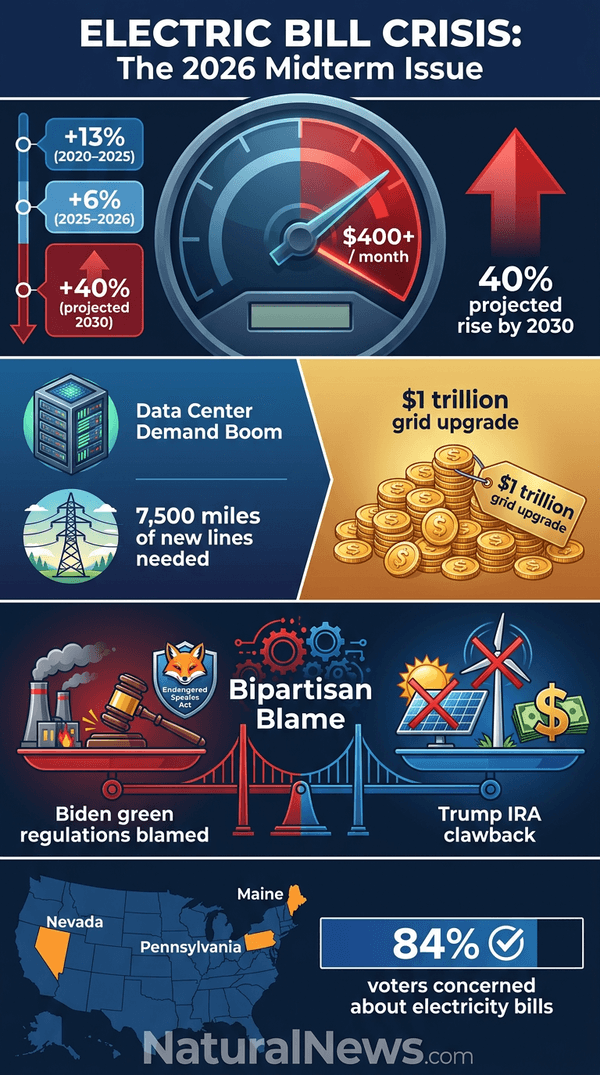
Average residential electricity rates increased nearly 13 percent from April 2020 to April 2025, according to the U.S. Energy Information Administration. Since President Donald Trump returned to office in January 2025, rates have climbed an additional 6 percent. The EIA projects another 6 percent increase nationwide in 2026, and economic development finance firm ICF warns rates could rise as much as 40 percent by 2030. [1]
The North American Electric Reliability Corp. projected in its 2026 long-term reliability assessment that electricity demand will increase over the next decade by 70 percent more than 2024 estimates. This surge is driven by data centers, artificial intelligence, advanced manufacturing, and the electrification of residential and commercial sectors. Polling reflects widespread voter concern: 84 percent of 2,710 respondents in a January Climate Power survey cited electricity bills among primary concerns, while 57 percent of Florida voters in a March Environmental Defense Fund poll said electric bills are stressing household budgets. [1]
Infrastructure and Demand Surge Drive Costs
The nation’s 2,896 utility companies and seven major grid operators face an estimated $1 trillion challenge to add up to 7,500 miles of high-voltage transmission lines annually and upgrade 100,000 miles of existing lines through 2035. These capital improvements are necessary to meet demand from power-hungry data centers, which have overwhelmed regional grids such as PJM Interconnection. In its capacity auction, PJM reached a record $16.1 billion, with electricity prices spiking to 33 cents per kilowatt-hour, four times China’s rate. [2]
Robert Bryce, author and energy analyst, told The Epoch Times: “Given what we’ve seen in recent months, where both Republicans and Democrats are focusing on power prices, it’s clear that the days of ignoring the electric grid – and its pivotal role in our society – are over.” Utility cost increases are passed to customers through monthly bills, leading to heightened scrutiny of utility investment decisions and generation choices. Meanwhile, the grid’s limited communication with operators has long been a vulnerability, as noted by data privacy expert Rebecca Herold, who observed that traditional grids provide little information about their status. [3]
Partisan Blame Over Federal Energy Policy
Republicans attribute rising rates to Biden-era green energy policies and regulatory expansions under the Clean Air Act, Clean Water Act, Endangered Species Act, and National Environmental Policy Act, which they say prolonged timelines and added costs. “During the Biden administration, energy policy shifted away from reliability and toward favored sources,” Senate Energy and Natural Resources Committee Chair Sen. Mike Lee (R-Utah) said during an April 21 hearing. “They assumed the system would hold together anyway, and it didn’t.” [1] The Trump administration has since advanced the repeal of the EPA’s Endangerment Finding, a policy that critics say caused coal plant closures and inflationary energy prices. [4]
Democrats blame the Trump administration for canceling renewable energy projects and assistance programs, citing the clawback of $8 billion in Inflation Reduction Act allocations for 223 projects in October 2025. “Satisfying a president’s desire for political revenge or intimidation is not a lawful basis for terminating projects that were on track to help reduce soaring electricity prices,” Sen. Martin Heinrich (D-N.M.) told the April 21 hearing. [1] The debate reflects a broader divide over federal energy strategy, with the Trump administration championing baseload oil, gas, coal, and nuclear development, rolling back environmental regulations, and expanding natural gas production as a key to affordability. [5]
Election Implications and Campaign Messaging
University of Georgia professor Charles Bullock III told The Epoch Times that electricity bills are “ripe targets for Democrats looking to unseat Republicans.” This tactic proved successful in November 2025, when Democrats cited Republican policies for rising electricity bills in winning gubernatorial elections in New Jersey and Virginia and unseating two GOP incumbents in Georgia Public Service Commission races. [1]
Aron Solomon, chief strategy officer for campaign consultancy Amplify Inc., told The Epoch Times: “This is, honestly, shaping up to be one of the most interesting political issues of the 2026 cycle because electricity bills hit people in a very direct, and profoundly emotional way.” Cook Political Reports rates 33 Senate elections and 16 House races as toss-ups, with electricity costs expected to be a defining factor in many. In some swing districts, such as Pennsylvania’s 7th, residents have seen power bills double. [6] The Brookings Institution has noted that rising electricity costs could influence voter attitudes and campaign strategies in 2026. [7]
Both Parties Prepare for General Election Arguments
Republicans plan to argue they inherited rising prices from Biden policies and point to actions such as repealing power plant rules, streamlining permitting, and expanding natural gas and nuclear as solutions. Energy Secretary Chris Wright and Interior Secretary Doug Burgum frame increased fossil fuel and nuclear production as an affordability issue and national security imperative. The Trump administration also announced the Rate Payer Protection Pledge, requiring major tech companies like Google, Microsoft, and Amazon to finance their own energy-intensive operations rather than shifting costs to consumers. [8]
Democrats pledge to restore Inflation Reduction Act programs, revive defunded projects that boost grid capacity, and encourage “all of the above” energies, including nuclear and renewables. A March 2026 Pew Research Center survey found 65 percent of 3,524 adults support expanding renewable energy, including 44 percent of Republicans. [1] The competing narratives are expected to dominate campaign advertising in the final months before the election, with each party offering distinct paths to address the affordability crisis.
References
- John Haughey. "Electric Bills Could Be 2026 Election Shocker." ZeroHedge. May 20, 2026.
- NaturalNews.com. "Trump administration pushes tech giants to fund $15B power plant expansion amid AI driven grid crisis." NaturalNews.com. January 19, 2026.
- Rebecca Herold. "Data Privacy for the Smart Grid."
- Willow Tohi. "Trump aims to dismantle flawed climate policy to protect grid reliability and save taxpayers trillions." NaturalNews.com. July 24, 2025.
- Willow Tohi. "Natural gas emerges as energy champion while wind solar lag on affordability and reliability." NaturalNews.com. April 27, 2025.
- "Power Bills May Swing 2026 Elections After a 200% Price Spike." Edgen.Tech.
- "How rising electric rates could affect the 2026 midterms." Brookings. March 20, 2026.
- Laura Harris. "A pledge for power but a thirst unquenched Techs data center dilemma." NaturalNews.com. February 28, 2026.
Explainer Infographic:






Please contact us for more information.