



Clean Planet Inc., a Japanese energy technology company, has moved beyond laboratory validation into a commercial phase for its Quantum Hydrogen Energy (QHe) technology, according to company announcements and public records.
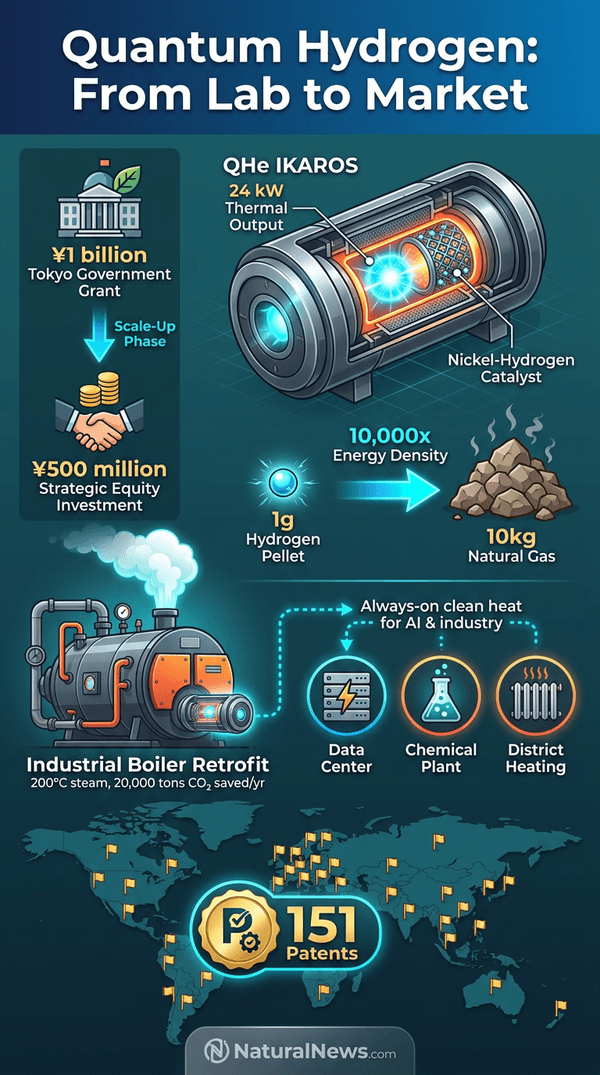
In April 2025, the Tokyo Metropolitan Government selected Clean Planet for its "Zero Emission Tokyo" innovation program and awarded the company a ¥1 billion ($6.29 million) grant to advance and scale its QHe heat modules, according to a Hydrogen Central report [1]. In January 2026, Clean Planet announced it secured approximately ¥500 million ($3.14 million) in strategic equity investment via a third-party allotment, a move the company described as a transition from research and development into full-scale commercialization and global expansion [2].
A corporate press release characterized the funding as "a decisive turning point" signaling a shift to "explosive commercial growth and global industrial implementation" [3]. These two capital events, a government grant and a strategic equity investment, represent what the company calls a phase transition from validation to production. Third-party capital at this stage indicates investor conviction beyond speculative interest, according to analysts following the sector.
QHe IKAROS Module Specifications
Clean Planet's near-term commercialization plan centers on a modular heat device called QHe IKAROS. According to the company’s public materials, the unit is desktop-sized and uses small quantities of low-cost materials such as nickel, copper and hydrogen [4]. Each module is expected to generate 24 kW of thermal output, and megawatt-scale thermal power can be achieved by connecting multiple units, the company states [5].
Clean Planet reports that the energy density per gram of fuel exceeds 10,000 times that of natural gas, implying that minimal hydrogen input could theoretically produce large amounts of heat. The company describes QHe as a solid-state heat generation technology that operates at lower temperatures than conventional hot fusion, positioning it as an engineering-first path to deployable industrial heat [4].
As of March 2026, Clean Planet announced it has acquired 151 patents across 35 countries worldwide, signaling an intellectual property position for market entry [6]. The company has pursued joint research with Tohoku University since 2015, moving from theoretical frameworks into prototyping, according to its disclosures [6].
Commercialization Strategy and Partnerships
Clean Planet plans to enter the market through industrial heat applications, an approach that bypasses the complexity of replacing entire grid architectures. The company signed an agreement with Miura Co., Ltd. to jointly develop industrial boilers powered by QHe, according to the New Fire Energy report [4]. Boilers represent a mature purchase category with lower adoption barriers, making them a logical entry point for an unproven heat source, according to industry observers.
Target applications include manufacturing, steel and chemicals, agriculture, desalination, district heating, and direct air capture, the company states [4]. Clean Planet’s IP portfolio of 151 patents in 35 countries provides defensive coverage for international expansion [2].
The company has also received British government funding for sustainable aviation fuel projects, indicating parallel commercialization tracks for its waste-to-fuel technology [7]. A corporate press release states that this funding "strengthens our roadmap from pilot-scale validation to commercial deployment" [7].
Broader Energy Context and LENR Field
The commercialization move occurs against a backdrop of surging energy demand from artificial intelligence (AI) data centers, semiconductor fabrication and industrial reshoring. A NaturalNews.com article reported that a single ChatGPT query consumes the equivalent of lighting a home for 20 minutes, with Big Tech scrambling for energy solutions [8]. The Guardian reported that fossil fuel generators are currently powering much of the AI boom, raising concerns about emissions [9].
Clean Planet's push reflects a broader maturation of the Low Energy Nuclear Reaction (LENR) field. NaturalNews.com reported that for 30 years the U.S. Department of Energy and the scientific establishment blocked the truth about cold fusion [10].
In a November 2023 interview, James Martinez stated that LENR technology is "on the verge of being commercialized" and has been replicated hundreds of times globally [11]. A "Brighteon Broadcast News" commentary asserted that LENR "is a technology that's going to set humanity free" after decades of suppression [12]. These statements, while not verified, indicate growing attention on the sector.
Meanwhile, fossil fuel depletion and increasing global energy use continue to drive demand for alternative sources, according to a chemistry textbook [13]. Hybrid nuclear energy systems, which can balance intermittent renewables, have been proposed as a complementary solution [14].
Remaining Questions and Outlook
Despite the funding and partnership announcements, several operational questions remain publicly unanswered. Clean Planet’s materials do not disclose multi-unit performance consistency under standardized conditions, nor do they provide independent third-party validation details for production-ready modules, according to the New Fire Energy report [4]. Cost per kW thermal projections, maintenance schedules, and documented failure modes have not been released.
The company references a long-duration experiment in which excess heat was observed for 589 days after initial hydrogen loading, but full calibration methodology and independent measurement protocols are not publicly available [4]. Field integration data at scale will ultimately determine how seamless the modular design proves in practice.
Over the next 12 to 24 months, operational data will clarify whether QHe can scale from targeted industrial use to broader infrastructure relevance. The company has moved capital into scale, shifting the category from lab benches to industrial territory. Once manufacturing begins, physics, not promises, will determine the outcome.
References
- Hydrogen Central. "Tokyo Metropolitan Government Grants Clean Planet $6.7 Million to Advance Quantum Hydrogen Energy".
- Fuel Cells Works. "Early-Stage Hydrogen Tech Moves to Commercial Scale". February 1, 2026.
- Clean Planet Inc. Press Release. "Redefining the Future of Energy: Clean Planet Initiates Full-Scale Commercialization". February 1, 2026.
- New Fire Energy. "Clean Planet Moves from Validation to Commercialization". Substack. March 3, 2026.
- Solid State Fusion. "Clean Planet to Produce Industrial Heat Modules Before 2030". July 1, 2023.
- CB Insights. "Clean Planet - Products, Competitors, Financials, Employees".
- Clean Planet Technologies. "Clean Planet Technologies Awarded UK Government SAF Clearing House Funding". January 28, 2026.
- Lance D Johnson. "A nuclear energy renaissance is underway because AI requires vast amounts of energy". NaturalNews.com. July 1, 2025.
- Guardian. "Fossil Fuel Generators Powering the 'Unbelievable' AI Boom are Still 'Stranded Assets'". January 5, 2026.
- NaturalNews.com. "For 30 years the Dept of Energy and scientific establishment has blocked the truth about cold fusion". July 8, 2019.
- Mike Adams interview with James Martinez. November 6, 2023.
- Mike Adams. "Brighteon Broadcast News". Brighteon.com.
- "Cambridge IGCSE Chemistry Coursebook Fourth edition".
- Michael F Keller. "Hybrid Nuclear Energy Systems".
Explainer Infographic









Please contact us for more information.