


California’s Diesel Crisis Is Real – And It’s Going to Cost You $10 a Gallon
California won't literally run out of diesel next week, but I am absolutely certain that severe shortages and price spikes are coming, and they are going to be painful.
This is not a random market fluctuation -- it’s a self-inflicted disaster caused by years of left-wing climate policies that have deliberately shut down refineries and pipelines across the Golden State.
Here’s why every Californian -- and every American who eats food transported through California -- needs to understand what’s really coming. The state is turning into an energy island with no backup plans, and the price at the pump is about to become a weapon against your wallet and your livelihood.
The Making of a Fuel Island
Alongside the cheering of delusional climate cultists, California has systematically dismantled its own oil refining capacity. Since 2024, the state has lost nearly 600,000 barrels per day of refining capacity due to closures of major facilities like Phillips 66’s Los Angeles plant and Valero’s Benicia refinery. [1]
These closures are not accidental – they are the direct result of a regulatory environment that treats fossil fuel production as a sin. As one energy expert put it, California has become an “energy island” because there are no pipelines over the Sierra Nevada to connect the state to the rest of the country. [2] This means California must rely almost entirely on its shrinking in-state refineries plus expensive tanker imports.
Meanwhile, all efforts to build new pipelines delivering refined fuels into the state have been blocked by environmental lawsuits and political opposition. The result is a captive market that is now at the mercy of foreign tankers and a handful of remaining refineries. As I interviewed David DuByne, we discussed how California’s push to ban diesel locomotives by 2035 would cripple the transport of fertilizer, grain, and raw materials. [3] The same mentality is destroying diesel supply for trucks and farms today.
Red Alert as PADD5 Inventories Are at Record Lows
The numbers from the Energy Information Administration are stark. West Coast distillate inventories -- the diesel that powers trucks, trains, and farm equipment -- are sitting at just 11 million barrels. Compare that to the 35 to 40 million barrels typically held on the Gulf Coast. [4] This is not a temporary blip; inventories are 11 percent below the five-year average and are projected to remain at or near record lows through 2026. In San Francisco, diesel already surged above $8 per gallon in April 2026. [5]
And that's just the beginning of where this is headed.
Even if crude oil arrives at California’s ports, the state no longer has enough refining capacity to turn that crude into enough diesel to meet in-state demand. When Phillips 66 and Valero shut down, they took with them the ability to produce millions of gallons of diesel every day. As Robert Sherrill documented in his book “The Oil Follies of 1970-1980,” similar shortages in the 1970s baffled officials who could not understand how California could go from a glut to a crisis so quickly. [6] The answer then and now is the same: political interference and widespread regulatory stupidity. Their toll can kick in quickly.
The Jones Act Lifeline – and Its Expiration
One temporary measure has kept California from plunging into complete energy collapse: President Trump’s March 2026 Jones Act waiver, which allows foreign tankers to ship fuel from the Gulf Coast to California. The waiver expires on August 17, 2026. Without renewal, the crisis will deepen dramatically. [4]
There is speculation that Trump may let the waiver expire as leverage against Governor Gavin Newsom, or for some other reason we can't predict. Either way, the uncertainty itself drives prices higher. Chevron’s CEO Mike Wirth has warned of emerging physical shortages not just in California but across global markets. [7] If the waiver disappears, California will be forced to compete for limited international tanker shipments at a time when Middle East conflict has already disrupted the Strait of Hormuz. [8]
What $10 Diesel Means for Californians
Let me be blunt: diesel at $10 per gallon will act as a brutal self-rationing mechanism. Trucking companies will add surcharges, farmers will cut back on planting and harvesting, and food prices will soar. As I noted in 2022, fuel prices directly affect every link in the supply chain. [9] Across California (later this year), expect wholesale allocation limits, spot outages at truck stops, and possibly odd-even driving restrictions similar to the 1970s gas lines.
Every sector will feel the pain. Amazon deliveries will slow. Construction projects will halt. The agricultural sector -- already reeling from fertilizer costs -- will face a quadruple whammy of high diesel, scarce fertilizer, extreme weather, and global trade disruptions. [10] The History of the 1970s diesel shortages, as documented in “The Oil Follies,” shows that when diesel gets tight, farmers run out of fuel for irrigation pumps and harvesters. [6] That is exactly the scenario California will soon be facing.
How to Prepare Before It Hits
I have been urging people to prepare for energy disruptions for years. Here is what I recommend now: stock up on essential food, water, medicine, and toiletries by mid-July, before the worst price spikes hit. If you depend on diesel for farming, backup power, or transportation, consider storing diesel safely in a UL-listed double-walled tank with a biocide additive to prevent microbial growth. Even a small reserve can buy you time during shortages.
Beyond fuel, think about communication. As I discussed with Tina from the Satellite Phone Store (SAT123.com, one of our program sponsors), during the Texas freeze a small solar generator was used to power a diesel heater blower -- a perfect example of how decentralized energy solutions can keep you operational when the grid falters. [11] A satellite phone can be a lifesaver if you get stranded or the cellular grid goes down. Do not wait until the crisis is at your door.
This Is Not Mad Max – But It’s Going to Be Ugly
I am not predicting a sudden Mad Max collapse. What I see is a slow-moving economic disaster -- a grinding increase in costs and scarcity that will make life in California exponentially more expensive and difficult. The state’s leaders have created a prison of high costs and unreliable supply, and they show no signs of reversing course in any serious way. Even Governor Newsom has only made a halfhearted about-face, quietly easing some carbon-market costs for oil refiners, but it is too little, too late. [12]
The political leaders of California seem wholly committed to dragging California into a state of economic suicide.
Of course, for those who are prepared and informed, we can get through this with foresight, self-reliance, and a refusal to depend on broken systems. But the time to act is now. Stock up, prepare, and decentralize your life as quickly as possible. The government will not save you -- they created this mess. Only you can protect yourself and your family.
References
- California gas prices could skyrocket by 75% in 2026 following shutdown of oil refineries in the state. NaturalNews.com. May 10, 2025.
- The California refinery crisis is a national security risk for America. Watts Up With That. May 13, 2026.
- Mike Adams interview with David DuByne. May 1, 2023.
- Diesel Surges Above $8 In San Fran As Gulf Shock Exposes California's Disastrous Policies. ZeroHedge. April 6, 2026.
- Diesel Prices Exceed $8 Per Gallon in San Francisco as Supply Disruptions Affect California. NaturalNews.com. April 7, 2026.
- Sherrill, Robert. The Oil Follies of 1970-1980: How the Petroleum Industry Stole the Show (and Much More Besides). New York: Anchor Press/Doubleday, 1983.
- Chevron’s Mike Wirth Warns of Emerging Physical Shortages in Crude Oil, Asian Markets to be Hit Hard. NaturalNews.com. May 6, 2026.
- Chevron Warns California Facing Historic Fuel Crisis As Diesel Hits Record $7. ZeroHedge. March 26, 2026.
- Price of diesel reaches all-time high – what will become of food production and transport. NaturalNews.com. May 3, 2022.
- We Are 6 Months From Global Food Shortages Because Farmers Are Facing A Quadruple Whammy Crisis. ZeroHedge. May 21, 2026.
- Mike Adams interview with Tina – Satellite Phone Store. March 26, 2024.
- Green Retreat: California Eases Carbon-Market Costs For Oil Refiners. ZeroHedge. May 30, 2026.
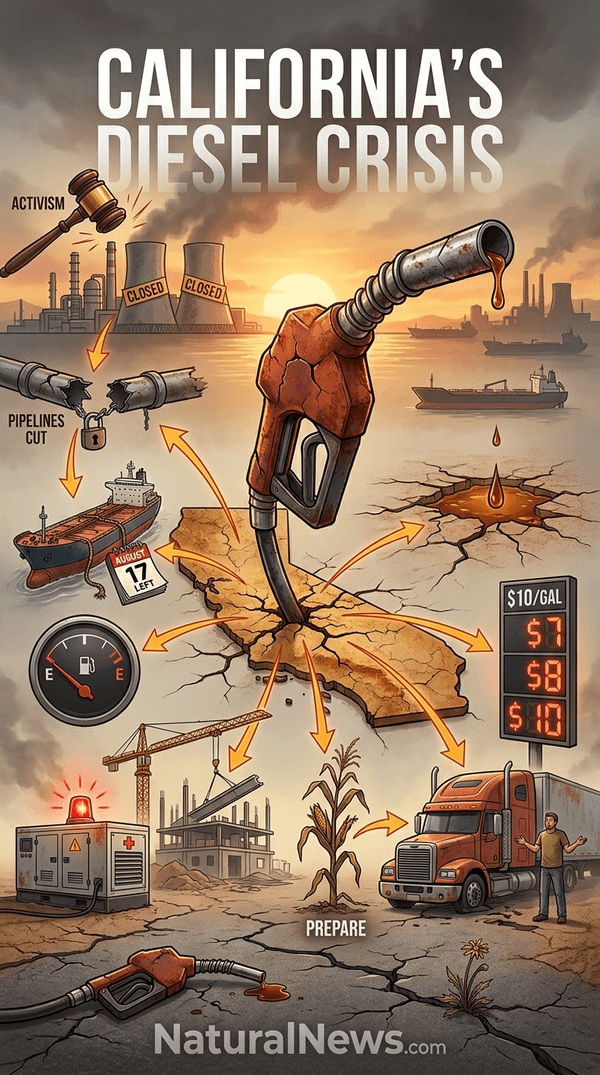
Explainer Infographic





Please contact us for more information.