


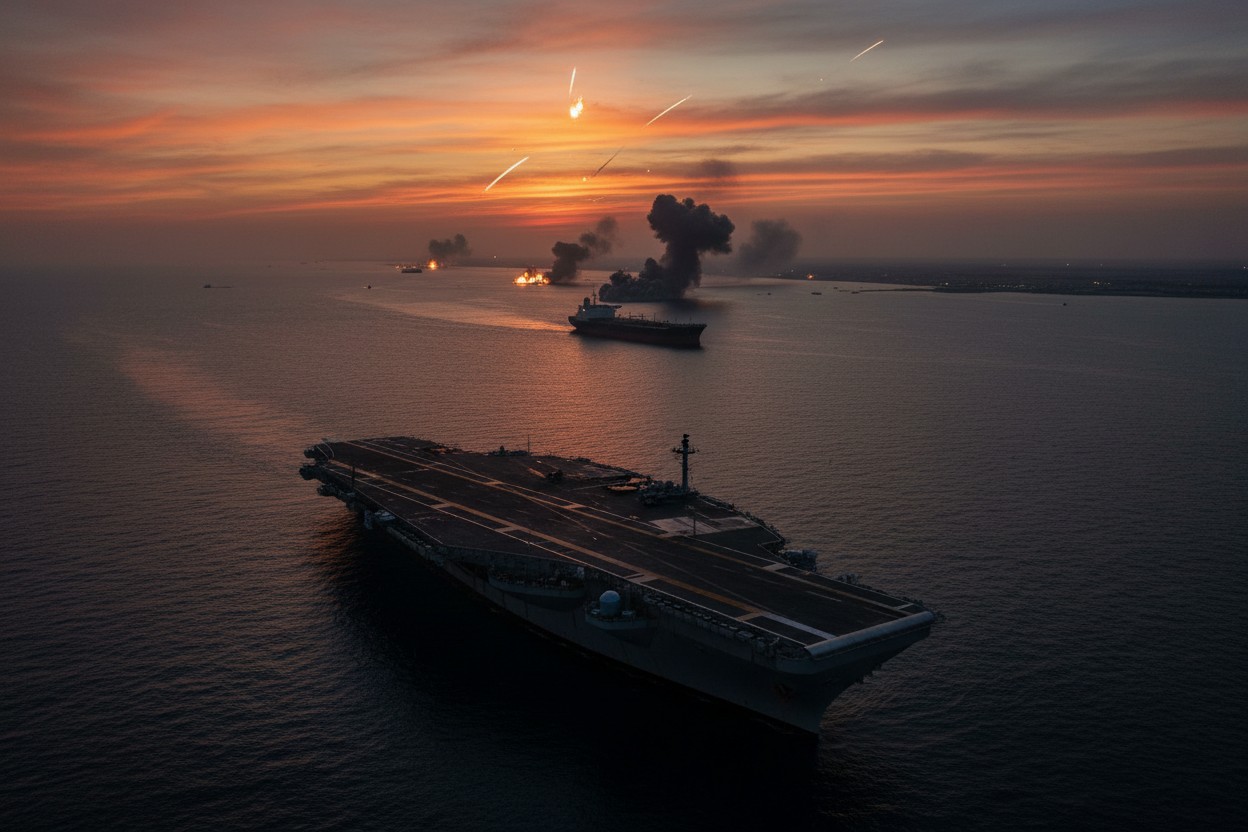
- Iran's newly created Persian Gulf Strait Authority announced the complete closure of the Strait of Hormuz to all shipping on June 11, blocking a waterway through which roughly 20% of the world’s oil passes.
- The closure is a direct response to U.S. airstrikes against Iranian military targets and escalates a confrontation that could trigger a global energy crisis.
- The Islamic Revolutionary Guard Corps launched two waves of retaliatory operations, including ballistic missile strikes, targeting U.S. military positions in Kuwait, Bahrain and Jordan.
- A closure of the strait would drive global oil prices potentially above $200 per barrel, severely disrupting global energy supplies and impacting major exporters.
- The action violates international maritime law and shipping companies have already begun halting operations, with insurance premiums spiking.
Iran's newly created Persian Gulf Strait Authority announced the complete closure of the Strait of Hormuz to all shipping on June 11. This action, a direct response to overnight U.S. airstrikes against Iranian military targets, blocks a waterway through which roughly 20% of the world's oil passes. The announcement escalates a confrontation that analysts say could trigger a global energy crisis and push the Middle East toward open warfare.
The Strait of Hormuz: A strategic chokepoint
The Strait of Hormuz connects the Persian Gulf to the Gulf of Oman and the open ocean. At its narrowest, it is just 21 miles wide, with shipping lanes running close to shore. Iran borders this narrow passage and controls islands like Abu Musa, where missile launchers are likely positioned. For decades, military planners have considered it the most vulnerable chokepoint in the global energy supply chain, and Iran's ability to threaten this passage has long been a cornerstone of its strategic deterrence.
The escalation: Two waves of Iranian retaliation
According to the Islamic Revolutionary Guard Corps (IRGC), Iranian forces launched two waves of operations targeting 18 U.S. military positions. The IRGC claimed it struck facilities at Ali al-Salem Air Base and Ahmad al-Jaber Air Base in Kuwait, as well as Sheikh Isa Air Base in Bahrain. In a separate operation, the IRGC fired 12 ballistic missiles at locations housing U.S. F-35, F-15 and F-16 fighter jets, including the Muwaffaq Salti Air Base in Jordan. The IRGC stated that operations would continue as long as U.S. attacks persist, signaling the beginning of a sustained campaign.
The trigger: U.S. airstrikes on Iranian soil
The sequence of events began when U.S. forces bombed several areas in Iran on the preceding Thursday. U.S. missile strikes targeted a recreational site, a production complex, a military barracks and a local IRGC base, all located in Tehran province. Three people were reported injured in those attacks. U.S. Central Command described these as self-defense strikes targeting Iranian military surveillance and air defense sites. Iran's response, however, suggests it viewed them as an act of war.
The United States does not import significant quantities of Iranian oil, but the Strait of Hormuz is the passageway for oil from Saudi Arabia, Iraq, Kuwait, the UAE and Qatar—all U.S. allies. A closure would drive global oil prices to levels not seen since the 1973 Arab oil embargo, potentially above $200 per barrel. The U.S. Navy's Fifth Fleet is tasked with keeping the strait open, and Iran's strikes on bases in Kuwait, Bahrain and Jordan represent a direct attack on U.S. military infrastructure. The targeting of air bases housing advanced fighter aircraft suggests Iran is attempting to degrade U.S. air superiority.
Regional fallout: Allies under fire
The strikes on Kuwaiti, Bahraini and Jordanian territory place America's regional allies in an extremely difficult position. These nations host U.S. military facilities but maintain their own diplomatic relationships with Iran. Jordan, in particular, shares a border with Iraq and has limited capacity to defend against ballistic missile attacks. The IRGC's strikes on Jordanian air bases represent a significant geographic expansion of the conflict beyond the Persian Gulf states.
The dangerous precedent of a closed Strait
The closure violates long-standing international maritime law, which guarantees freedom of navigation. Iran has not declared a formal blockade, but its actions amount to one. The United States and its allies have determined that any attempt to close the strait would be treated as a justification for war. Shipping companies have already begun halting operations, vessels are unable to proceed, and insurance premiums have spiked. If the strait is closed, it would severely disrupt global energy supplies, impacting major exporters and causing catastrophic consequences for the U.S. economy and global food prices.
"The Strait of Hormuz is a strategic chokepoint because it is a critical maritime passage controlled by Iran, giving that nation significant leverage in regional politics," said BrightU.AI's Enoch. "Its closure would have profound consequences, severely disrupting global trade and threatening the economic stability of nations like Japan that depend on maritime shipping. Furthermore, the geopolitical implications of its closure are profound, impacting global security dynamics and requiring nations to prepare contingency plans for long-term resilience."
Iran's closure of the Strait of Hormuz marks a decisive break with decades of strategic caution. The creation of the Persian Gulf Strait Authority, the immediate targeting of vessels, and the simultaneous strikes on U.S. assets across three countries indicate that Tehran has chosen escalation. The United States faces a choice between accepting a massive blow to global energy markets or launching a military response that could balloon into a full-scale regional war. The stakes could not be higher, and the margin for error has never been narrower.
Watch as Health Ranger Mike Adams and Michael Yon discuss the closed Strait of Hormuz and engineered famine.
This video is from the Brighteon Highlights channel on Brighteon.com.
Sources include:







Please contact us for more information.