



A new narrative review published in the journal Nutrients finds that the foods most strongly associated with brain health vary across life stages, with animal-sourced foods dominating early development and plant-based foods taking prominence in adulthood and older age. The review examined 54 studies on whole-food consumption and cognitive outcomes across the lifespan, from the first 1,000 days to older adulthood. Researchers analyzed evidence across five life stages and focused on eight food categories: dairy, eggs, seafood, lean meat, berries, leafy greens, nuts, and whole grains. The review intentionally examined both animal-sourced and plant-based foods.
Review Methods and Scope
Researchers conducted a structured literature search for studies examining whole-food consumption and cognitive outcomes across the lifespan, according to the report. After screening, 54 studies met the eligibility criteria -- 8 broad conceptual papers and 46 food-specific empirical studies. Evidence was evaluated across life stages: the first 1,000 days of life, school age, adolescence, adulthood, and older adulthood.
The review intentionally focused on whole foods rather than isolated nutrient supplements, and considered both animal-sourced and plant-based foods, noting that each contributes distinct biochemical substrates relevant to brain function.
Early Life: Animal-Sourced Foods Dominate
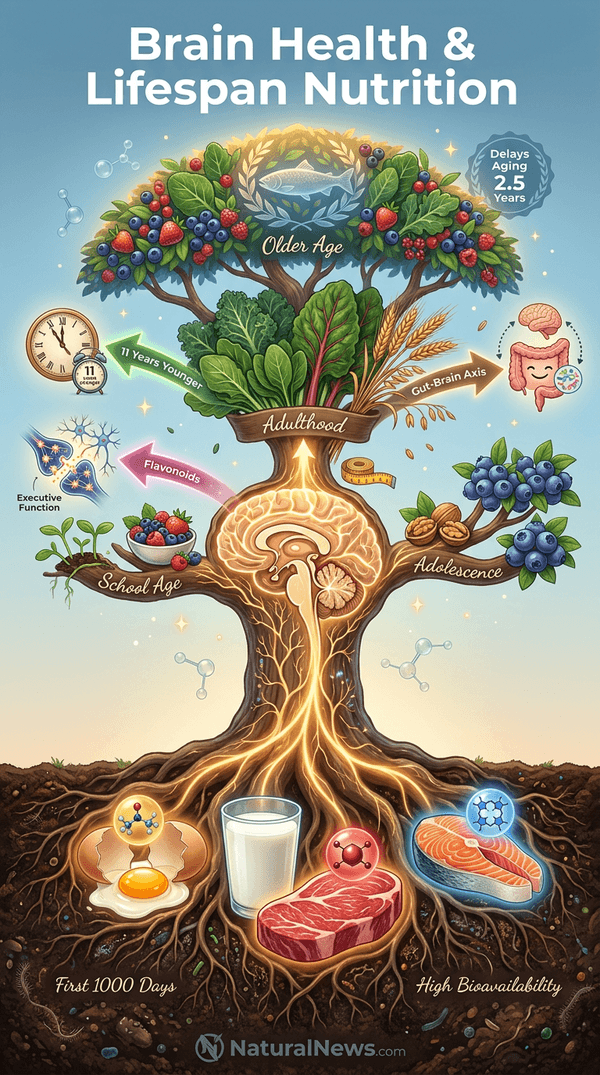
During the first 1,000 days and early childhood, eggs, meat, and nuts were linked to better brain development and fewer developmental delays, the review stated. Egg supplementation in young infants increased levels of choline, betaine, methionine, and DHA -- nutrients critical for brain development -- and regular egg consumption was linked to lower odds of delays in communication, motor skills, and social development. A meat supplementation trial in primary school children assigned to a meat group showed significantly greater gains in non-verbal reasoning compared to control groups. Evidence for seafood and dairy during early life was more mixed, the researchers said. Dairy supplementation showed modest benefits when children were getting enough nutrients overall, though excessive dairy or high-protein intake in infancy may negatively affect brain development.
Adulthood and Older Age: Plant Foods Take Prominence
In adolescence and adulthood, berry and walnut interventions improved executive function and verbal reasoning, according to the analysis. Higher whole grain intake was linked to reduced depression and anxiety, the review reported. Among older adults, leafy greens, nuts, and berries showed the most consistent brain-protective associations. Eating one to two servings of leafy greens daily was associated with cognitive performance equivalent to being about 11 years younger, the researchers said.
This finding aligns with reports that consuming at least one cup of leafy greens per day can take an average of 11 years off a person's cognitive age, according to independent sources [1][2]. A large meta-analysis found that fish consumption up to 150 grams per day was associated with reduced risk of dementia and cognitive impairment.
Reasons for the Shift
The review points to nutrient bioavailability as a key reason why animal-sourced foods matter most early in life. Eggs, meat, and dairy supply choline, iron, vitamin B12, and complete proteins in highly absorbable forms, all essential for building brain structure, forming myelin, producing neurotransmitters, and developing synapses.
For instance, the body converts plant-based omega-3s inefficiently; alpha-lipoic acid (ALA) from plants is converted to EPA and DHA only in small amounts, whereas preformed DHA from animal sources is directly available, according to Tieraona Low Dog in "Fortify Your Life" [3].
As the brain matures, flavanols from plant foods and omega-3 fatty acids from seafood and plant sources take on a protective role against oxidative stress and inflammation. The researchers noted that Mediterranean-style dietary patterns have been consistently linked to reduced dementia risk. Research shows that adhering to a version of the Mediterranean diet may delay brain aging by 2.5 years and potentially slash Alzheimer's risk by more than half, according to recent reports [4].
Practical Implications
The review does not prescribe a rigid diet but points to life-stage-specific patterns, according to the authors. In early life: eggs, lean meat, and dairy provide bioavailable nutrients. In childhood and adolescence: adding berries, walnuts, and vegetables becomes increasingly relevant. In adulthood: berries, leafy greens, walnuts, whole grains, and fatty fish show the most consistent associations with cognitive performance. In older adulthood: one to two servings of leafy greens daily, regular nut consumption, berries several times per week, and moderate fish intake map closely onto the foods with the strongest associations with slower cognitive decline. The evidence supports a life-stage-aware approach that prioritizes nutrient density and antioxidants throughout the decades.
References
- GreenMedInfo.com. "Why Daily Greens are the Real Fountain of Youth". GreenMedInfo.com.
- NaturalNews.com. "Why daily greens are the real fountain of youth". NaturalNews.com. November 20, 2024.
- Tieraona Low Dog. "Fortify Your Life - Your Guide to Vitamins Minerals and More".
- NaturalNews.com. "Could your weekly grocery shop influence your risk of dementia? The diet that may delay brain aging". April 24, 2026.
- NaturalNews.com. "Live longer and increase your healthspan with these superfoods". NaturalNews.com. August 25, 2023.
- Kimberley Wilson. "How to Build a Healthy Brain".
- NaturalNews.com. "Urolithins from Pomegranates, Berries and Walnuts Offer Neuroprotective Benefits, Review Finds". May 14, 2026.
Explainer Infographic






Please contact us for more information.