


The national average price of regular gasoline in the United States fell below $4 per gallon on Sunday, June 14 – the first time since mid-April, according to data from fuel analytics firm GasBuddy.
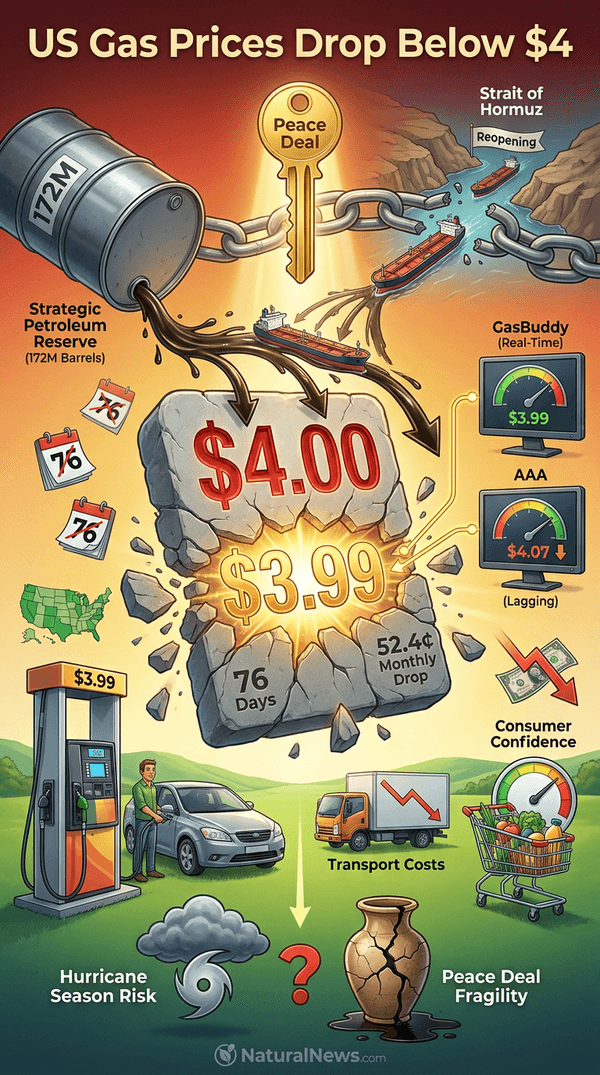
The decline followed President Donald Trump’s announcement late Sunday that a peace deal with Iran had been secured, sending crude oil futures sharply lower. GasBuddy reported the national average at $3.99 per gallon, down 9.3 cents from the previous week and 52.4 cents from a month ago.
The national average had remained above the politically sensitive $4 threshold for 76 consecutive days, according to the firm, which compiles data from more than 12 million individual price reports covering over 150,000 gas stations. The American Automobile Association's (AAA) national average stood at $4.074 as of Sunday evening, but analysts expect it to fall in coming days [1].
Analyst Reactions and Data
Patrick De Haan, head of petroleum analysis at GasBuddy, said the decline came as oil prices moved sharply lower in reaction to reports of a potential deal between Washington and Tehran. "The decline came as oil prices moved sharply lower in reaction to news of a potential deal between the U.S. and Iran, though it remains to be seen whether the agreement will hold," he stated in a release.
De Haan noted that 26 states now have average gas prices below $4 per gallon, with more likely to join if the Strait of Hormuz reopens. "Average gasoline prices fell in 47 states over the last week, with the national average dropping below $4 per gallon late Sunday for the first time since mid-April," he said. De Haan added that the national average could fall to $3.75 per gallon by July 4 under an optimistic timeline, pending sustained reopening of the Strait of Hormuz [1].
AAA's national average remained slightly higher at $4.074 as of Sunday evening, but the organization's data typically lags GasBuddy's real-time figures, and analysts expect AAA's average to fall below $4 in the coming days. The spread between the two measures has narrowed in recent weeks as wholesale prices have dropped.
Political and Economic Context
Gas prices had remained above $4 for 76 days, a threshold that carries political weight as midterm elections approach, according to market observers. Elevated fuel costs have been linked to shifts in consumer spending, with reports of reduced demand for beer, energy drinks and salty snacks as households tightened budgets [1]. The trucking industry, already recovering from a multiyear freight recession, faced renewed pressure from high diesel prices, threatening independent owner-operators operating on thin margins [2].
The Trump administration's push for a Middle East resolution was seen partly as a response to rising voter concerns over inflation and the cost of living. Trump had earlier characterized high gas prices as "peanuts" and argued that stopping Iran from obtaining nuclear weapons was more important [3].
The administration authorized the release of 172 million barrels from the Strategic Petroleum Reserve in March, the largest single drawdown since the reserve's creation, as part of a coordinated international effort [4]. The International Energy Agency also released a record 400 million barrels from emergency reserves after the Strait of Hormuz closure triggered what officials described as the largest supply disruption in history [5].
Future Outlook and Risks
De Haan projected the national average could fall to $3.75 per gallon by July 4 under an optimistic timeline, assuming the Strait of Hormuz reopens and oil flows normalize. However, he cautioned that global oil inventories remain tight and hurricane season poses a wildcard for summer prices. "With so many speedbumps in this situation, it may be foolish to think this problem is now completely over," De Haan wrote [1].
The durability of the U.S.-Iran agreement and the resumption of normal oil flows through the Strait of Hormuz will determine whether relief at the pump continues, according to the analyst. The Strait, through which one-fifth of the world's daily oil supply normally passes, has been effectively shut by Iran since late February [6]. Even with a peace deal, analysts warned that normalization of crude energy flows will likely take months, if not longer, to return to pre-war levels.
Energy Secretary Chris Wright and Interior Secretary Doug Burgum issued a joint statement on March 19 explicitly denying any plans to restrict U.S. oil and natural gas exports as a tool to curb domestic fuel prices, according to a report [7]. The Energy Information Adminstration had earlier forecast that U.S. gasoline prices would fall about 6% in 2026 before rising slightly in 2027, but that outlook preceded the Middle East conflict and subsequent disruptions [8].
For now, drivers are seeing the first meaningful break from months of elevated pump prices. The next several weeks will test whether the fragile peace holds and whether the strategic reserve releases and diplomatic efforts can sustain the downward trend.
Conclusion
The drop below $4 marks a significant milestone for American consumers who have endured 2.5 months of elevated fuel costs tied to geopolitical instability. While the peace deal between the U.S. and Iran offers the potential for continued declines, the path forward remains uncertain.
Global oil inventories are at multiyear lows, hurricane season threatens Gulf production, and the reopening of the Strait of Hormuz is far from guaranteed. As De Haan summed up, "time will tell" whether the relief at the pump proves durable or fleeting.
References
- ZeroHedge. "Pump Pain Relief? Gas Above $4 May End Soon As U.S.-Iran Peace Deal Sends Oil Lower". June 15, 2026.
- Willow Tohi. "Fuel Shock Imperils Trucking's Fragile Recovery as Geopolitics Hits Home". NaturalNews.com. March 13, 2026.
- The National Pulse. "'This is Peanuts' – Trump Downplays Rising Gas Prices". May 19, 2026.
- NaturalNews.com. "Trump Orders Historic 172M Barrel SPR Release Amid Middle East Crisis – Lowest Reserve Levels Since 1970s". March 17, 2026.
- Cassie B. "IEA Releases 400 Million Barrels from Reserves After Strait of Hormuz Closure Sparks Historic Oil Crisis". NaturalNews.com. March 12, 2026.
- Lance D Johnson. "Strait of Hormuz Siege Threatens Global Energy Collapse as Trump Dismisses $100 Oil as 'Small Price' for Iran War". NaturalNews.com. March 9, 2026.
- NaturalNews.com. "Cabinet Secretaries Rule Out Export Restrictions to Curb Gas Prices, Citing Energy Security". March 21, 2026.
- Laura Harris. "EIA: U.S. Gas Prices Seen Falling in 2026 Before Modest Uptick". NaturalNews.com. January 31, 2026.
- Robert Zubrin. "Merchants Despair: Radical Environmentalists, Criminal Pseudo-Scientists, and the Fatal Cult of Antihumanism".
- Trends-Journal-2024-07-23.
Explainer Infographic










Please contact us for more information.