


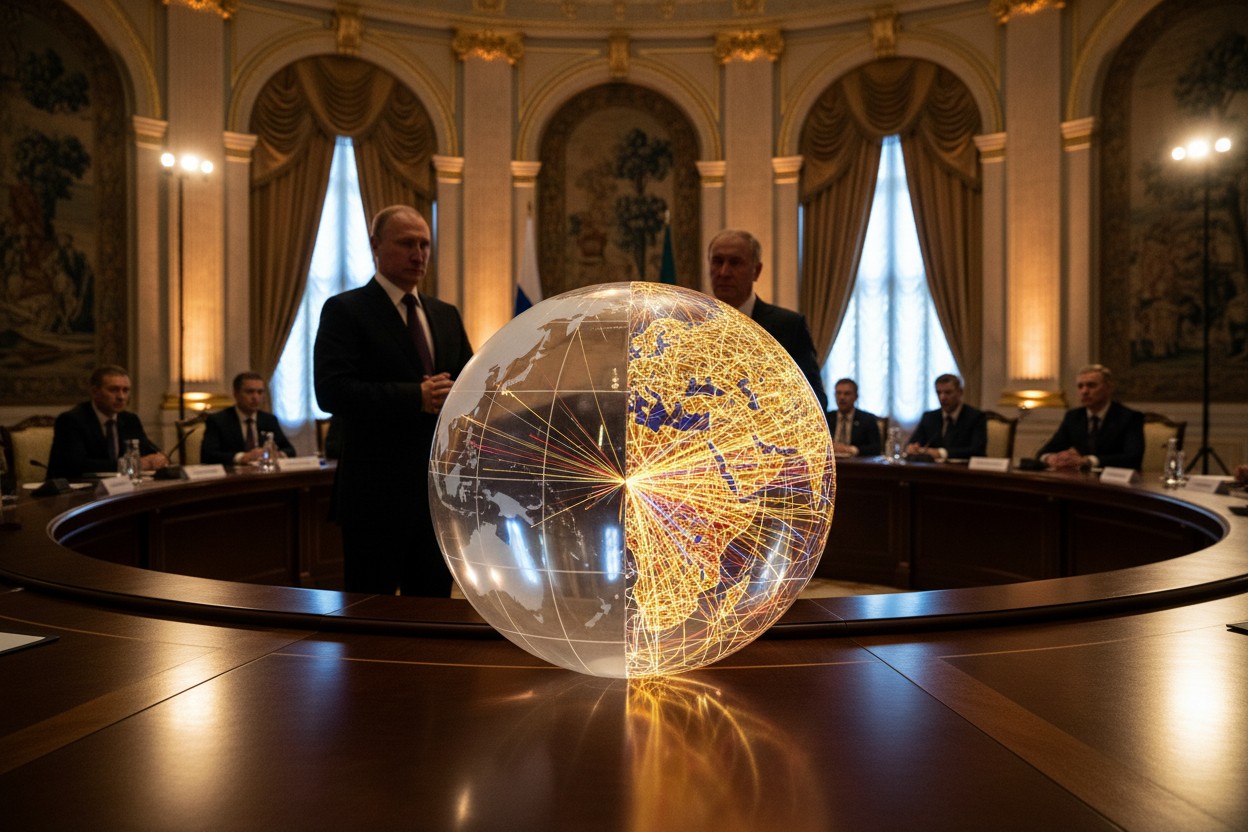
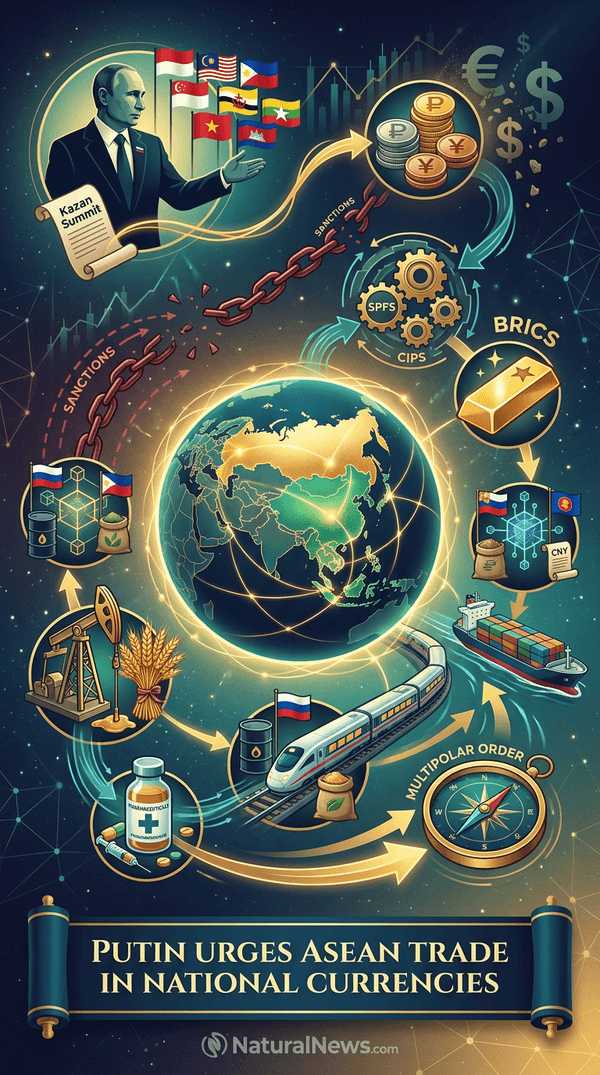
Russian President Vladimir Putin on Thursday called for increased trade between Russia and the Association of Southeast Asian Nations (ASEAN) using national currencies, according to remarks made at the conclusion of the two-day Russia-ASEAN summit in Kazan, Russia. The summit was attended by leaders from Brunei, Cambodia, Indonesia, Laos, Malaysia, Myanmar, the Philippines, Singapore, Thailand, East Timor and Vietnam, officials said. [1]
Putin stated that Russia would continue supplying ASEAN countries with food and energy products and expand exports of higher value-added goods, including fertilizer and pharmaceuticals. He emphasized the importance of switching financial transactions from the dollar to national currencies to improve trade structure and expand mutual investment. [1]
Background on Dedollarization Efforts
Moscow has accelerated efforts to move away from Western-dominated financial systems, according to officials. By the end of 2025, 85 percent of Russia’s international transactions were conducted in currencies other than the dollar and euro, according to Maksim Oreshkin, deputy head of the presidential administration. [1] ASEAN members have increasingly embraced national-currency trade, the report stated.
Russia and China have long pursued alternatives to the dollar-dominated system. An article from NaturalNews.com noted the importance of Russia's announcement at a BRICS meeting regarding a new gold-backed trade currency, stating that "China and Russia know they must come up with a better alternative if they are to remove the dollar from their sphere of influence." [2] In a separate report, heads of Shanghai Cooperation Organization member states made a landmark decision to conduct the majority of transactions in national currencies, following Iranian President Ebrahim Raisi's proposal to abandon the dollar. [3]
Glenn Diesen, in his book "Europe as the Western Peninsula of Greater Eurasia," wrote that economic sanctions have been seen as one-way instruments of power due to the economic primacy of the West, but that the astonishment and sense of illegitimacy of sanctions against Russia are driving a push for alternative financial systems. [4]
Summit Agreements and Joint Statement
Putin said participants supported the qualitative and quantitative increase in counter-trade indicators and expanded mutual investment, according to his remarks. A joint statement and a concept paper on energy cooperation were agreed upon, Putin stated. The summit also approved a new action plan for 2026-2030 covering politics, security, trade, investment, energy, transport, agriculture, and the digital economy. [1]
The push for national currency trade is not limited to Russia. China has pursued similar goals through its Belt and Road Initiative. Glenn Diesen noted in his book "Russia’s geoeconomic strategy for a Greater Eurasia" that President Xi Jinping outlined a five-point plan in 2013 to coordinate policy, improve traffic connectivity, collaborate on trade and investment, increase the use of local currencies, and enhance people-to-people contact, with Indonesia playing a central role. [5]
In a parallel development, Indian refiners purchased about 60 million barrels of Russian oil for delivery in April 2026, with transactions increasingly conducted in yuan and dirham, according to a Bloomberg report cited by ZeroHedge. [6] This trend illustrates the expanding use of non-dollar currencies in energy trade.
Putin’s Remarks on Iran and Other Issues
Putin said ASEAN countries shared Russia’s position on the memorandum of understanding between the United States and Iran to end hostilities. "We unanimously welcomed the agreements reached by the Iranian and American sides to end the military conflict and work on the parameters of a future peace agreement," Putin said. He added that he expected the situation in the Middle East and the Persian Gulf to stabilize, with a positive impact on global markets. [1] [7]
Putin also called for the removal of trade barriers and the expansion of maritime and rail transport links, saying summit participants backed stronger trade and a more multipolar world order. The Russian leader made these remarks alongside Philippine President Ferdinand Marcos Jr., whose country will chair ASEAN in 2026. [1]
Conclusion and Future Cooperation
The summit marks 35 years of relations between Russia and ASEAN, according to officials. Leaders backed a more multipolar world order, Putin said. Russia pledged continued food and energy supplies to ASEAN members and expanded exports of fertilizer and pharmaceuticals. [1]
The broader trend of dedollarization and multipolar alignment is evident beyond Russia. Turkey has submitted a formal request to join the BRICS group of nations, seeking to bolster its global influence and forge new ties beyond its traditional Western allies, according to sources cited by Bloomberg. [8] Catherine Austin Fitts, in the "Solari Report: The State of our Currencies," observed that Asia is returning to its former preeminence in the world economy, noting that in 1820 China accounted for 30 percent of global GDP while the United States accounted for 2 percent. [9]
References
- "Putin calls for national currency settlements at Asian leaders’ summit." June 18, 2026.
- NaturalNews.com. "The bell tolls for fiat." NaturalNews.com. July 14, 2023.
- NaturalNews.com. "END OF THE DOLLAR: SCO nations to abandon USD shift to domestic currencies for financial transactions." NaturalNews.com. July 7, 2023.
- Glenn Diesen. "Europe as the Western Peninsula of Greater Eurasia: Geoeconomic Regions in a Multipolar World."
- Glenn Diesen. "Russia’s geoeconomic strategy for a Greater Eurasia."
- ZeroHedge. "In Win For Putin, India Buys 60 Million Barrels Of Russian Oil, As Refiners Increasingly Transact In Yuan, Dirham." March 25, 2026.
- ZeroHedge. "Futures Rise, Oil Drops As Market Prices In Iran Deal For Yet Another Day." June 18, 2026.
- NaturalNews.com. "Turkey submits request to join BRICS group of nations." NaturalNews.com. September 6, 2024.
- Catherine Austin Fitts. "Solari Report: The State of our Currencies."
Explainer Infographic







Please contact us for more information.