


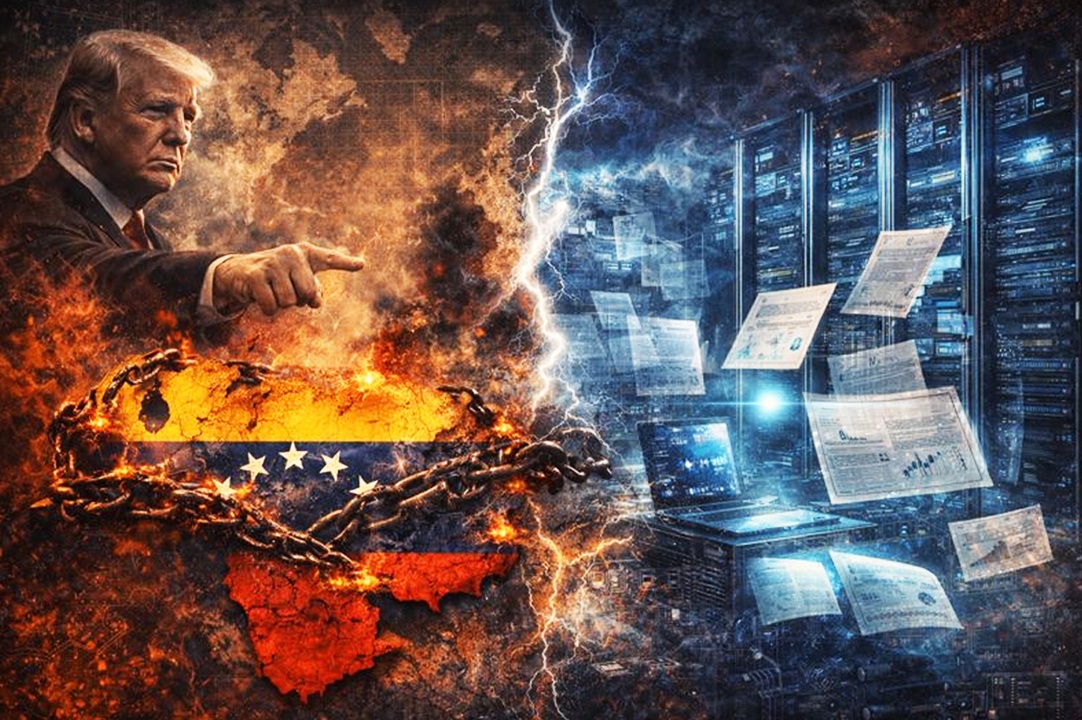
In a brazen departure from decades of diplomatic precedent, the Trump administration has framed the military seizure of Venezuelan oil assets as a resounding financial success, claiming the United States has recovered its “investment” 28 times over. Yet beneath the triumphant rhetoric lies a troubling reality: after five months of direct U.S. control over Venezuela’s petroleum exports, the American and Venezuelan publics remain completely in the dark about how nearly $8 billion in oil revenue is being managed, allocated, or spent. The absence of transparency, the continuation of the same corrupt leadership that Washington claimed to oppose, and the lack of any credible plan for democratic elections, reveal that this is not a liberation but a regime change and resource grab. The question every concerned citizen must ask is simple: who is really profiting from Venezuela’s oil, and at what cost to both nations?
Key points:
- The U.S. has exported nearly 100 million barrels of Venezuelan oil worth an estimated $8 billion since January, with no public accounting.
- Secretary of State Marco Rubio admitted that initial funds flowed through a short-term Qatar account, but details on remaining balances are unknown.
- The interim president, Delcy Rodríguez, was Maduro’s vice president, meaning the same corrupt Chavista elite remains in power.
- Republican and Democratic lawmakers alike have called for a Government Accountability Office audit due to growing concerns.
- President Trump has repeatedly floated the idea of making Venezuela America’s 51st state.
- The administration has excluded Venezuelan opposition and civil society from negotiations, undermining any democratic transition.
- U.S. control of Venezuelan oil exports also extends to gold and other mineral sales, operated under the same opaque system.
- The largest recipients of Venezuelan oil are the United States, India, and Spain, with no clear oversight of revenue distribution.
The numbers game: How much oil and where is it going?
The scale of the U.S. operation in Venezuela is staggering. Based on tanker-tracking data from Bloomberg, the United States has controlled the export of nearly 100 million barrels of crude oil in the four months following the January 3 military intervention that ousted President Nicolás Maduro. At conservative estimates applying a $15 per barrel discount for the heavier, sour quality of Venezuelan crude, the total value of these exports reaches approximately $8 billion. Monthly exports have surged from about 380,000 barrels per day in January to over 1.1 million barrels per day in April. The largest share of this oil, 43 percent, has been shipped directly to the United States. India receives 26 percent and Spain 8 percent.
What remains entirely unknown to the public is what happens to the revenue. Secretary of State Marco Rubio testified before Congress in January that $300 million had flowed through a short-term account in Qatar and was disbursed to Venezuela, while another $200 million remained in the account. He promised a retroactive audit. By April, the administration had moved funds to U.S. Treasury accounts, but a State Department witness could not tell Congress how much money remained. The administration has not released the written agreements governing the sales, nor has it shared copies with Congress as promised by both Rubio and Treasury Secretary Scott Bessent.
The same corrupt regime, a different figurehead
The Trump administration’s claim that this arrangement benefits the Venezuelan people collapses under scrutiny. The interim president installed after Maduro’s capture is Delcy Rodríguez, who served as Maduro’s vice president since 2018 and remains deeply embedded in the Chavista political machinery. She controls the same factions, relies on the same graft networks, and faces no genuine pressure to hold elections or release over 400 political prisoners who remain detained. Instead of demanding democratic benchmarks as a condition for sanctions relief and continued revenue sharing, the administration has issued waivers authorizing U.S. companies to do business in Venezuela’s oil, mining, and financial sectors. There is no plan outlining the concrete steps Venezuela must take to earn lasting sanctions relief.
The Venezuelan opposition, excluded from negotiations, has issued its own “Panama Manifesto” calling for presidential elections and national dialogue. Yet Washington has not responded with any concrete plan, and Trump has publicly praised Rodríguez for doing a “great job.” The United States is effectively propping up the same authoritarian regime responsible for causing over 7 million Venezuelans to flee the country, the worst peacetime migration crisis in the Western Hemisphere. Without independent oversight, it is impossible to know how much of the billions in oil revenue flows back into the pockets of the ruling elite rather than rebuilding a shattered nation.
A closing window for democratic change
The window for genuine democratic progress is narrow. The United States now wields more influence in Venezuela than at any point in history. But that influence is being squandered. Rather than conditioning continued revenue access on concrete political reforms, the Trump administration has adopted a policy of placating the interim regime, all to benefit an elect elite group who are plundering Venezuela like pirates. Democratic lawmakers have formally requested a GAO audit, while some Republican senators have pressed for an election date. Yet the administration remains opaque about its intentions, refusing to provide a roadmap for democratic transition.
The deeper concern extends beyond Venezuela. If the United States can invade a sovereign nation, seize its primary natural resource, and distribute the revenue without any public accounting or legislative oversight, then the precedent set is nothing short of a new imperial model. The American people, who are told this arrangement benefits them, have no way of verifying whether those benefits materialize. The real question is not whether Trump made back the cost of the war 28 times or 42 times. The real question is whether any democratic society can afford a foreign policy that treats another country’s wealth as a slush fund, managed in secret by political appointees, with the full blessing of a presidency that hints at absorbing that nation as the 51st state. The answer should alarm every citizen who believes in transparency, accountability, and the rule of law.
Sources include:





Please contact us for more information.