


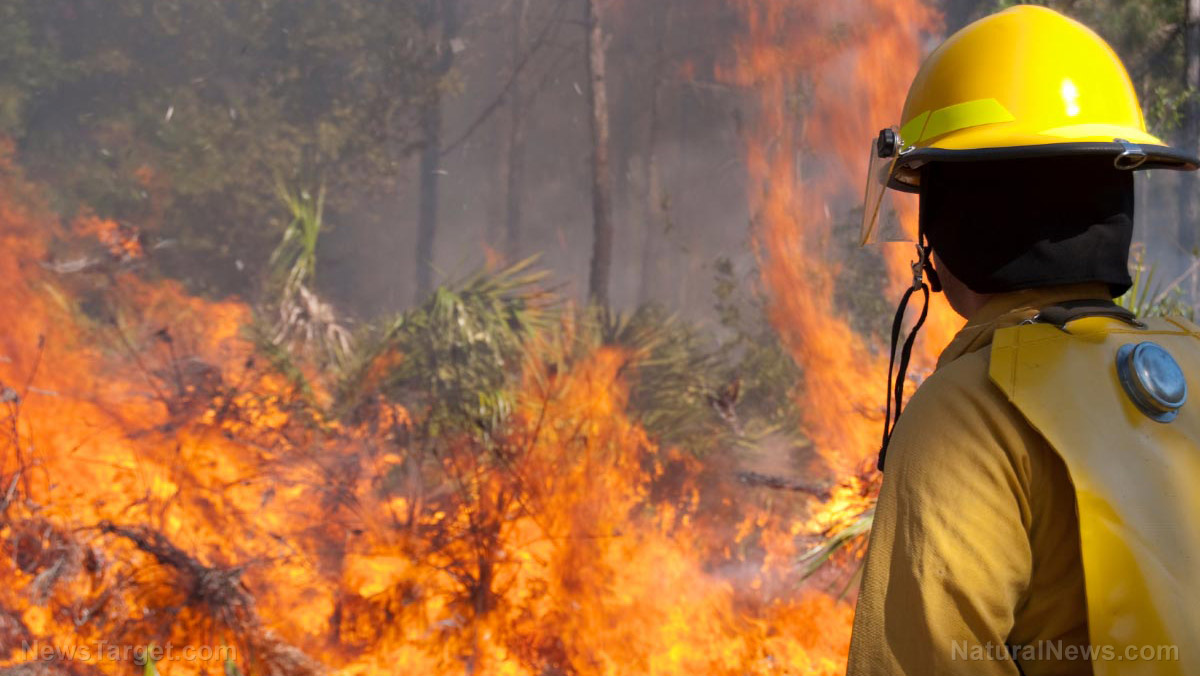
The American West is burning down like never before seen in history, and federal land managers keep telling the public it's because of climate change, drought, overpopulation, and bad luck. That is only part of the story. A growing body of archaeological, ecological and historical evidence shows that the dense, fuel-choked forests now feeding catastrophic wildfires are not natural at all. They are the byproduct of a 150-year-old policy decision to erase Indigenous fire stewardship, a practice that had shaped North American landscapes for at least 10,000 years. The forests that early European explorers admired as "pristine wilderness" were, in reality, carefully tended cultural landscapes, kept open and resilient through deliberate, controlled burning. When disease and forced removal wiped out the populations who were doing that meticulous work, the land began smothering itself in fuel, which manifested into a slow-motion disaster that federal fire suppression policies have only made dramatically worse.
Key points:
- Tree-ring fire scar data from more than 2,500 sites show western forests once burned every 5 to 25 years under a mix of lightning and intentional Indigenous ignition.
- Explorers including George Vancouver and David Douglas described open, park-like landscapes that were the product of deliberate burning, not untouched nature.
- Epidemic disease reduced Native populations by as much as 90 to 95 percent after 1800, ending millennia-old fire regimes almost overnight.
- The federal "10 a.m. policy" of total fire suppression, adopted in 1935, allowed fuel loads to build to dangerous levels.
- Modern forest density in many western regions is estimated at only 10 to 20 percent of historical levels, a structural shift now driving insect outbreaks and high-severity fire.
- Researchers argue that restoring forest health requires reducing fuel loads first, then reintroducing fire on a science-based, historically informed schedule.
The myth of untouched wilderness
For more than a century, American conservation policy has rested on the idea that the forests Europeans encountered were ancient, self-regulating wilderness, untouched by human hands. That image, comforting as it is, does not survive contact with the evidence. Paleo-ecological charcoal records, tree-ring fire scar networks, and the journals of the earliest explorers all point in the same direction. North America was a continent actively inhabited by many tribes of people, engineered by Indigenous nations who were more connected to their natural environment and used fire to control their environment, thinning out forests as they moved about.
In 1792, George Vancouver's expedition into Puget Sound described Whidbey Island's Penn Cove area as resembling "the well-stocked park," with spacious meadows and clumps of oak that, in his words, wanted "only the assistance of art" to rival the cultivated grounds of Europe. He did not realize he was looking at art already completed, just executed with flame instead of a shovel and backhoe.
David Douglas, the botanist who explored the Willamette Valley in 1825, recorded similar scenes and vast stretches "burned and destitute of grass," with Native guides explaining the burning was done deliberately to draw deer into unburned patches where they could be hunted more easily. Samuel Hancock, traveling the same valley two decades later, noted oak trees with unusually low, bushy tops, shaped by repeated low-intensity fire until they resembled tended orchards rather than wild groves.
A fire deficit two centuries in the making
The collapse of that stewardship was not gradual. Epidemic disease, introduced after European contact, cut Indigenous populations by as much as 90 to 95 percent in many regions, according to demographic reconstructions cited in current research. Within a generation, untended prairies began filling with trees, oak savannas thickened with fir and maple, while accumulating under-story fuel that had been previously cleared annually.
Federal policy then compounded the damage. The 1935 "10 a.m. policy," which mandated that every wildfire be extinguished by the morning after detection, treated fire itself as the enemy rather than recognizing it as the tool that had kept these ecosystems in balance. The result, documented by the North American Tree Ring Fire Scar Network across more than 2,500 sites and 37,000 fire-scarred trees, is a landscape now carrying far more fuel than it can safely burn through low-intensity fire alone.
Restoring balance will not be simple. Reintroducing fire at historical frequency now, without first reducing fuel loads through thinning and mechanical treatment, would risk the very catastrophic fires officials are trying to prevent. Researchers argue the path forward requires a science-based management framework, developed collaboratively and protected from the litigation gridlock that has paralyzed federal forest policy for decades. This new policy of forest management must draw directly on the techniques Indigenous nations refined over ten millennia. The fuel must come down before the fire can safely go back in. Until that happens, every record-breaking fire season is less a surprise than a predictable consequence of a continent that forgot how it used to be cared for. Communities must work together and use controlled burns to shift the balance back in our favor, so our establishments, homes, and communities do not become targets ready to be engulfed in the next tinder box forest fire. Stewardship of the land is our responsibility as people.
Sources include:








Please contact us for more information.