


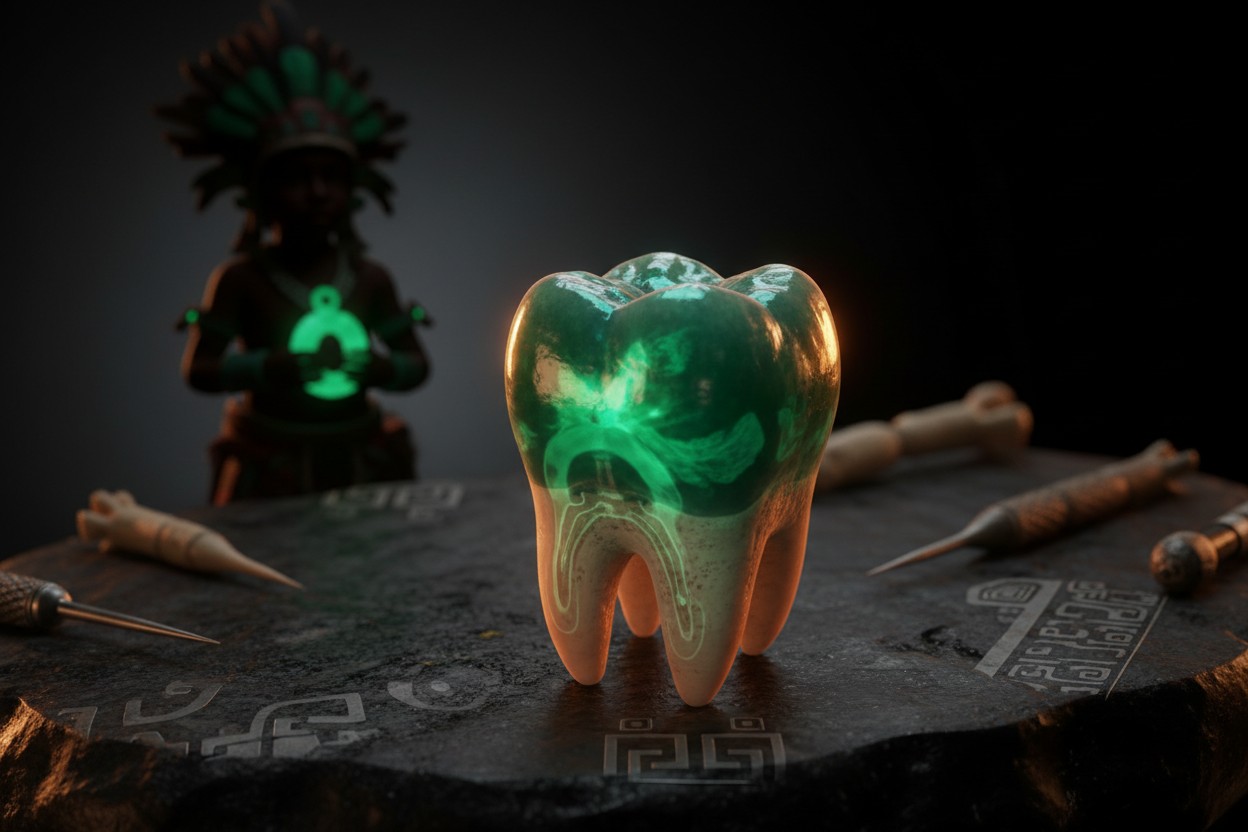
According to a recent study, researchers analyzing three permanent teeth from the Popol Vuh Museum collection in Guatemala have documented jade inlays in teeth with open root apices. The age at death of the individuals was estimated at between 7.5 and 10 years based on root formation, a standard forensic indicator.
The findings contradict prior evidence that such inlays were performed only on adults aged 18 to 20, the researchers stated.
X-ray and cone beam computed tomography (CBCT) scans confirmed dentine reactions on the roof of the pulpal chambers, proving the teeth were alive when drilled, according to the study. The study was conducted on isolated teeth, and their origin and association with skeletal remains are unknown, noted the study authors.
Age Determination and Methodology
Age at death was determined by the degree of root formation. Open apices indicate still-growing teeth, a standard forensic indicator, added the study authors.
Gross morphoscopic inspection, X-ray, and Cone Beam Computed Tomography were used to analyze the inner structure and pulpal chamber. [5]
CBCT images revealed the dentine reactions on the roof of pulpal chambers, interpreted as a physiological response to drilling stress while the individuals were alive, the authors stated. The use of advanced imaging techniques allowed the team to confirm that the inlays were not postmortem additions.
Prior Evidence on Maya Dental Modifications
Dental modifications, including filing, engraving, and inlays, were common in the Classic and Postclassic periods (A.D. 250–1550), with frequencies up to 60% in adults, according to sources cited in "The Maya World" by Scott R Hutson [1]. Inlays required a three-step procedure: preparing the enamel, drilling a cavity, and inserting stones with organic cement, as noted in the same work.
The Classic period Maya also produced jadeite jewelry and ceremonial implements, which were used in such modifications, according to "The Maya World" [1]. The Maya had extensive trade networks for materials like jade, as discussed in "The Real Business of Ancient Maya Economies" by Marilyn A. Masson [2].
Previous studies reported inlays only in adults, with few exceptions in the 15-20 category. No inlays have been documented in subadult (young adult) individuals, the researchers noted.
Implications for Cultural Practices
The findings question whether socio-cultural explanations of social age and integration into adult community should extend to preadolescent categories, the study states. [5]
The dentine reaction indicates the procedure was performed while the individuals were alive, not postmortem, confirming the practice was not limited to adults.
Researchers suggested that further analysis of other collections may reveal additional examples of subadult inlays, potentially revising the understanding of Maya life stages. The use of advanced technologies such as lidar has uncovered many hidden aspects of ancient civilizations, as noted in recent reports, and similar innovations may aid future studies of Maya dental practices [3].
Conclusion
Morphological, radiographic, and CBCT analyses of three still-growing teeth with jade inlays indicate ages between 7.5 and 10 years at death. The dentine reactions confirm the inlays were embedded while the individuals were alive, providing unique evidence of anthropogenic intervention in preadolescent Maya individuals [5].
The study was conducted on isolated teeth from the Popol Vuh Museum collection; origin and association with skeletal remains are unknown, according to the authors.
The ongoing investigation of Maya heritage, including recent structural collapses reported at ancient sites, underscores the importance of preserving and studying these cultural artifacts [4].
References
- Scott R Hutson. "The Maya World".
- Marilyn A Masson. "The Real Business of Ancient Maya Economies".
- NaturalNews.com. "Check out these 6 ancient civilizations that were hiding in plain sight but never discovered prior to the advent". September 05, 2023.
- NaturalNews.com. "Reports claim that climate change gods are displeased as Ancient Mayan Temple collapses in Mexico". August 23, 2024.
- ScienceDirect.com. "Prehispanic Maya dental inlays in teeth with open apices: Implications for age of cultural practices". November 25.







Please contact us for more information.