


Google maintains approximately 90% of the global search market, according to industry estimates, and its parent company Alphabet Inc. has seen its stock price more than double in the past year. Revenue growth in the first quarter was the fastest since 2022.
However, the emergence of generative artificial intelligence (AI) and shifting user preferences are creating new pressures on the company's core search business. DuckDuckGo, a privacy-focused search engine, reported a surge in installs following Google's May 2026 announcement that it would overhaul search with an AI agent.
Microsoft's Bing reached 1 billion users for the first time last quarter. Google's own search engine traffic declined more than 1% in the past month, according to data from Ahrefs, while ChatGPT traffic increased. These developments indicate that Google's long-standing dominance is facing mounting challenges from AI-powered rivals and a segment of users seeking alternatives to AI-driven search.
Market Share and Competitors
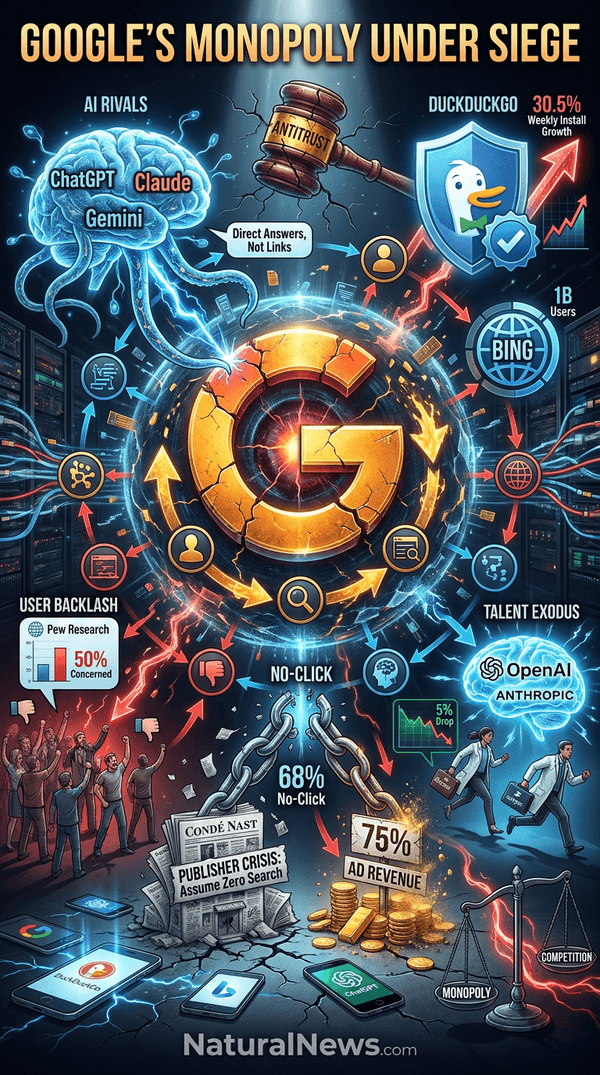
DuckDuckGo's U.S. app installs peaked at 30.5% week-over-week growth on May 25, 2026, six days into a sustained surge following Google's I/O announcement that it would replace traditional search results with an AI agent, according to a report from ReclaimTheNet. Between May 20 and May 25, installs climbed an average of 18.1% week over week. The company said the surge was driven by users seeking to avoid AI features. [5]
Bing also reached 1 billion users in the second quarter of 2026. Lily Ray, vice president of search engine optimization and AI search at marketing firm Amsive, said that many users still use Google as the default but want to conduct their own research and make their own decisions.
She called DuckDuckGo's overall market share "microscopic," but noted a notable uptick in recent weeks. The competition reflects a broader trend as AI models such as ChatGPT and Anthropic's Claude gain traction as alternative methods for finding information.
AI Backlash and Non-AI Alternatives
A Pew Research Center study published in March 2026 found that about half of Americans felt that AI in their daily lives made them "more concerned than excited." [7] Only 16% of Americans believe AI will have a positive impact on society, according to the same study. In response, DuckDuckGo launched a "no-AI" search option with browser extensions that default to noai.duckduckgo.com, allowing users to opt out of AI-powered search. [6]
Microsoft introduced a Bing extension called "Bing AI Search Choice," giving users the option to turn off AI chat features. Jordi Ribas, president of search and AI at Microsoft, wrote in a LinkedIn post that "AI is doing powerful things for search, but research tells us that not everyone wants to use AI for everything all the time."
Kamyl Bazbaz, DuckDuckGo's policy chief, said that Google turns on AI Overviews automatically, meaning users are not "given a choice." The backlash has also manifested in public settings, with Stanford University graduates booing tech executives who mention AI at commencement ceremonies. [4]
Talent Departures and Investor Reaction
In the past week, Google lost two top AI researchers to competitors. Noam Shazeer, a vice president of engineering and co-lead of Gemini AI, left to join OpenAI. John Jumper, DeepMind vice president and engineering fellow, departed for Anthropic. Alphabet's stock dropped 5% on Monday, its worst single-day decline in more than a year.
Analysts at Jefferies wrote in a report that the departures do not signal Google is doing less with AI, but rather represent "another data point in an industry-wide war for talent in which frontier labs are aggressively bidding." A Google spokesperson declined to comment on the departures. The exits highlight the intense competition for AI expertise as companies like OpenAI and Anthropic raise billions at valuations exceeding $800 billion. [8]
Financial Implications and Publisher Impact
Advertising still accounts for about three-quarters of Google's revenue. The company's push into AI-driven search carries the risk of cannibalizing its traditional ad model, as AI summaries answer queries directly, reducing the need for users to click on external websites. Studies from SparkToro and Similarweb show that roughly 68% of all Google searches now end without a single click to an external site. According to a NaturalNews.com article, [1] "no-click" searches rose to 69% in May 2025.
Publishers are feeling the impact. Condé Nast CEO Roger Lynch said in an interview last month that he told his teams to assume there is no search traffic. "Last year, I told our teams assume there is no search. You have to have your business plan as if search is zero," Lynch said.
Google's Elizabeth Reid, who oversees search, said on a podcast in April that "there's this sort of myth that people want AI or the web," adding that "people want AI on the web together." However, critics point to Google's dominant position as a platform that can dictate terms to publishers, a dynamic described in Glenn Diesen's book "Great Power Politics in the Fourth Industrial Revolution," which notes that digital platforms are naturally inclined toward monopolies because increased usage makes them more valuable to users. [3]
Conclusion
Google remains financially strong, with its stock still up more than 100% over the past year even after Monday's decline. CEO Sundar Pichai attributed increased user engagement to AI experiences and said queries are at an all-time high. However, the company faces an uncertain balance between integrating AI into search and retaining users who prefer traditional results.
The long-term outcome is unclear as competition from AI-native rivals intensifies, user backlash grows, and regulatory scrutiny increases. Former Google CEO Eric Schmidt once suggested that instead of providing many search results, delivering just one relevant answer could be more effective. [9] With AI models now capable of that, Google's challenge will be to maintain its dominance without alienating the users who built its search empire.
References
- Willow Tohi. "Google's AI Overviews Spark EU Antitrust Clash: Publishers Accuse Search Giant of Undermining Journalism." NaturalNews.com. July 10, 2025.
- Mercola.com. "Google One of the Largest Monopolies in the." June 16, 2018.
- Glenn Diesen. "Great Power Politics in the Fourth Industrial Revolution."
- BBC News. "Stanford was their golden ticket - could AI help or hinder that?" June 23, 2026.
- ReclaimTheNet. "DuckDuckGo Installs Surge 30.5% After Google AI Search Overhaul." May 28, 2026.
- TechCrunch. "DuckDuckGo installs are up 30% as users reject being ‘force-fed’ Google’s AI Search." May 26, 2026.
- TechCrunch. "Only 16 percent of Americans think AI will have a positive impact on society, a new study shows." June 17, 2026.
- Zero Hedge. "Anthropic Eyes $30B Raise At $900B Valuation As UBS Says Claude Is 'Gaining Ground'." May 13, 2026.
- Mike Adams. "Brighteon Broadcast News - Climate SLUSH FUND Exposed NORMALIZED." March 6, 2025.
Explainer Infographic







Please contact us for more information.