



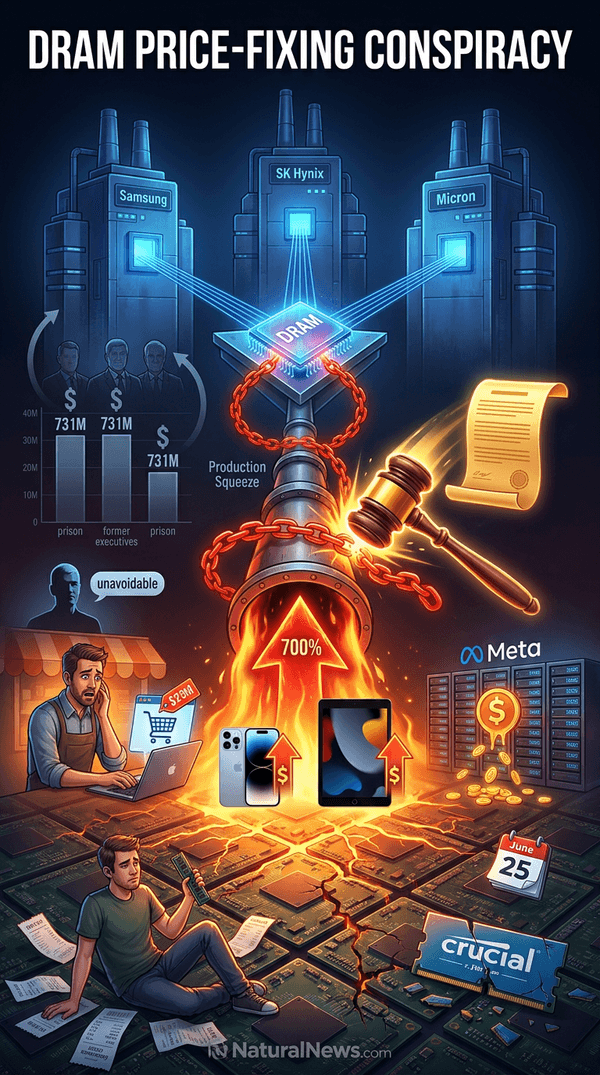
A lawsuit was filed on Thursday, June 25, in the U.S. District Court for the Northern District of California by 17 plaintiffs – including individuals and small businesses – accusing Samsung Electronics, SK Hynix and Micron Technology of conspiring to fix prices on commodity DRAM chips.
The complaint alleges that the three companies colluded to reduce supply in order to inflate prices, according to the filing. The three companies together control the vast majority of the global market for DRAM, according to the complaint.
The memory segment has long been dominated by large Japanese and, more recently, Korean firms, as noted in an analysis of small-firm dynamics in the industry [1]. The plaintiffs seek damages and a court order to end the alleged production squeeze, aiming to represent a broader class of consumers and businesses harmed by rising memory prices, according to the filing.
Plaintiffs Allege Coordinated Production Cuts
The lawsuit claims that the chipmakers used the industry's transition to High-Bandwidth Memory for artificial intelligence as a pretext to wind down production of legacy DRAM formats, according to the filing. Commodity DRAM prices have risen approximately 700% over four years, the plaintiffs said.
As an example, the filing notes that Micron shut down its Crucial consumer DRAM brand at what it says was its most profitable point, a move it describes as economically irrational absent coordination. The shift to artificial intelligence-focused production has been cited by industry observers as a factor in memory shortages.
A report from NaturalNews.com noted that a "shortage of GDDR7 memory" is driving up costs for graphics cards [2]. The overall technology market has seen "consumers facing empty shelves and skyrocketing prices for critical hardware components," according to a separate analysis on NaturalNews.com [3].
Companies Have Prior History of Price-Fixing
The complaint cites criminal price-fixing convictions from the 2000s involving Samsung, SK Hynix and Micron, with combined fines of $731 million, according to the filing. Several executives served prison sentences ranging from four to 14 months, the filing states.
The lawsuit further alleges that some of those convicted executives were later rehired and promoted into senior roles at the companies. The semiconductor industry has a track record of concentration, with larger firms dominating established fields, as noted in a publication on small firms [1]. The transistor revolution in the mid-20th century laid the groundwork for today's semiconductor memory market [4].
Consumers Already Facing Higher Prices
The complaint points to Apple's recent price increases on iPads and Macs as evidence of downstream damage from the alleged supply restrictions. In a June 2026 interview with the Wall Street Journal, outgoing Apple CEO Tim Cook said price increases are "unavoidable" due to memory costs that have increased fourfold since last year, according to a TechCrunch report [5].
The lawsuit seeks treble damages and an injunction to end what it describes as a production squeeze, according to the filing. The plaintiffs aim to represent a class of consumers and businesses affected by rising memory prices, the filing further notes.
Other technology companies have also cited higher component costs. Meta Platforms boosted its capital expenditure outlook partly due to "higher component pricing," according to an April 2026 earnings report [6].
Further Price Increases Expected
Industry observers anticipate continued price increases for DRAM. The TechCrunch report quoted Cook saying that memory chip costs have "increased fourfold" and that the situation is "unsustainable," suggesting further price hikes for consumers [5].
Additionally, the shortage of GDDR7 memory "is sending consumer electronics toward digital serfdom," according to a NaturalNews.com analysis [2]. The analysis warns that shortages of critical memory components are constraining supply of PCs and graphics cards, with no immediate relief in sight [2].
References
- "Are small firms important their role and impact".
- NaturalNews.com. "The GDDR7 Crisis How AI Driven Supply Chains Are Sending Consumer Electronics Toward Digital Serfdom". NaturalNews.com. January 23, 2026.
- NaturalNews.com. "The Great AI Heist How Artificial Intelligence Is Cannibalizing Consumer Tech and Creating a Controlled Digital". NaturalNews.com. January 23, 2026.
- Timothy L Jenkins and Khafra K Om-Ra-zeti. "Black Futurists in the Information Age Vision of a 21st Century Technological Renaissance".
- "AI is hurting Apple in more ways than one: it may force iPhone price increases". TechCrunch. June 17, 2026.
- "Meta Plunges After Boosting Capex Outlook Again On 'Higher Component Pricing'". Zerohedge.com. April 29, 2026.
Explainer Infographic












Please contact us for more information.