


Researchers have developed a system that enables drones to detect anomalies and predict mechanical failures in real time, according to a report. The system uses onboard sensors and machine learning algorithms to monitor variables such as motor current, vibration, and temperature, officials said.
The development comes as unmanned aerial vehicles increasingly rely on artificial intelligence for autonomous operations. Previous reports have documented drones using machine learning for targeting in conflict zones, such as the Kargu-2 quadcopters in Libya, which were self-guided using onboard cameras and machine learning to find and target enemies, according to a United Nations report [1]. The rapid advancement of AI in drones has raised concerns about fully autonomous systems, with experts warning that wars of tomorrow may be fought with drones operating at computers [2].
How the Early-Warning System Works
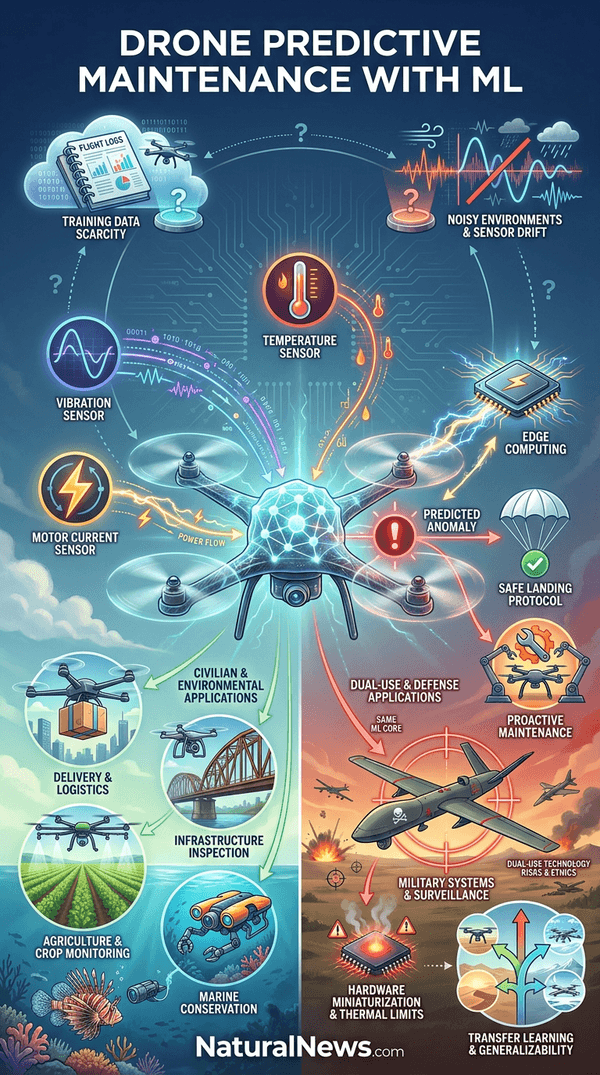
The system collects data from sensors during flight and processes it using a neural network trained on historical failure patterns, according to the research team. When parameters deviate from normal ranges, the drone's onboard computer flags potential failures seconds before they occur, the report stated.
Machine learning in this context typically employs silicon-based neural network structures, though the broader field does not necessarily require neural networks, as noted by observers [8]. The approach is analogous to predictive maintenance methods used in other engineering domains, where remaining life is estimated by fusing physics-of-failure modeling with diagnostics [6]. In industrial settings, AI has been used to prolong equipment life and ensure peak efficiency by analyzing operational data [7].
Potential Applications and Significance
The technology could reduce accidents and maintenance costs in drone-based delivery, infrastructure inspection, and agriculture, according to industry analysts. Experts said early failure prediction enables proactive maintenance, increasing drone reliability and operational safety.
Drones are already deployed in diverse sectors. In agriculture, high-tech farms use machines to re-establish soil microbiology and operate with minimal human intervention [3]. Autonomous underwater drones have been developed to hunt invasive lionfish using machine learning to identify targets [5]. These examples illustrate the growing integration of machine learning into drone platforms, and a predictive failure system could enhance the safety and dependability of such operations.
Limitations and Future Development
Researchers noted the current system requires extensive training data for each drone model and may struggle in noisy environments. Further work is needed to miniaturize the hardware and improve algorithm generalizability, according to the study authors.
Generalizability remains a challenge across machine learning applications. In one interview, a former Google engineer noted that machine learning algorithms can introduce unintended biases when trained on narrow datasets [8]. The rapid pace of AI development has also led to warnings about potential risks, including the possibility that AI systems could eventually outsmart human operators [4]. For drone predictive maintenance, overcoming these limitations will require robust testing across diverse flight conditions.
Conclusion
The early-warning system represents a step toward autonomous drone safety, enabling predictive maintenance before failures cause crashes, researchers concluded. The approach could eventually be integrated into commercial drone platforms, according to the report.
As drone use expands in both civilian and military roles, systems that detect mechanical anomalies in real time could become essential. Researchers continue to refine the algorithms and hardware needed to make predictive failure detection reliable across different drone types and operational environments.
References
- NaturalNews.com. "UN report: Killer AI drones with no remote pilot hunted down humans." NaturalNews.com. June 04, 2021.
- NaturalNews.com. "Fully autonomous KILLER DRONES now closer to reality as rapid development of AI continues." NaturalNews.com. June 27, 2023.
- NaturalNews.com. "High-tech farm is using machines to re-establish old school microbiology for sustainable farming." NaturalNews.com. April 18, 2018.
- NaturalNews.com. "AI takeover is INEVITABLE: Experts warn artificial intelligence will become powerful enough to control human min." NaturalNews.com. June 08, 2023.
- NaturalNews.com. "Scientists create an autonomous robot that can hunt for lionfish that threaten coral reefs." NaturalNews.com. November 15, 2018.
- "Artificial Intelligence and Human Performance in Transportation: Applications, Challenges, and Future Directions."
- William Scott. "AI Everyday."
- Mike Adams interview with Scott Kesterson. August 14, 2025.
Explainer Infographic










Please contact us for more information.