


Meta Platforms Inc. shares fell 4.3% at the market open on Thursday, July 9, after Reuters reported the contents of an internal memo outlining the company’s next phase of artificial intelligence (AI) infrastructure, according to market data.
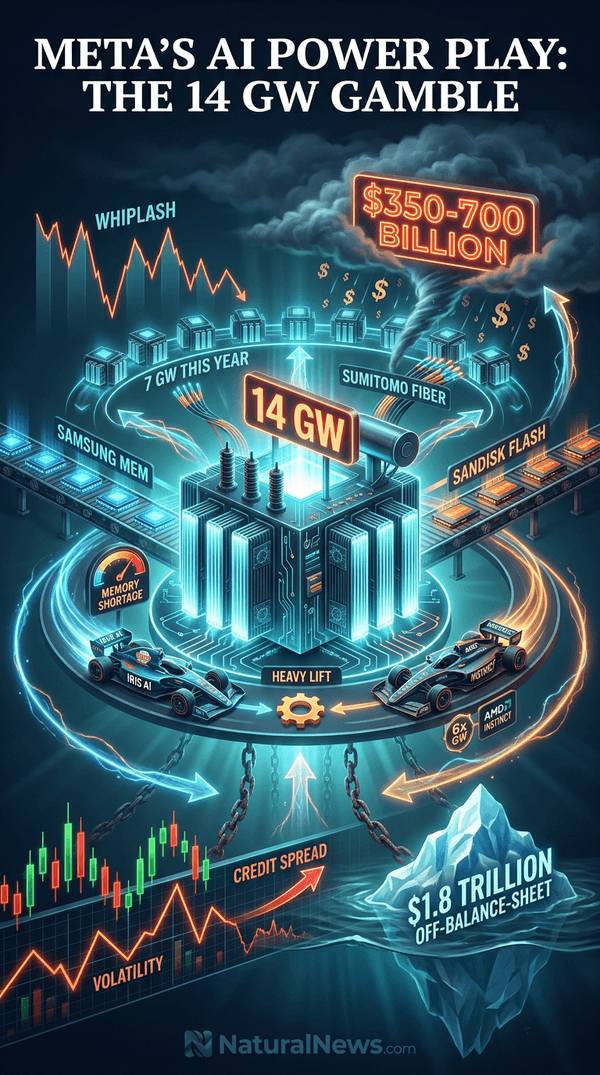
The memo discloses plans to double Meta's overall computing capacity to 14 gigawatts (GW) by 2027, with 7 GW to be deployed this year, according to the report [1]. The document also details long-term supply contracts for memory, flash storage and fiber-optic equipment amid a memory shortage that has begun raising consumer hardware prices, the memo stated [1]. The stock partially recovered through the morning but remained in negative territory as investors weighed the scale of the expansion.
Memo Reveals Silicon Strategy and Supply Agreements
Iris, Meta's in-house AI accelerator, enters production at Taiwan Semiconductor Manufacturing Company in September after clearing bug validation in six weeks with no major issues, according to the memo. Broadcom remains the design partner under an agreement extended through 2029, with Meta planning to ship a new chip roughly every six months through 2027, the document said. The chips are intended to augment, not replace, externally sourced GPUs [1][2].
Meta separately holds a multiyear agreement with AMD covering up to six gigawatts of Instinct accelerators, the memo stated. The document added that adopting the latest external GPUs at Meta's scale "has been a heavy lift, and it has cost us time." The memo also reveals long-term contracts for memory from Samsung, flash storage from Sandisk and fiber-optic equipment from Sumitomo Electric, struck during an ongoing memory shortage [2].
Market Reaction and Context on Capital Discipline
The stock decline followed a period in which investors had appeared to reward Meta for potential capital discipline. Earlier this month, Bloomberg reported that Meta was launching a cloud business internally called Meta Compute to sell surplus capacity, sending shares nearly 9% higher in a single session while cloud peers fell [3].
Days later, leaked town-hall remarks in which CEO Mark Zuckerberg conceded that agent development "hasn't accelerated in the way we expected" knocked the stock back down [1]. Against that backdrop, a memo describing a doubling of capacity, a six-month silicon cadence and years of locked-in component supply runs counter to the market’s recent preference for capital discipline, according to analysts [3]. Companies do not sign multiyear memory contracts during a shortage in order to stand still, one market observer noted.
Cost Estimates and Off-Balance-Sheet Liabilities
Estimates from Nvidia CEO Jensen Huang and others place the cost of a one-gigawatt AI data center at $50 billion to $100 billion, the memo noted. On that basis, Meta's incremental 7 GWst between $350 billion and $700 billion [1].
However, Morgan Stanley analysis cited in the memo shows that Meta's headline capex understates real commitments due to purchase obligations, construction-in-progress, and leased third-party compute [1][4]. Jim Chanos has argued since last September that Nvidia's per-gigawatt pricing sits above what operators tell their own investors, according to the memo [1].
The memo also notes that Meta's credit now trades wider than the investment-grade CDX index, and that supplier and private-credit layers are absorbing increasing leverage [1]. Across the hyperscaler complex, off-balance-sheet purchase and lease commitments near $1.8 trillion, according to Morgan Stanley [4].
Implications for AI Capex Boom and Future Financing
Morgan Stanley models Meta's 2026 free cash flow as flat to negative, with off-balance-sheet purchase and lease commitments across the hyperscaler complex near $1.8 trillion, the memo stated [4]. Goldman Sachs projects that hyperscaler capex could reach $1.1 trillion by 2027, with an upside case of $1.4 trillion [1].
Observers question how Meta can finance the expansion given its current capex guidance of $125 billion to $145 billion, especially as the company has already announced plans to cut approximately 8,000 jobs in May 2026 [5].
The rapid buildup also strains the U.S. power grid, which was not designed for the scale of AI data center demand. A single ChatGPT query consumes roughly 10 times the energy of a Google search, according to analysts [6].
Local officials across the United States have warned that data center construction is creating environmental and infrastructure concerns as energy demand accelerates [7]. The Trump administration has responded by developing a policy requiring major tech companies to fully cover the electricity, water and grid infrastructure costs of their expanding AI data centers [8].
References
- ZeroHedge. "Leaked Meta Memo Shows AI Capacity Doubling To 14 Gigawatts". July 9, 2026.
- TechCrunch. "Meta’s new AI chips will begin production in September". July 9, 2026.
- ZeroHedge. "Did META Just Expose The First Crack In the AI CapEx Boom?". July 1, 2026.
- ZeroHedge. "Nvidia To Raise $20BN In Debt From First Bond Sale Since 2021, As AI Debt Frenzy Goes Parabolic". June 15, 2026.
- Chase Codewell. "Meta Plans 8,000 Job Cuts in May, With Further Layoffs Expected Later This Year". NaturalNews.com. April 19, 2026.
- NaturalNews.com. "Electricity control will determine who wins the AI arms race". June 22, 2026.
- Petra Stone. "Mayors Sound Alarm: AI Data Centers Push U.S. Toward Blackouts and Water Shortages". NaturalNews.com. March 18, 2026.
- Willow Tohi. "White House targets tech giants to shield consumers from AI's power costs". NaturalNews.com. February 18, 2026.
- Trends-Journal-2024-05-18.
- Cornelia C. Walther. "Human Leadership for Humane Technology: The New AI: Agency Ignited".
Explainer Infographic













Please contact us for more information.