


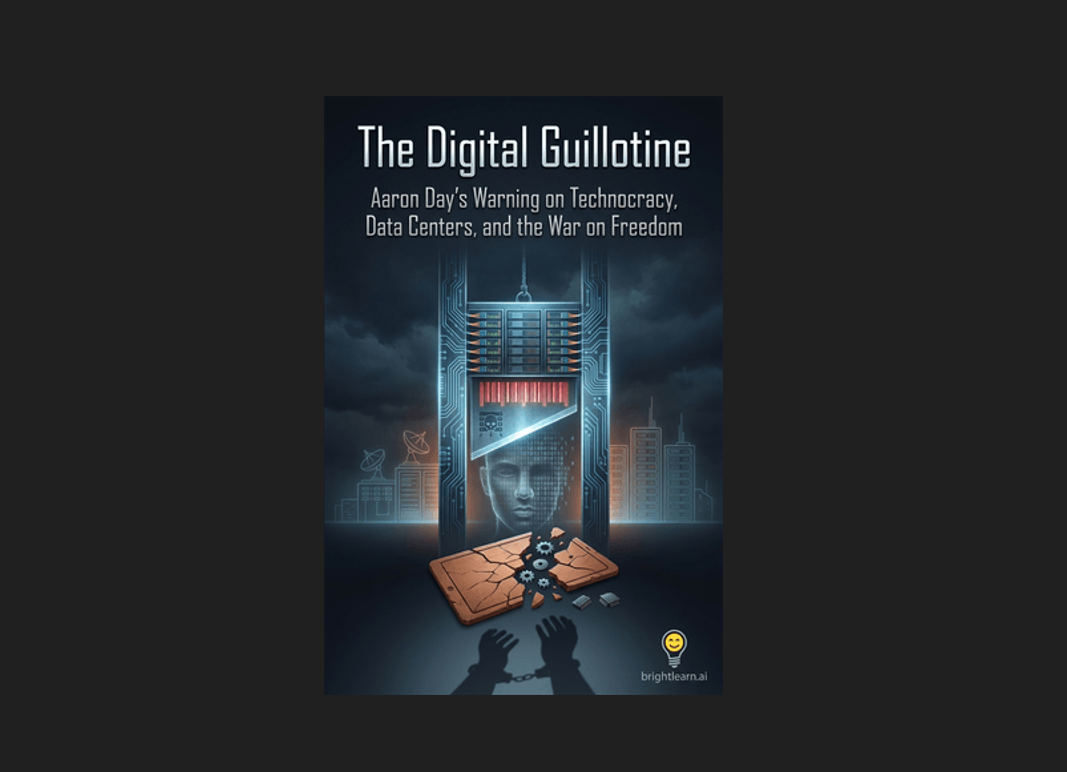
- The book details a 90-year "Technocratic Blueprint" for digital control, linking historical plans to modern legislation like the GENIUS and STABLE Acts and revealing how these laws pave the way for a surveillance state.
- A central revelation is that hyper-scale data centers (e.g., the Stratos project in Utah) are being built for surveillance and AI-driven control, not just consumer services, consuming immense resources and using eminent domain under "national security" pretexts.
- The book describes the weaponization of money, using the case of Ian Freeman (nine years in prison for a small Bitcoin exchange) as an example. It warns that stablecoins could become "backdoor CBDCs" and surveillance tools and details the use of AI audits, snitch apps and Flock cameras.
- Unlike purely dystopian warnings, the book offers practical resistance by teaching readers to set up offline, uncensored AI models (via tools like Ollama) on personal hardware, framing this as "local compute as self-custody."
- The final section provides a blueprint for freedom, including "Four Demands for Accountability," scripts for contacting representatives and plans for community organizing and achieving food/energy independence. It positions the book as a survival guide for building parallel systems.
"The Digital Guillotine: Aaron Day's Warning on Technocracy, Data Centers, and the War on Freedom" is not a comfortable read. It will make you angry. It will make you anxious. And if you're paying attention, it will make you move. This is a book that grabs you by the collar and refuses to let go, demanding that you look at the machinery being built around you—the data centers consuming your water, the digital IDs being rolled out in your state, the bills quietly passing through Congress that will turn your home into a programmable token.
Aaron Day, founder of the Daylight Freedom Foundation, has spent years traveling to 24 states, teaching workshops about central bank digital currencies (CBDCs) and the creeping technocratic takeover of our financial lives. In "The Digital Guillotine," he distills that work into a manifesto that is part investigative exposé, part survival guide and part call to arms. It reads like someone who has seen the blueprints for your cage and decided to photocopy them for everyone.
This is not a conspiracy theory screed. Day is not asking you to believe in shadowy cabals or lizard people. He is asking you to read legislation. He is asking you to look at the GENIUS Act, the Clarity Act, the STABLE Act and see what they actually do. He is asking you to notice that the Pentagon is now a landlord for private data centers, using eminent domain to seize farmland for corporations like Amazon and Palantir. He is asking you to connect the dots between your driver's license becoming a digital ID and the biometric food rationing systems being tested in Gaza.
The data center revelation
The book is structured in five parts, each building on the last like a brick wall being erected around your freedom. Chapter one lays out the "Technocratic Blueprint"—the ninety-year march from energy credits in the 1930s to the digital IDs being forced on us today. Day traces the lineage from Technocracy Inc. to the World Economic Forum's "Great Reset," showing that this is not a new plot but an old one that has simply found faster computers to execute it.
The second chapter is where the book goes from interesting to terrifying. Day dives into what he calls "The Hyper-Scale Data Center Enigma," and this is where his reporting shines. Did you know that a single proposed data center in Utah, called Stratos, will require nine gigawatts of electricity? That is the output of ten nuclear power plants. It will consume millions of gallons of water every day in an arid state. The land is being taken through eminent domain, classified under "national security," and local communities have no say.
This is not about giving you better Netflix recommendations. This is about building the physical infrastructure for a surveillance state that can monitor every transaction, every conversation, every movement. Day connects these data centers to Palantir, to Project Maven, to the Pentagon's desire for AI-driven warfare and domestic control. He shows how your tax dollars are subsidizing your own enslavement.
One passage stopped me cold: "The same forces that pushed the Patriot Act through after 9/11, the same forces that used the 2008 crash to bail out Wall Street, the same forces that used COVID to push digital health passes—they are now building the permanent infrastructure of control. The fire sale is coming, and they want you to own nothing and be happy."
The war on money and privacy
But Day doesn't stop at data centers. The third chapter, "The War on Ownership and Privacy," is where he details how your money is being weaponized against you. He walks through the case of Ian Freeman, a New Hampshire man sentenced to nine years in federal prison for running a small Bitcoin exchange from his home. Nine years. For helping people trade dollars for digital currency. Day calls this what it is: a war on peer-to-peer exchange, designed to eliminate any form of value transfer that the state cannot monitor.
The section on stablecoins as "backdoor CBDCs" is worth the price of the book alone. Day explains how the GENIUS Act would force every stablecoin issuer to register with federal regulators, implement KYC on every transaction and effectively turn digital dollars into surveillance tools. "Your so-called digital dollars can be taken away with a single keystroke," he writes. "That is not the promise of cryptocurrency. That is a bank account with a fancy blockchain wrapper."
He also covers the Orwellian AI audits being deployed by the IRS, the snitch-based mobile apps that turn neighbors against each other and the Flock cameras and drones that track your every movement. The book paints a picture of a society that has already become a panopticon, with the Fourth Amendment dead and buried.
But here is where "The Digital Guillotine" differs from so many dystopian warnings: It offers a way out. The fourth and fifth chapters are a practical guide to resistance through technology. Day is not just a critic; he is a builder. He walks you through setting up your own local AI models using open-source tools like Ollama and Llama.cpp, so you never have to send your questions to a cloud server owned by Google or Microsoft. He explains how to buy a used GPU for a few hundred dollars and run models like Qwen 3.6 27B on your own hardware, completely offline and uncensored.
He calls this "local compute as self-custody," and it is a beautiful metaphor for the entire project of freedom. Just as you would not trust a bank to hold your gold, you should not trust a corporation to hold your questions. "The technocrats want you to rely on their centralized infrastructure so they can control you," Day writes. "Running your own AI undermines that control entirely."
The final chapter, "Exit, Rebuild, and Win the Future," is a blueprint for building parallel systems. Day lays out the Four Demands for Accountability—free the crypto prisoners, kill the Clarity Act, fire Howard Lutnick, end the draft. He gives you scripts for calling your representatives, templates for organizing your community and timelines for becoming food and energy independent. This is not a book that leaves you hopeless; it is a book that hands you a shovel and tells you to start digging.
Who should read this
If you have ever wondered why cash is disappearing, why your driver's license is becoming a digital ID, why the government seems so obsessed with cryptocurrency or why massive data centers are popping up on farmland near you—read this book. If you care about privacy, about property rights, about the ability to transact without permission—read this book. If you think the "financial innovation" being sold to you is actually a surveillance system—read this book.
And if you are a young person who thinks privacy is for old people and that government cameras in your home are fine as long as you have nothing to hide—please, for the love of everything, read this book. Aaron Day has a chapter specifically for you, and it might save your future.
"The Digital Guillotine" is not a comfortable book, but it is an important one. It is the work of someone who has seen the machinery of control being assembled and decided to sound the alarm. Day writes with the urgency of a man who knows the clock is ticking, but also with the practicality of someone who has already started building the lifeboats.
The American republic, as Day argues, may already be dead. But that does not mean we have to be. This book is a guide for the living. Read it, share it and then get to work.
Grab a copy of "The Digital Guillotine: Aaron Day's Warning on Technocracy, Data Centers, and the War on Freedom" via this link. Read, share and download thousands of books for free at Books.BrightLearn.AI. You can also create your own books for free at BrightLearn.AI.
This video is from the Health Ranger Report channel on Brighteon.com.
Sources include:








Please contact us for more information.