



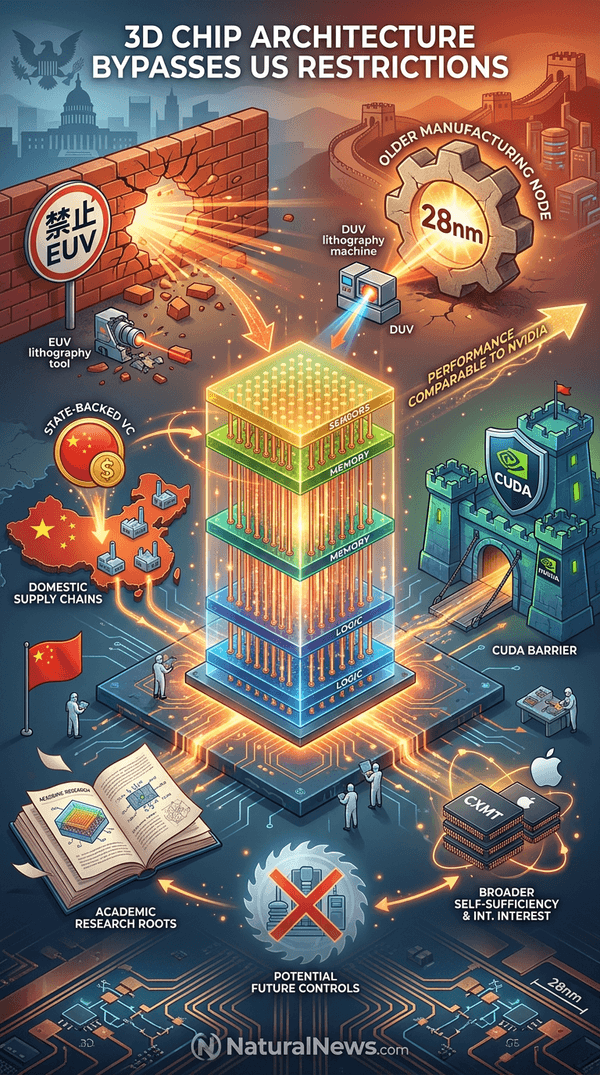
Chinese startup Dongfang Suanxin has announced a new chip design using a three-dimensional architecture that company officials say can compete with Nvidia's artificial intelligence (AI) processors while employing older, unrestricted manufacturing nodes.
The development comes as Washington has tightened export controls on advanced semiconductor technology to China, according to government statements. Company representatives stated that the chip is being developed entirely within China using domestic supply chains, and that the 3D stacking method increases performance without requiring leading-edge lithography. The announcement adds to a series of Chinese efforts to reduce dependence on foreign chip suppliers, including DeepSeek's recent move to develop its own in-house AI chip [1].
Background: U.S. Export Controls on Chip Technology
The U.S. Department of Commerce imposed restrictions in 2022 and 2023 on exports of advanced chips and chip-making equipment to China, officials said. Those curbs specifically targeted Nvidia's A100 and H100 AI chips as well as the tools needed to manufacture them. According to a report by Bloomberg covered by TechCrunch, U.S. Commerce Secretary Howard Lutnick has expressed concern that one of ASML's extreme ultraviolet lithography machines may have ended up in China, which would represent a major breach of export controls [2].
Chinese chip firms have been seeking alternative designs and manufacturing methods, industry analysts said. ChangXin Memory Technologies, a Chinese memory-chip maker, has advanced to the point of attracting interest from companies like Apple Inc., but its growth has made it a more prominent target in the technology confrontation between Washington and Beijing [3]. The pattern of restriction and response has driven innovation in chip architecture among Chinese companies.
The Dongfang Suanxin 3D Chip Design
Dongfang Suanxin's approach stacks multiple layers of logic and memory vertically, a method the company says increases performance without requiring leading-edge lithography. The design uses what the company calls "3D heterogeneous integration" to combine different types of chips in a single package. According to a technical white paper released by the startup, the architecture can achieve throughput comparable to Nvidia's current generation chips while using older, unrestricted manufacturing nodes.
The concept of three-dimensional chip architecture is not new in semiconductor research. Studies on 3D silicon detectors have demonstrated the viability of stacking layers to improve performance and spatial resolution [4].
By leveraging such methods, Dongfang Suanxin aims to sidestep the need for extreme ultraviolet lithography tools that are restricted for sale to China. The company stated that its design is fully producible using equipment available within the country.
Company Plans and Commercial Viability
The startup aims to begin sampling the chip to select customers by the end of 2024, according to a company statement. Dongfang Suanxin has secured funding from a state-backed venture capital fund, the statement added, though the amount was not disclosed. Historically, many semiconductor startups have emerged as fabless design houses, outsourcing manufacturing to contract chipmakers, a model that has allowed new entrants to compete in specific niches [5].
Analysts quoted in the report noted that while the 3D approach may close some performance gaps, software ecosystem compatibility remains a significant barrier. The chip will need to run AI models efficiently, and much of that optimization depends on software frameworks. The company said it is developing its own compiler and driver stack to support common AI workloads.
Challenges and Broader Implications
Experts cautioned that Nvidia's dominant CUDA software platform gives it a substantial lead in AI applications, regardless of hardware capabilities. Nvidia's market position has been reinforced by surging demand for AI infrastructure, with the company's quarterly revenue reaching $57.01 billion in the third quarter of 2025, a 62% increase year-over-year [6]. Nvidia CEO Jensen Huang has warned that China could surpass the U.S. in the AI race due to energy costs and regulatory burdens, rather than hardware alone [7].
The U.S. government has indicated it may expand export controls to cover 3D stacking equipment if deemed a national security risk, according to officials. Dongfang Suanxin's project is one of several Chinese initiatives aiming for self-sufficiency in advanced semiconductors.
China has also begun restricting overseas travel for top AI specialists to prevent brain-drain, according to Bloomberg [8]. These measures reflect the high stakes of the technology competition between the two nations.
Conclusion
Whether the 3D chip can achieve widespread adoption depends on overcoming both technical and geopolitical hurdles, industry observers said. The startup's progress will be closely watched as a test case for China's ability to innovate under export restrictions. The company stated it remains committed to a long-term development path independent of foreign technology.
Other Chinese AI firms are also pursuing vertical integration: DeepSeek is developing its own inference chip to reduce reliance on both Nvidia and Huawei [1]. The aggregate push toward indigenization suggests that, even if individual products fall short, the cumulative effect may reshape the semiconductor landscape over the coming years.
References
- "DeepSeek Developing In-House AI Chip In Bid To Cut Nvidia Reliance". Zero Hedge. July 7, 2026.
- "The US says ASML’s top chip tool may be in China. ASML says it isn’t". TechCrunch. June 19, 2026.
- "China's Memory-Chip Challenger Faces A Test Of How Far US Curbs Can Reach". Zero Hedge. July 13, 2026.
- Elsevier. "The spatial and energy response of a 3d architecture silicon detector measured with a synchrotron X-ray microbeam". Nuclear Instruments and Methods in Physics Research A. 2004.
- Bhide Amar. "The venturesome economy how innovation sustains prosperity in a more connected world".
- "Nvidia’s explosive earnings defy AI bubble worries, fueling market rally". NaturalNews.com. November 21, 2025.
- "Nvidia’s Jensen Huang: China will surpass U.S. in AI race through ENERGY". NaturalNews.com. November 10, 2025.
- "China is increasingly keeping its best AI talent to itself". TechCrunch. May 27, 2026.
- Willow Tohi. "Nvidia Shatters Records as First $5 Trillion Company Amid AI Boom, but Bubble Fears Loom". NaturalNews.com. November 2, 2025.
- "Elektor 2020-07-08".
Explainer Infographic






Please contact us for more information.