


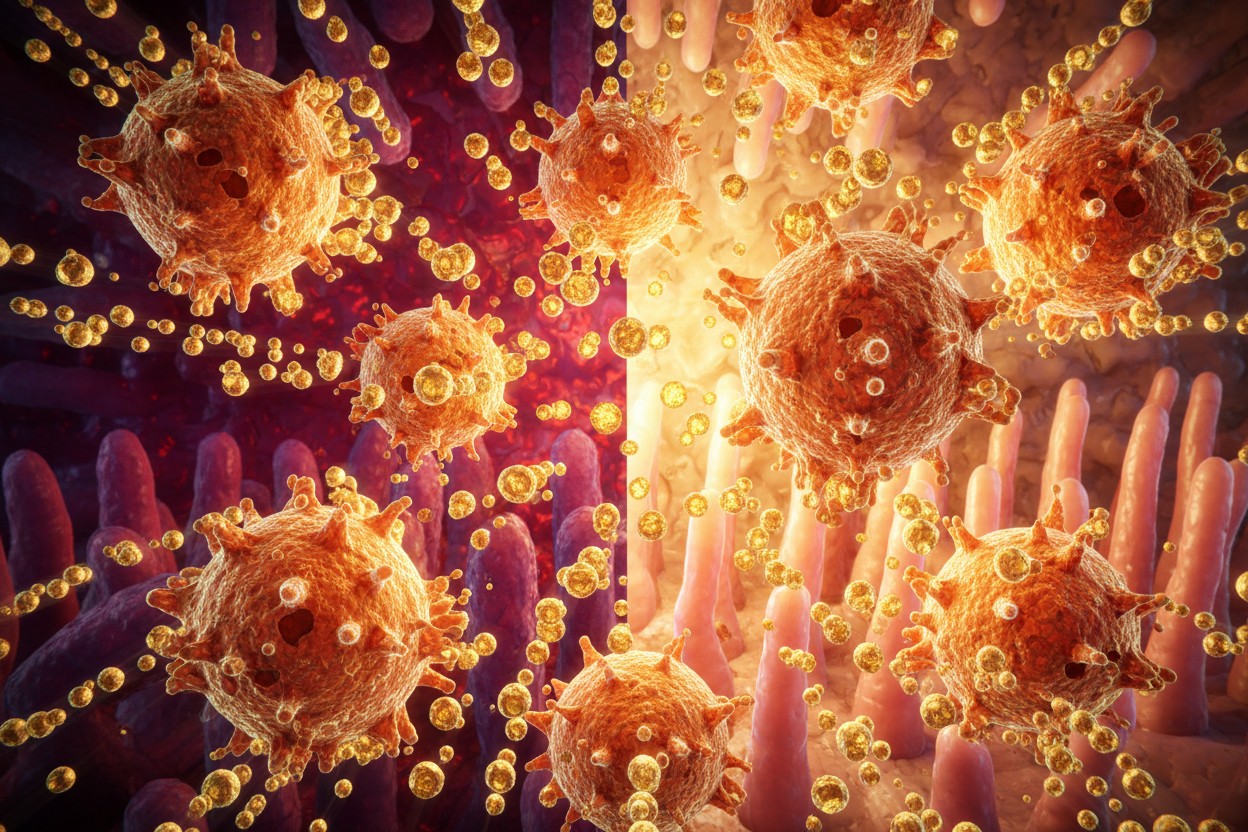
Just seven daily doses of a nano-formulated curcumin preparation reduced shedding of the Cyclospora cayetanensis parasite by 97.2% and eliminated detectable parasites from intestinal tissue of infected mice, according to a peer-reviewed animal study published in Parasitologists United Journal.
The study compared nano-curcumin, regular curcumin and the standard antibiotic Bactrim in mice deliberately infected with C. cayetanensis, the microscopic parasite responsible for a multistate outbreak in the United States. As of July 9, 2026, the Centers for Disease Control and Prevention had confirmed 843 domestically acquired cases across 31 states, including 86 hospitalizations. Multiple outbreaks remain under investigation, and the contaminated food sources have not yet been identified.
Researchers reported that no recurrence of infection was observed after nano-curcumin treatment, unlike with Bactrim or regular curcumin, where low-level shedding persisted or the infection returned after treatment withdrawal. "Controlled human trials are now needed to determine whether these striking results can be reproduced in people," the study authors stated.
Study Methodology and Treatment Groups
Mice were experimentally infected with C. cayetanensis and treatment began on day six post-infection, when parasite shedding had started, according to the study. All treatments were administered orally once daily for seven consecutive days.
The study included three treatment groups: nano-curcumin at 2 mg/kg, regular curcumin at 2 mg/kg, and Bactrim (trimethoprim-sulfamethoxazole) at 5 mg/kg trimethoprim plus 25 mg/kg sulfamethoxazole. A group of infected mice receiving no treatment served as the control.
Mice were monitored through day 30 of the study, more than two weeks after the last dose, to assess parasite shedding levels, intestinal tissue damage, and infection relapse. Researchers tracked oocyst counts in stool and examined intestinal tissue using histological staining and scanning electron microscopy.
Results: Nano-Curcumin Showed Strongest Parasite Reduction and Prevented Relapse
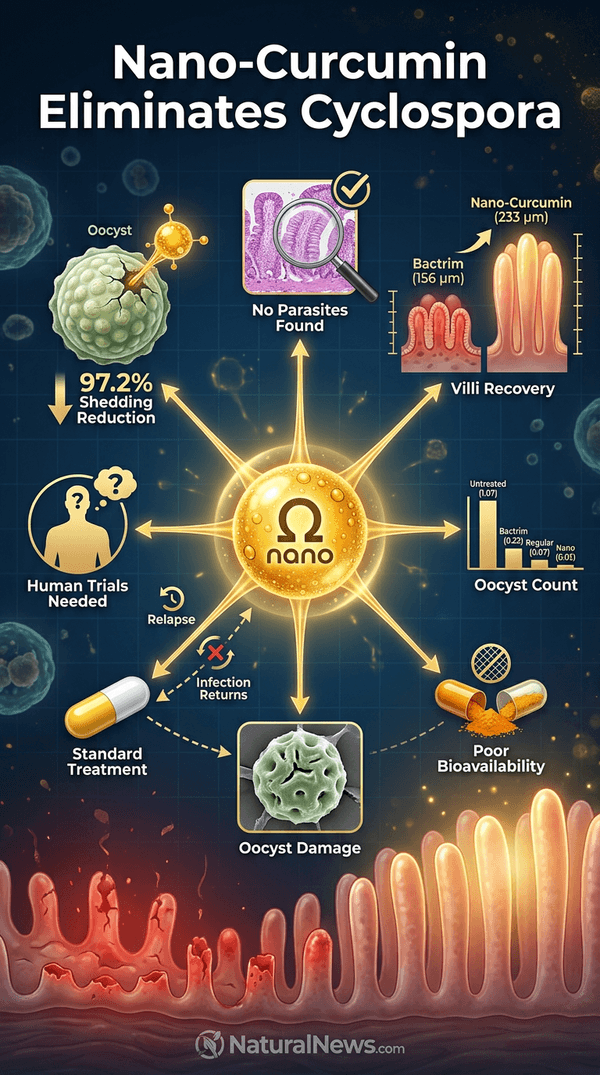
By the end of the seven-day treatment, parasite oocyst shedding had fallen by 84% with nano-curcumin, 77.3% with Bactrim, and 73.3% with regular curcumin. At day 30, more than two weeks after treatment ended, shedding reduction reached 97.2% for nano-curcumin, 93.5% for regular curcumin, and 79.4% for Bactrim. Untreated control mice showed persistent and increasing shedding throughout the study period.
Mean stool oocyst counts at day 30 were 1.07 in untreated infected mice, compared with 0.22 in the Bactrim group, 0.07 with regular curcumin, and just 0.03 with nano-curcumin. All three treatments significantly reduced shedding compared with the untreated control according to the study.
Crucially, no parasites were detected in intestinal tissue of nano-curcumin-treated mice using standard histological staining, and no relapse occurred after treatment withdrawal. The authors stated that the infection appeared to have been eliminated in that group. Meanwhile, some low-level shedding remained in the regular curcumin group and Bactrim group, and rebound infection occurred after treatment stopped in those groups.
Mechanism: Curcumin Damages Parasite Structure and Restores Intestinal Tissue
Scanning electron microscopy revealed that curcumin treatment caused structural damage to Cyclospora oocysts, according to the study. Untreated oocysts had smooth, regular outer surfaces, while curcumin-treated oocysts showed dimples, protrusions and surface irregularities. Nano-curcumin produced even more dramatic changes, including enlargement or shrinkage, deep furrows, pores, perforations, and rough surface damage.
The intestinal findings were equally striking. Untreated infection caused shortened and blunted villi, epithelial erosion, inflammation, and progressive destruction of the absorptive intestinal surface. Both Bactrim and regular curcumin improved intestinal tissue, but nano-curcumin produced the greatest recovery, according to the researchers.
Mean intestinal villous length was approximately 126 micrometers in untreated infected mice, 156 micrometers with Bactrim, 190 micrometers with regular curcumin and 233 micrometers with nano-curcumin. In the nano-curcumin group, the intestinal surface remained intact, inflammation declined markedly, and villous length returned toward normal.
Implications and Need for Human Trials
Curcumin, the major biologically active polyphenolic compound in turmeric, has demonstrated antiparasitic, anti-inflammatory and antioxidant properties, but historically its therapeutic use has been limited by poor water solubility and low bioavailability [1]. Nano-curcumin is formulated in oil-based droplets of 30 to 40 nanometers to improve delivery and absorption. Such nano-formulations have been shown to enhance bioavailability in animal models [2].
The study demonstrated that regular curcumin also showed strong activity against Cyclospora, suggesting that curcumin itself has intrinsic antiparasitic properties. The improved results with nano-curcumin indicate that drug delivery technology may be key to maximizing the compound's effect, according to the authors.
Bactrim remains the standard treatment for human cyclosporiasis because it has direct clinical evidence in infected patients. Human clinical trials have shown that TMP-SMX successfully treats cyclosporiasis and can shorten average parasite shedding. Curcumin and nano-curcumin have not yet been tested in human patients with cyclosporiasis.
The authors noted that curcumin is generally considered non-toxic even at high doses [3], and their evidence for this infection currently comes from this animal study. "Controlled human trials are now needed to determine whether these striking results can be reproduced in people," the authors stated.
Conclusion
The findings provide evidence that nano-curcumin, a natural compound derived from turmeric, can eliminate Cyclospora infection in mice and restore damaged intestinal tissue without relapse. The study adds to a growing body of research on curcumin's therapeutic potential, which has also been examined for conditions including non-alcoholic fatty liver disease [4] and Alzheimer's disease [5].
While the results are striking, the authors emphasized that human trials are required before any conclusions can be drawn about efficacy in people. For now, the study suggests that curcumin-based preparations, particularly nano-formulations, warrant further investigation as potential natural alternatives to pharmaceutical treatments for parasitic intestinal infections.
References
- Mercola.com. "Curcumin COVID 19 Studies". September 13, 2021.
- LaTeX with hyperref package. "Curcumin in Health and Disease".
- Jun SasakiMasaki Kichida. "Curcumin Biosynthesis Medicinal Uses and Health Benefits".
- NaturalNews.com. "Curcumin improves symptoms of NAFLD and obesity". August 13, 2019.
- Joseph Jebelli. "In Pursuit of Memory The Fight Against Alzheimers".
Explainer Infographic










Please contact us for more information.