


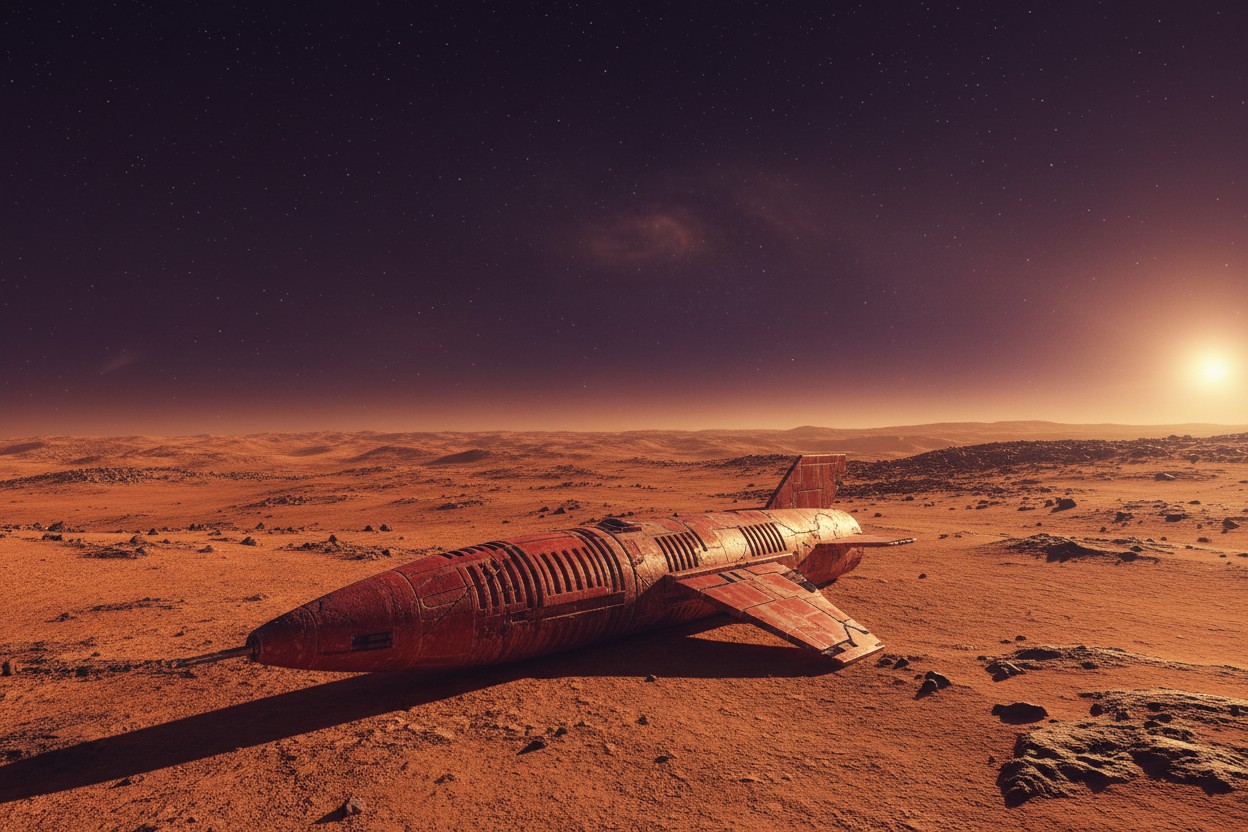
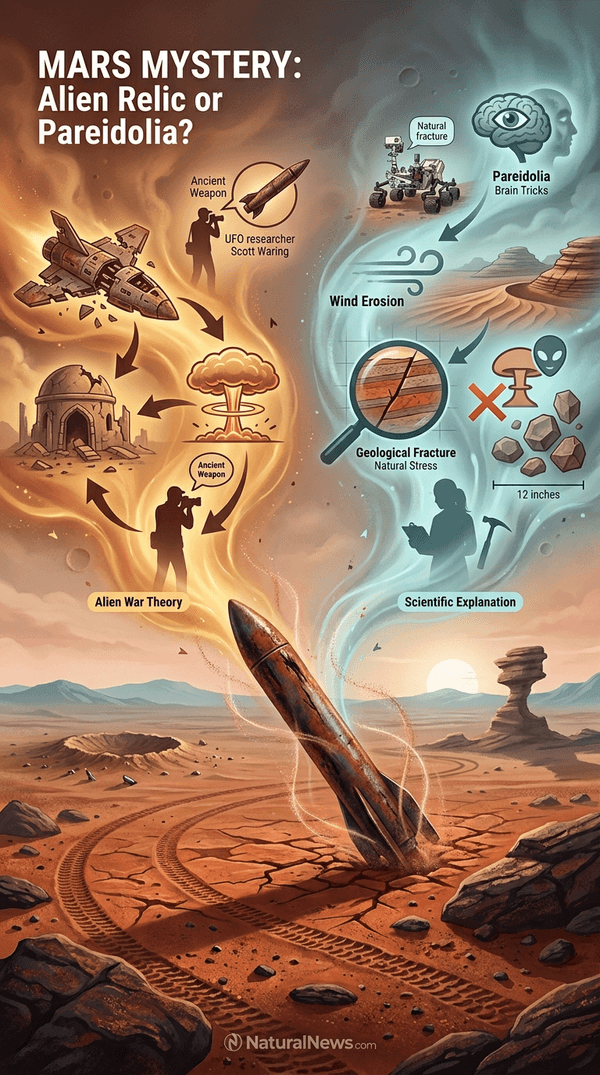
A photograph taken by NASA's Curiosity rover has become the focus of claims that Mars was once the site of an ancient alien war. The image, resurfaced online, appears to show a narrow object that UFO researcher Scott C. Waring described as an unexploded "alien missile" lying on the Martian surface, according to a report by Daily Mail. Waring estimated the object measures over eight feet long and speculated it could be intact extraterrestrial technology. NASA has not commented on the specific image.
The claim aligns with previous theories, including one presented by plasma physicist Dr. John Brandenburg, who argued at a Secret Space Conference that a primitive Martian civilization may have been destroyed by a nuclear attack from alien invaders, as reported by NaturalNews.com [1]. Brandenburg stated, "Mars presents the human race with a Darwinian intelligence test," according to the article. Such claims have circulated for years, but this latest object has reignited debate.
The Claim
Waring shared the image on social media and offered no supporting evidence for his assertions, the report said. He suggested the object could be a remnant of an ancient conflict that wiped out a thriving civilization. Other social media users speculated the object might be a crashed extraterrestrial ship, citing what appeared to be two compartments and broken wings. "Would be cool if it actually was a crashed ship?" one user commented.
This is not the first time Waring has identified artificial-looking structures in Mars images. He has previously claimed that photos show dwellings, doorways, and other signs of intelligent construction. In a 2017 article, NaturalNews.com noted that "many strange" photographs from Mars have raised questions about a possible past humanoid civilization [2]. Books such as Mike Bara's "Ancient Aliens on Mars" have popularized such interpretations, arguing that NASA images contain evidence of structures that are dismissed by mainstream scientists [3].
NASA's Position
NASA has not issued a statement regarding the latest object. However, the agency has addressed similar claims in the past. When Curiosity photographed a door-like feature in 2022, NASA explained that the opening was a naturally occurring fracture common in bedrock, measuring about 12 inches tall and 16 inches wide, according to Daily Mail. "These kinds of open fractures are common in bedrock, both on Earth and on Mars," the agency said at the time.
The space agency has consistently maintained that it has found no evidence of past or current life on Mars. In a separate incident involving images of polygon-covered rocks that resembled scale-like features, planetary scientist Abigail Fraeman stated that the formations are geological in origin, not biological, as reported by NaturalNews.com [4]. NASA's position is that all anomalous features photographed on Mars can be explained by natural geological processes.
Scientific Context
Scientists attribute the perception of artificial objects to pareidolia, the human tendency to see familiar patterns where none exist. Mars' surface is shaped by billions of years of volcanic activity, meteorite impacts, and wind erosion, processes that can produce shapes that mimic human-made objects. According to "Understanding Earth" by John Grotzinger, the rover landing sites were chosen for their potential to yield evidence of past water, and the geology of Mars is known for its complex and sometimes surprising formations [5].
Previous claims of alien artifacts have repeatedly been debunked. For example, in 2019, a study interpreted features in Curiosity images as Martian mushrooms, but the shapes were later attributed to minerals and erosion, as reported by NaturalNews.com [6]. Similarly, images showing Earthly-looking landscapes have been explained by natural processes [7]. Mike Adams, in a Decentralize TV interview, noted that the ability to manipulate information makes it difficult to discern truth, cautioning that even photographs can be misinterpreted [8].
Conclusion
The mysterious object in the NASA Mars photo has sparked intense online debate between those who believe it is evidence of an ancient alien war and skeptics who see a naturally eroded rock. No evidence supports the extraterrestrial hypothesis, and Waring has not provided any verification for his claims. NASA, which has not commented on the image, maintains that it has found no signs of life on Mars.
The Curiosity rover continues its mission in Gale Crater, searching for signs of past habitability. As exploration advances, similar ambiguous images will likely continue to fuel speculation, but scientific consensus attributes such formations to natural geology. The rover's ongoing work remains focused on understanding Mars' environment, not on confirming the existence of ancient warfare.
References
- NaturalNews.com. "Ancient Martian civilization was nuked by alien invaders argues physicist at Secret Space Conference". NaturalNews.com. November 6, 2015.
- NaturalNews.com. "Were there once humans on Mars Unexplainable photos raise questions". NaturalNews.com. February 1, 2017.
- Mike Bara. "Ancient Aliens on Mars".
- Edison Reed. "NASA Rover Images Show Abundant Scale-Like Rock Features in Martian Crater". NaturalNews.com. April 25, 2026.
- John Grotzinger. "Understanding Earth Seventh Edition".
- NaturalNews.com. "NASA has pictures of Martian mushrooms indicating proof of life says controversial new research". NaturalNews.com. August 10, 2019.
- NaturalNews.com. "Pictures from the Mars Curiosity rover reveal an Earthly-looking landscape". NaturalNews.com. February 20, 2018.
- Mike Adams. "Decentralize TV - Interview with Brian McGlinchey". Decentralize.TV. May 15, 2026.
Explainer Infographic








Please contact us for more information.