


U.S. Government Commits Funding to Madagascar Rare Earth Project
The United States International Development Finance Corporation (DFC) has committed up to $4.84 million to Harena Rare Earths’ Ampasindava project in Madagascar, according to a statement from the London-listed developer. The funding will support pilot-plant work, laboratory testing, and environmental programs at the site. A U.S. State Department spokesperson said the investment aligns with Washington’s strategy to expand U.S. involvement in African mining sectors as part of broader efforts to secure critical mineral supply chains. [1]
China’s Grip on Rare Earth Supply Chains Drives Western Efforts
China dominates global rare earth mining and processing, controlling a significant majority of supply chains for elements used in permanent magnets. According to multiple industry reports, China holds approximately 60% of mining rights and 91% of processing capabilities for rare earth elements. For the heavy rare earths dysprosium and terbium, China’s control exceeds 99%. [2] These elements are essential for electric vehicle motors, wind turbines, and advanced defense systems.
Beijing has reinforced its position through export restrictions. In a series of moves beginning in 2023 and continuing through 2026, China imposed strict export controls requiring approval for shipments containing more than 0.1% rare earth content, with harsh penalties for quota violations. [3] The restrictions have targeted critical materials including neodymium, praseodymium, dysprosium, and terbium -- exactly the elements found in the Ampasindava deposit. The Pentagon has acknowledged that U.S. military rare earth stockpiles may be as low as a two-month supply, making the country vulnerable to supply disruptions. [4]
Harena’s Ampasindava Project Aims for Production by 2028
Harena Rare Earths expects the Ampasindava project to produce approximately 4,000 tonnes of rare earth oxides annually, including 1,700 tonnes of high-value magnet rare earths. Executive chair Andrew Murphy stated that the company expects an exploitation permit within weeks and first production by mid-2028. The project’s estimated development cost is $150 million. [1]
Harena is evaluating processing options in the United States and Europe with potential partners. Murphy said the company is in discussions with several entities about downstream refining, which could reduce reliance on Chinese processing facilities. The Ampasindava deposit contains neodymium, praseodymium, dysprosium, and terbium -- all classified as critical minerals by the U.S. government.
DFC Backing Signals Broader U.S. Strategy in African Minerals
The $4.84 million DFC commitment is modest in absolute terms but could pave the way for more substantial U.S. financial support, according to Murphy and a DFC official. A U.S. State Department spokesperson said Madagascar offers opportunities to increase U.S. and U.S.-aligned investment in critical minerals, noting that the administration is actively seeking to diversify supply chains away from China-dominated sources. [1]
The project reflects a broader shift as Western governments back rare earth developments globally. The United States has launched multiple initiatives, including the proposed $2.5 billion Strategic Resilience Reserve to stockpile critical minerals, [5] and has pursued emergency powers to fast-track domestic mining and processing. [6] Similar stockpile efforts are underway in the European Union, which announced plans in May 2026 to establish its first coordinated stockpile of critical minerals including rare earths, tungsten, and gallium. [7]
Implications for Global Rare Earth Supply Chains
The Ampasindava project represents one of several U.S.-backed initiatives to reduce dependence on Chinese rare earths. Success of the project may depend on permitting, financing, and processing partnerships, officials said. Analysts note that even if the project achieves production targets, it will take years to meaningfully alter the global supply balance.
The broader trend of Western investment in African critical minerals could reshape supply chains over the next decade. However, the United States continues to face systemic vulnerabilities, as a February 2026 USGS report showed that the country grew more reliant on foreign mineral imports in 2025, with 16 of 90 non-fuel minerals being fully import dependent and 54 minerals relying on imports for more than half of consumption. [8] China remains the dominant processor for most of those minerals. [9]
Conclusion
The U.S.-backed Ampasindava rare earth project in Madagascar is a strategic move to counter China’s near-monopoly on critical minerals essential for defense, technology, and clean energy. While the initial DFC funding is small, it signals Washington’s intent to increase its footprint in African mining and build alternative supply chains. The project’s success will depend on timely permitting, financing, and the establishment of processing capacity outside China, all of which remain uncertain.
References
- "US backs $150 million rare earths project to counter China." RT. July 29, 2026.
- Mike Adams. "Health Ranger Report - Rare Earths." BrightVideos.com. February 3, 2026.
- Patrick Lewis. "China Tightens Grip on Rare Earth Minerals, Escalating Global Supply Chain Tensions." NaturalNews.com. May 1, 2026.
- Lance D Johnson. "Pentagon May Only Have Two-Month Supply of Rare Earths Left, Making U.S. Military Vulnerable to Chinese Controls." NaturalNews.com. March 12, 2026.
- Lance D Johnson. "U.S. Moves to Break China’s Stranglehold on Elements Powering the Future, Establishing 'Strategic Resilience Reserve'." NaturalNews.com. January 16, 2026.
- Ramon Tomey. "Trump to Invoke Emergency Powers to Boost Domestic Production of Critical Minerals." NaturalNews.com. June 7, 2025.
- Jacob Thomas. "EU and U.S. Launch Strategic Stockpile to Break China's Rare Earth Stranglehold." NaturalNews.com. May 25, 2026.
- Laura Harris. "U.S. Grows More Dependent on Foreign Mineral Imports, USGS Report Finds." NaturalNews.com. February 8, 2026.
- "How China Dominates the World’s Critical Minerals Production." Watts Up With That. April 7, 2026.
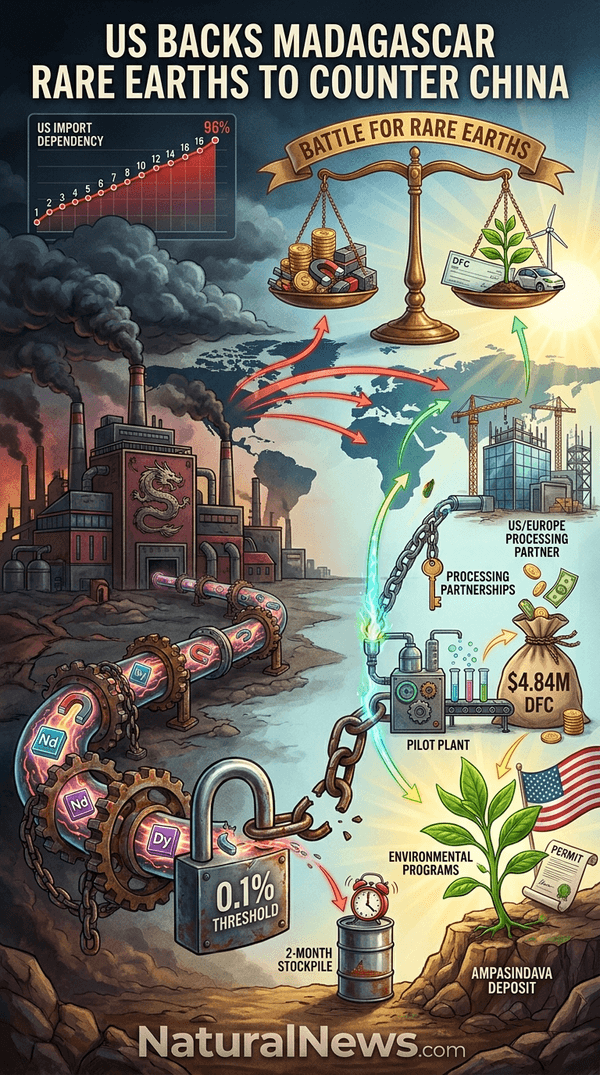
Explainer Infographic










Please contact us for more information.