


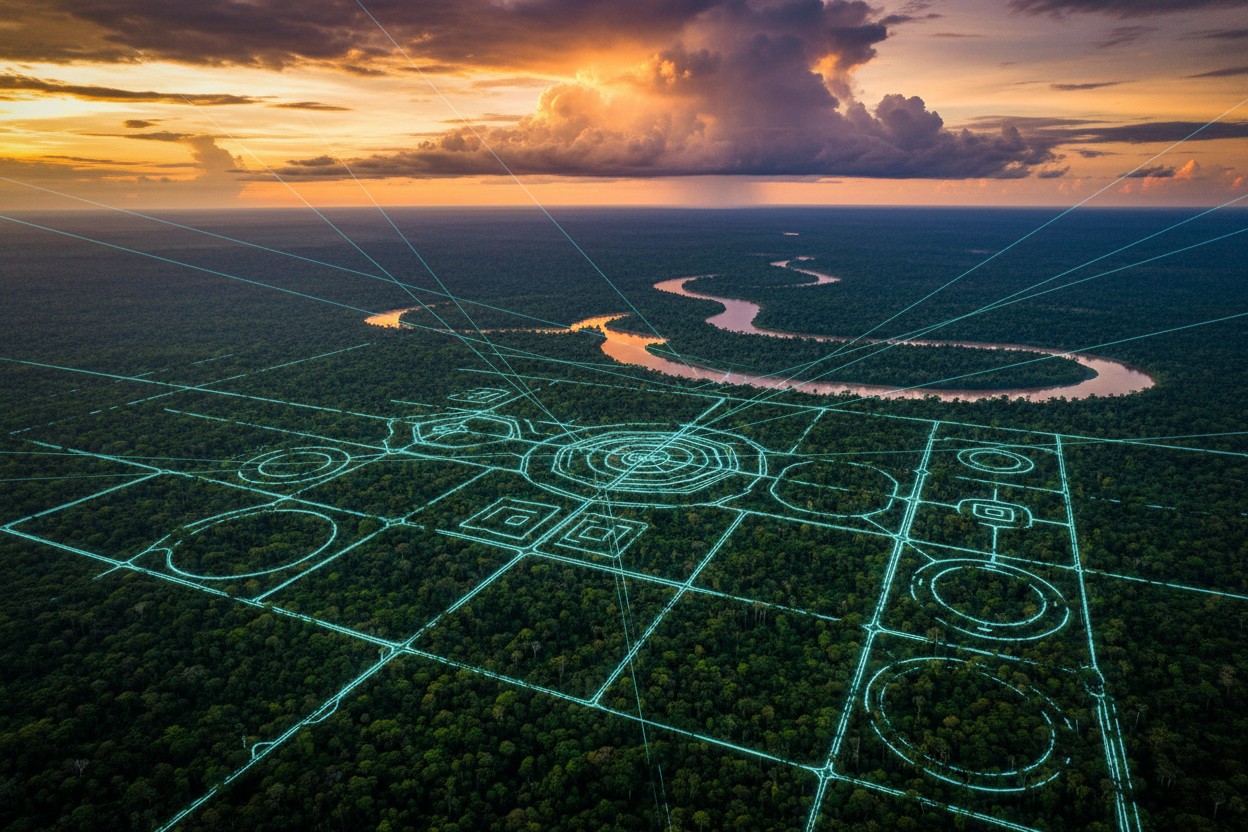
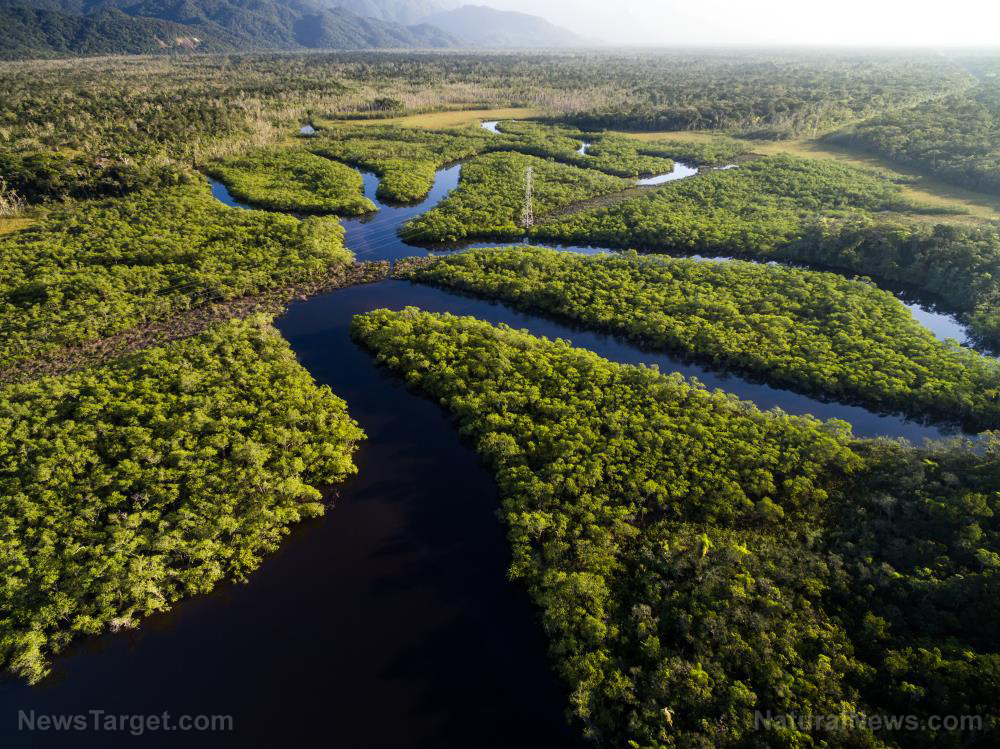
Laser scans of the southwestern Amazon have revealed nearly 400 previously unknown earthworks hidden beneath the rainforest canopy, according to a study led by the University of Helsinki and published in the journal Nature. The findings indicate that the region, in what is now the Brazilian state of Acre, was home to a large pre-Columbian population that researchers have named the Aquiry civilization.
The research team used computer modeling to estimate that about 20,000 earthworks may exist across an area of roughly 400,000 square kilometers. According to the study, the region was home to an estimated 1.25 million to three million people during the first millennium AD. The results were reported in late July 2026.
Study Finds Evidence of Large Pre-Columbian Population in Amazon
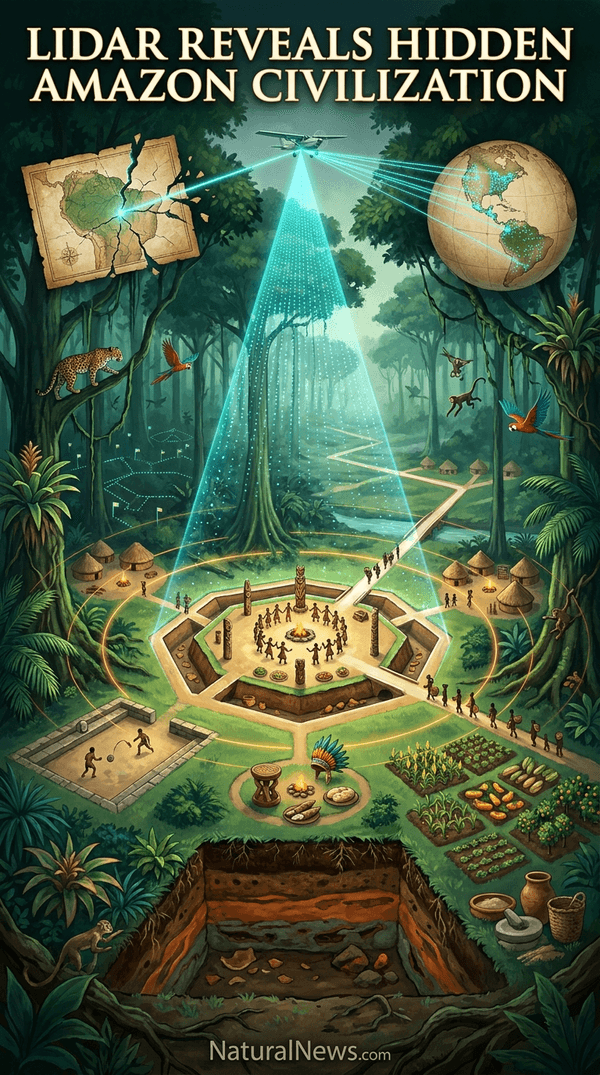
The study identified the ancient Aquiry civilization as a network of communities rather than a single unified realm, according to the researchers. Its population is estimated to have peaked between AD 100 and 300. Many of the earthworks served as ceremonial and political centers where people gathered for rituals, trade, feasting and ball games, according to native oral traditions cited by the team.
The largest sites were connected by straight roads and causeways, which the researchers said indicated a planned regional network rather than isolated villages scattered through the rainforest. The study's authors wrote that the cultural area documented with LiDAR alone contains as many earthworks as previously estimated for the whole of Amazonia.
Methodology: Laser Scanning Through Dense Forest Canopy
LiDAR, or light detection and ranging, is an airborne laser scanning technique. According to earlier reporting on the technology, LiDAR lasers can penetrate dense vegetation, allowing experts to view underlying structures that would otherwise remain hidden [1]. Similar airborne surveys have uncovered extensive ancient settlement networks in Guatemala, including almost 1,000 settlements spread out across 650 square miles and connected by a vast causeway system, according to a January 2023 report [2].
In Acre, the scans revealed geometric earthworks including circles, squares, rectangles and octagons. According to the research team, builders dug deep ditches and piled excavated earth into raised embankments; some structures measure hundreds of meters across. The researchers used computer modeling based on the scanned sites to estimate the total number of structures likely remaining undiscovered.
Aquiry Civilization and Its Ceremonial Centers
The Aquiry civilization flourished in what is now the Brazilian state of Acre, according to the study. The team reported that the community burned sections of forest to clear land for ceremonial centers and for fields of maize, squash and cassava, and also practiced horticulture and managed valuable tree species while maintaining much of the surrounding rainforest.
Native oral traditions, as cited by the researchers, describe these centers as venues for gatherings, political decision-making and displays of chiefly generosity. Ceremonies included ritual dance, music, feasting, athletic contests and ball games, the study stated.
Implications for Understanding the Amazon's Past
The findings challenge the belief that the Amazon was an untouched wilderness before European contact, the researchers reported. This aligns with the observation by Graham Hancock in his book "America Before" that assumptions about the past cannot be taken for granted; even in Guatemala, a country fifty times smaller than the Amazon, a major archaeological surprise was unveiled in 2018 [4]. LiDAR surveys there, Hancock wrote, turned previous assumptions "on its head" [5].
Elsewhere, LiDAR has revealed a 235-acre Menominee agricultural system in Michigan built between 1000 and 1600 CE, according to a June 2025 report, showing that such methods continue to reshape views of pre-Columbian land use [3]. Professor Martti Pärssinen, lead author of the study, said in a statement: "The research shows that the human impact on the Amazon's environment has been far greater than previously believed."
Open Questions and Calls for Further Research
The researchers noted that it is not known what languages the communities spoke, what they called themselves, or what caused the civilization's apparent collapse around AD 850. Only a small portion of the Amazon has been surveyed with LiDAR, according to the study, leaving the possibility of more undiscovered structures.
The authors wrote in Nature: "On the basis of both existing data and our LiDAR documentation, we show that this cultural area alone contains as many earthworks as previously estimated for the whole of Amazonia." They added that if similar results are found elsewhere in Amazonia, estimates of precolonial population density and its effects on soil, forest structure, biodiversity and climate models should be re-evaluated.
References
- NaturalNews.com. "Check out these 6 ancient civilizations that were hiding in plain sight but never discovered prior to the advent". NaturalNews.com. September 05, 2023.
- NaturalNews.com. "Archaeologists discover ruins of Mayan civilization in Guatemala using LiDAR technology". NaturalNews.com. January 11, 2023.
- Willow Tohi. "Ancient Agricultural Marvel Uncovered in Michigan's Frozen North Rewrites History of Indigenous Ingenuity". NaturalNews.com. June 12, 2025.
- Graham Hancock. "America Before".
- Graham Hancock. "America Before".
Explainer Infographic









Please contact us for more information.