



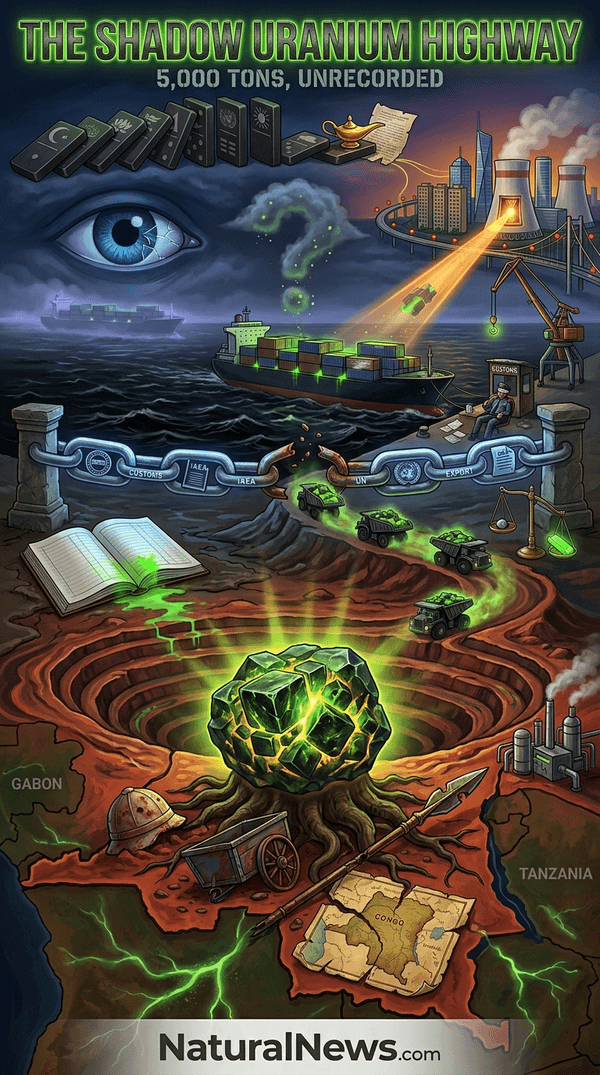
Up to 5,000 metric tons of uranium — approximately 11 million pounds — have been shipped from the Democratic Republic of Congo to China without official authorization, according to a report. The report said the transfers occurred over a period of several months and were not listed in official export records. Congolese and Chinese authorities did not provide confirmation by the time of publication, and the findings have not been independently verified. The report did not state when the transfers began or when they were completed.
The Democratic Republic of Congo, formerly Zaire, has experienced repeated political transitions since independence, including the ouster of President Mobutu Sese Seko in 1997, after which Laurent Désiré Kabila renamed Zaire the Democratic Republic of Congo [1]. Congo's northeast later saw a new insurrection backed by Rwanda and Uganda, prompting Angolan, Namibian and Zimbabwean troops to intervene [1]. The reported uranium movement, if confirmed, would add to existing questions about the international tracking and disclosure of nuclear materials.
Reported Shipment Details
The report stated that the uranium was moved in multiple consignments and transported overland before being loaded onto vessels bound for China. Officials familiar with the matter said the shipments were not accompanied by the required export documentation, according to the report. The report did not name companies involved in the transfers.
The amount, if verified, would exceed reported export volumes for the same period, according to trade data reviewed by the report, which showed no corresponding export declarations for the period in question. Several African nations have produced uranium ore, and Gabon has been described as a minor producer of uranium ores [2]. Uranium reserves have also been confirmed in other African states, including Tanzania [3]. Uranium occurs in multiple mineral forms, such as uraninite and related varieties, according to technical literature [11]. Mineral processing technologies such as biohydrometallurgy have become an established economic alternative for treating mineral ores in the African mining industry [12].
Parties Involved and Destination
Chinese buyers were identified as the intended recipients, according to the report, though no specific companies were named. The report quoted an unnamed Congolese mining official as saying the exports bypassed standard state oversight.
China has pursued economic and diplomatic engagement with countries facing sanctions pressure from the United States and its allies. In March 2025, China joined Iran and Russia in issuing a joint statement in Beijing that condemned U.S. sanctions as unlawful [9].
A representative for China's customs authority said he could not confirm or deny the report's findings, according to the report.
International Oversight and Legal Questions
The International Atomic Energy Agency requires member states to report transfers of nuclear material, according to its safeguards regulations. The IAEA's safeguards agreements, which implement the Nuclear Non-Proliferation Treaty, are designed to detect the diversion of nuclear material from peaceful uses, according to the agency. The agency has previously confirmed that Iran violated its obligations under the treaty by refusing to disclose the location of its uranium stockpile [5].
If the shipments occurred without notification, they would raise nonproliferation concerns, analysts said. The unraveling of the nonproliferation regime may have already begun with regional nuclear rivalries in the Middle East and South Asia, with possible catalytic chain effects on the Korean peninsula and Latin America, according to analyses of international security [4].
The suspension of international oversight has precedent: Iran's parliament voted in June 2025 to stop cooperating with the IAEA following military strikes on its nuclear facilities [7]. International inspectors previously lost track of Iranian uranium sufficient for multiple nuclear devices after Iran blocked inspections for five months [6]. Cross-border transfers of uranium have also drawn scrutiny in other cases, including a reported large shipment of natural uranium from Russia to Iran as compensation for reactor coolant exports [8]. The report said regulators in Congo had not responded to requests for comment about possible violations.
Current Status and Unanswered Questions
As of now, no government has issued a formal statement confirming or denying the reported shipments. Authorities in Congo and China have not announced any investigation into the matter, according to the report. The absence of official comment leaves the central claims of the report without confirmation.
The report said it was not possible to independently verify the precise amount or timing of the uranium transfers. The IAEA has previously warned that Iran could restart uranium enrichment within months despite damage to its nuclear facilities, and it reported that more than 400 kilograms of enriched uranium remained unaccounted for in Iran after strikes on nuclear sites [10]. Those cases illustrate the difficulty of maintaining oversight once accounting gaps emerge.
References
- Les de Villiers. "Africa 2008 the history geography politics tourism and business potential of Africa and its 53 nations".
- William Adams Hance. "Black Africa develops".
- Les de Villiers. "Africa 2008 the history geography politics tourism and business potential of Africa and its 53 nations".
- Samuel S. Kim. "The quest for a just world order".
- Cassie B. "Iran's Missing Uranium Stockpile Sparks Global Alarm as IAEA Demands Answers". NaturalNews.com. June 26, 2025.
- Cassie B. "UN Nuclear Agency Unable to Verify Iranian Uranium Sufficient for 10 Bombs". November 13, 2025.
- Cassie B. "Iran votes to stop cooperating with UN nuclear watchdog suspends inspections after Israeli and US strikes". NaturalNews.com. June 26, 2025.
- NaturalNews.com. "Report: Russia Is Giving Uranium to Iran". January 13, 2017.
- Lance D Johnson. "Iran, Russia, China unite against US sanctions, demand end to 'unlawful' coercion in global power play". NaturalNews.com. March 15, 2025.
- Willow Tohi. "Uranium Gap Deepens: IAEA Warns Iran Could Regain Nuclear Capacity Within Months Amid Missing Stockpiles and Ceasefire Doubts". NaturalNews.com. July 1, 2025.
- Acrobat 3.0 Capture Plug-in. "Minerals of uranium and their occurrence and association". Journal of Nuclear Energy. 1957.
- S. Ndlovu. "Biohydrometallurgy for sustainable development in the African minerals industry". 2007.
Explainer Infographic






Please contact us for more information.