


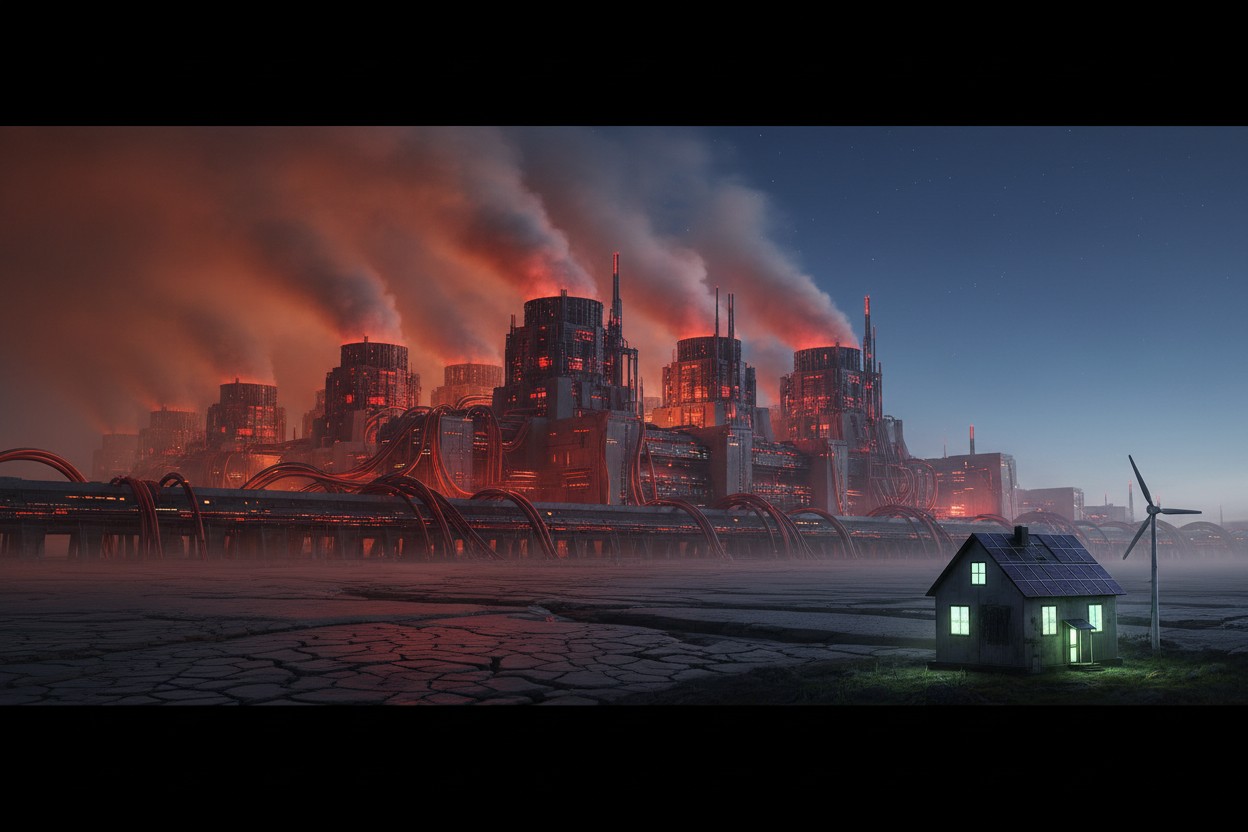
Overwhelmed by Invisible Infrastructure
For years, I sounded alarms about Big Tech surveillance and environmental destruction. I used to be told I was paranoid. Now I have to say it plainly: the AI boom is not just a tech story. The grabbing of land, water and electricity is a physical assault on our lives and our communities. You thought it would be Terminators, but it's actually data centers [1]. From farmland to rivers to the electric grid, hyperscale facilities are taking the very foundations of human survival, built not for progress but for profit and control [2].
Let's look at scale. Data centers currently consume about 4.4 percent of all U.S. electricity, a figure projected to reach 12 percent by 2030, according to industry estimates cited by the White House [3]. OpenAI is demanding 100 gigawatts of new energy capacity per year, equivalent to roughly 80 million households' worth of electricity [4]. In a recent Decentralize.TV conversation, Hakeem Anwar connected the dots on roughly 800 hyperscaler projects and 200 gigawatts of planned demand, and none of us were asked for permission [5]. Even Texas Governor Greg Abbott has ordered a pause on data center approvals pending an audit over grid reliability concerns [6]. Meanwhile, more than 300 cities, towns and counties have enacted bans or moratoriums on hyperscale construction [7].
Here's why this matters: no one voted for this. These facilities are being pushed through by giant corporations while citizens are left to deal with blackouts, higher bills, and stolen resources. We are building a machine that consumes our future, and the clock is ticking.
AI Runs on Water and Heat, Not Just Code
These are not abstract data center clouds. Every "cloud" is concrete, land, cooling towers, and exhaust. The same companies that fund space solar and fusion fantasies are still relying on natural gas to run their AI empires [8]. In Utah, one hyperscale project spanning 40,000 acres will reportedly use more electricity than the entire state [9]. The same installation could consume nearly 17 billion gallons of water per year just for its gas turbines, while expanding the state's CO2 output by up to 75 percent [10].
Mayors across the country are sounding alarms that AI data centers are pushing the U.S. toward blackouts and water shortages [11]. The water story is even worse than the electricity story. The water crisis is not just about annual consumption, it is about peak demand stressing local systems beyond capacity [12]. Handing our most essential resources to an industry that refuses to tell us how much it uses is madness.
Taxpayer Giveaways Are Fueling Our Own Displacement
The worst part is that we are paying for our own displacement. Every promise of jobs and tax revenue is matched by power bills, land disputes, and strain on aging electrical grids that get passed along to ordinary ratepayers while profits flow to hyperscalers [13]. Georgia Power is now preparing to seize 30 homes and 330 parcels of land to build a transmission line that will deliver nearly 10,000 megawatts, with about 80 percent of that capacity dedicated to data centers [14]. That is not progress. That is eminent domain for digital landlords.
The regulatory system has been captured as well. Investigations have found data centers exploiting permitting loopholes after the Supreme Court narrowed Clean Water Act protections, leaving many projects outside EPA jurisdiction or qualifying for streamlined permits with minimal review [15]. The first private data center on public land was approved using a permit intended for a solar project [16]. Meanwhile, the White House's Ratepayer Protection Pledge remains voluntary [17], and the administration is only now trying to force tech companies to cover the electricity, water, and grid infrastructure costs they should have covered all along [18]. Our tax code, our public lands, and our homes have become the bankroll for the AI bubble.
The Answer Is Local Action and Local Compute
Do not wait for Washington to solve this. The zoning hearing is where the fight can be won. Across the country, more than 300 cities, towns and counties have enacted bans or moratoriums on hyperscale construction [7]. New York and Texas are responding to that same pressure [19][6]. This is the democracy the system didn't expect: people reading the plans, questioning the water permits, and holding officials accountable for promised jobs that never arrive. I believe the most important thing you can do is show up at city hall and bring your neighbors with you.
At the same time, we need the technology itself decentralized. Instead of sending every prompt to a hyperscaler that burns through gigawatt-hours of electricity, run local models on hardware you own. Local AI, private phones, and community mapping are not luxuries; they are survival tools. Communities can also build privately funded, islanded off-grid utilities that bypass public utility regulation [20], and peer-reviewed research on decentralized energy planning confirms that locally available resources can anchor a sustainable energy future [21]. The tools already exist. What is missing is our willingness to use them.
Our Future Depends on Reclaiming Resources
This is not an anti-technology argument. I use and build AI tools. But I reject a future where a handful of billionaires get the energy and water while the rest of us are forced to ration electricity. I have been warning that the scarcity spreading across the globe is not an accident or a random market fluctuation; it is engineered [22]. We still have a narrow window to reverse course, but the window is closing [23]. If we do nothing, the controls will tighten. Ohio has already considered a law allowing utility companies to remotely control thermostats in homes during peak periods [24]. That is where this ends if we surrender our resources.
The path forward is to reclaim what is ours locally: produce your own power (if you can), filter your own water, grow your own food, and run your own models. Decentralized systems are more resilient, more honest, and much harder to threaten [21]. Bring your own power [20]. Bring your own compute. Bring your own community. The tech giants are not going to ask permission before they drain our water and our freedom, so we need to stop asking permission to defend our communities. Show up, organize, and decentralize.
Find the full interview with Hakeem Anwar at Decentralize.TV
References
- Mike Adams. Data Centers Are Stealing Your Water, Your Power, and Your Freedom — Here's How to Fight Back. NaturalNews.com. May 26, 2026.
- Mike Adams. Hyperscale Data Centers: Big Tech's War Against Humanity. NaturalNews.com. May 12, 2026.
- Trump Expands Consumer Protections as Data Center Energy Demand Sparks Ratepayer Concerns. NaturalNews.com. July 28, 2026.
- Kevin Hughes. OpenAI Demands 100 GW of New Energy Capacity Per Year. NaturalNews.com. November 1, 2025.
- Decentralize.TV - Episode 134 – Aug 6, 2026 - Hakeem Anwar: Reclaim Tech Privacy with Local AI. Brighteon.com. August 6, 2026.
- Abbott Orders Pause On Texas Data Center Approvals Pending Audit. Zero Hedge. August 5, 2026.
- Poll Finds 58% Oppose Local Data Centers as Issue Reshapes Midterm Campaigns. NaturalNews.com. August 2, 2026.
- Edison Reed. Big Tech Funds Space Solar and Fusion but Relies on Natural Gas for AI Data Centers. NaturalNews.com. May 4, 2026.
- Bright Videos News - Interview with Ben Swann transcript. Mike Adams - BrightVideos.com. May 22, 2026.
- Bright Videos News - CHEMICAL SENSITIVITIES WEAPONIZED FOOD transcript. Mike Adams - BrightVideos.com. May 12, 2026.
- Petra Stone. Mayors Sound Alarm: AI Data Centers Push U.S. Toward Blackouts and Water Shortages. NaturalNews.com. March 18, 2026.
- Chase Codewell. The Water Lie: Data Centers Are Selling Us. NaturalNews.com. May 18, 2026.
- America's AI Boom Forces a Reckoning Over Who Pays the Bill, Who Benefits in the End. NaturalNews.com. July 28, 2026.
- Georgia Power to Seize Homes for AI Data Center Transmission Line. NaturalNews.com. July 31, 2026.
- AI Data Centers Exploit Permitting Loopholes, Investigations Find. NaturalNews.com. July 24, 2026.
- First Private Data Center Approved on Public Land – Democrat Senator Alleges. 100PercentFedUp.com. July 29, 2026.
- Trump Expands Plan to Keep AI Data Centers From Increasing Household Energy Bills. The Epoch Times. July 23, 2026.
- Willow Tohi. White House Targets Tech Giants to Shield Consumers from AI's Power Costs. NaturalNews.com. February 18, 2026.
- Gov. Hochul Responds To Criticism, Explains Rationale For AI Data Center Moratorium. Zero Hedge. July 23, 2026.
- Free-Market Electricity Reform Advancing (Advocates for Consumer Regulated Electricity). Watts Up With That. July 31, 2026.
- Decentralized Energy Planning; Modeling and Application—a Review. Renewable and Sustainable Energy Reviews 11 (2007) 729–752. Elsevier.
- Mike Adams. Resilience Not Fear: Preparing to Thrive Through the Age of Engineered Scarcity. NaturalNews.com. May 28, 2026.
- Chase Codewell. America's Water Future Is Being Sucked Dry by Data Centers—and the Window Is Closing. NaturalNews.com. May 19, 2026.
- Brighteon Broadcast News - SUICIDE WAR. Mike Adams - Brighteon.com. September 8, 2025.
- Trends-Journal-2023-01-05.
- Carol Ann Rinzler. Nutrition for Dummies.
- Mike Adams. Interview with Zach Vorhies. January 3, 2024.
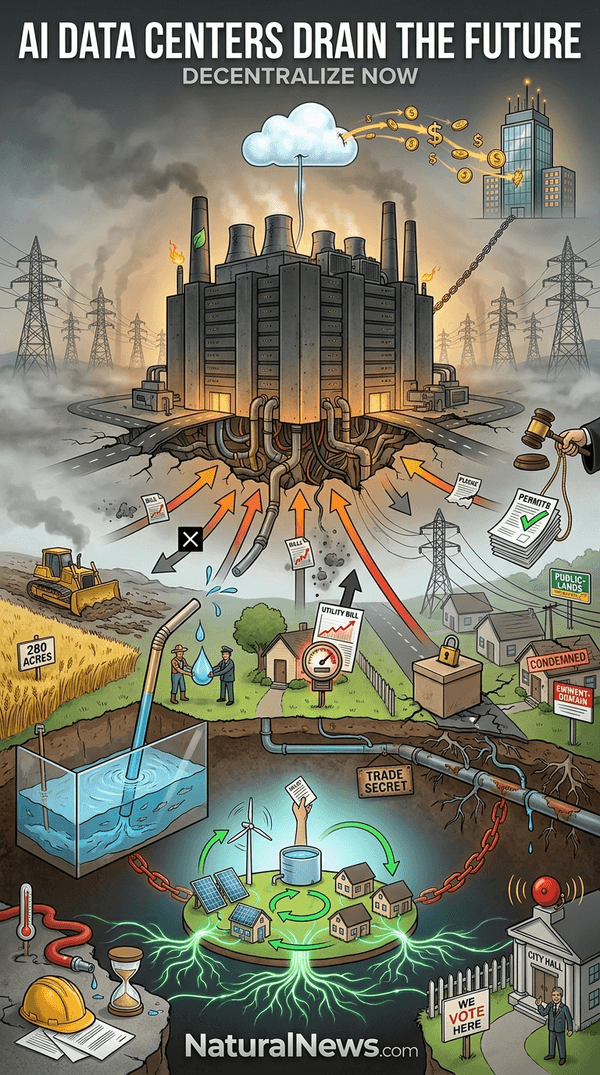
Explainer Infographic







Please contact us for more information.