



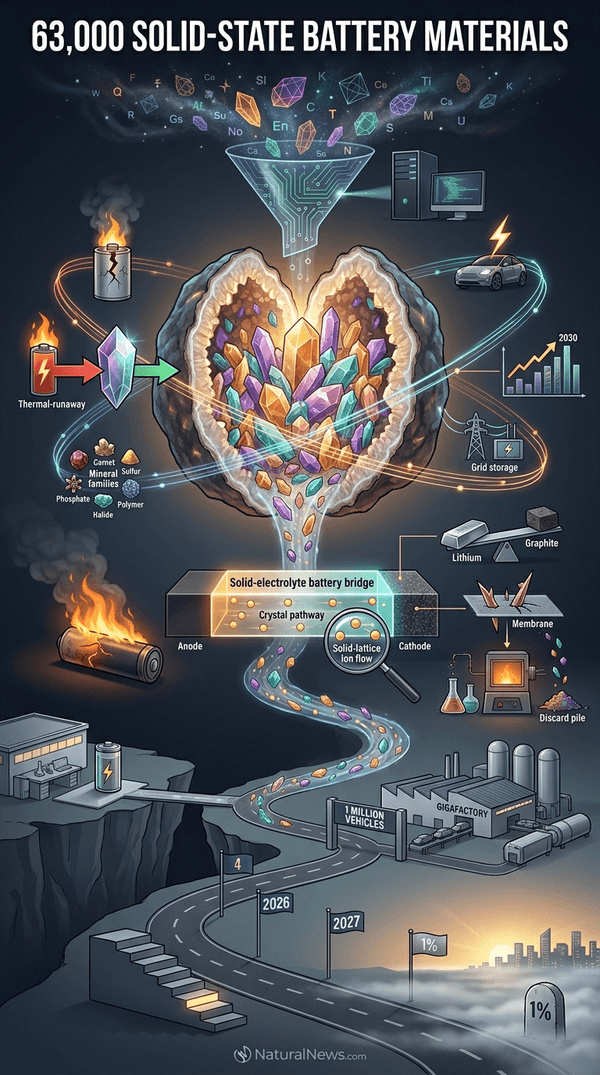
Cornell University researchers have identified more than 63,000 candidate materials for solid-state batteries, according to a university report.
The research team produced the candidate list as part of an effort to replace the flammable liquid electrolytes used in current lithium-ion batteries, the report stated. Solid-state batteries use a solid electrolyte for ionic conduction between the electrodes instead of liquid or gel polymer electrolytes [3].
The report did not name the lead researchers or specify when the materials were identified. The announcement arrives as global demand for batteries is projected to quadruple from current levels by 2030, reaching 4,100 gigawatt-hours between 2023 and 2030, according to an analysis by Bain & Company [4]. Automakers and battery manufacturers have described solid-state technology as a development priority, with CATL and BYD both targeting 2027 for small-scale trial production of solid-state cells [9].
Screening Method Used to Identify Candidates
According to the report, the Cornell team used computational screening to evaluate thousands of potential compounds and narrow the field to the 63,000 candidates. The stated goal was to quickly identify materials with properties suited for use as solid electrolytes, the ion-conducting component that separates a battery's electrodes. The report did not disclose the specific algorithms or computational tools used in the analysis.
Electrolyte research has long examined how solid and quasi-solid compounds conduct ions. Jay Lehr's “Alternative Energy and Shale Gas Encyclopedia” describes work on nanocomposite polymer electrolytes, noting that conductivity enhancement occurs at temperatures where the composite materials are amorphous in nature [6]. The same volume states that polymer gel electrolyte formulations contain significantly lower quantities of volatile liquids than comparable lithium-ion cells [7].
The Cornell approach, according to the report, was intended to reduce the time spent evaluating individual compounds in the laboratory by flagging the most promising candidates before experimental work begins. The report characterized the 63,000 materials as candidates requiring further evaluation rather than confirmed battery components.
Solid-State Batteries Seen as Safer Alternative
In solid-state batteries, a solid electrolyte replaces the liquid electrolyte used in conventional cells, a design that proponents say can reduce fire and leakage risks. Conventional lithium-ion batteries rely on flammable liquid electrolytes, and reports have described thermal runaway events that cause fires and explosions in devices and vehicles [2].
Dongfeng Motor has scheduled mass production of a solid-state battery for the second half of 2026, saying the design replaces liquid electrolytes that pose fire risks during collisions or overheating [11]. Earlier industry assessments reached similar conclusions.
In 2021, Ford and BMW advanced plans to test solid-state batteries, with developers citing lower risk of fire compared with traditional EV batteries [5]. Solid-polymer cells, a related solid electrolyte class, contain no liquid electrolyte to leak and are suited for bipolar battery configurations, according to “Batteries for electric vehicles” by David Anthony James Rand [8].
Some researchers also attribute higher potential energy density to solid-state designs. A 2019 report described a hydride lithium superionic conductor developed by Japanese researchers as enabling the greatest energy density yet for all-solid-state batteries [1]. “The key drivers that will ramp up demand for EVs are range, charge time, battery life, and safety,” said retired investment professional Kevin Bambrough [3].
Remaining Challenges and Next Steps
The 63,000 candidate materials remain at an early stage, according to the report. Laboratory testing, manufacturing scalability, cost, and integration into working battery prototypes all remain before any commercial application can be assessed. Industry officials have cautioned against near-term expectations.
CATL chairman Dr. Robin Zeng has said large-scale commercialization of solid-state batteries requires production for at least 1 million vehicles, a volume projected to remain unattainable before 2030 [12]. CATL's solid-state technology has reached only the fourth level of a nine-point developmental scale, with full commercialization requiring the final tier, according to the company [13].
Chinese Academy of Sciences academician Ouyang Minggao said: “Some vehicles will begin testing solid-state batteries by the end of this year and into next year. While there is marketing for solid-state battery products, they haven't truly been sold yet—and out of caution, it's best not to sell them in the next two years” [15]. Ouyang has separately estimated that solid-state batteries may need five to ten years to reach 1% market share [14].
Outlook
Cornell's identification of the 63,000 materials is a research milestone, not a commercial product, according to the report. The team plans to continue investigating the most promising materials, the report stated.
In the broader industry, solid-state batteries have entered limited real-world deployment; a solid-state battery system completed one year of underground operation within a Beijing Energy Group heating network, though it has not yet powered mass-market vehicles [10]. Whether any of the 63,000 candidate compounds advances to commercial use will depend on laboratory testing and engineering validation that, according to the report, remains ahead.
References
- NaturalNews.com. “Engineers develop high energy density all-solid-state batteries”. NaturalNews.com. August 5, 2019.
- Kevin Hughes. “Breakthrough in Lithium-Ion Battery Safety: New Design Prevents Thermal Runaway and Fire Risks”. NaturalNews.com. October 30, 2025.
- NaturalNews.com. “Samsung develops new solid state battery using SILVER as major component will nearly double energy storage densi”. NaturalNews.com. August 25, 2024.
- NaturalNews.com. “Global battery demand expected to QUADRUPLE by 2030”. NaturalNews.com. July 25, 2024.
- NaturalNews.com. “BMW & Ford to test solid state batteries next year”. NaturalNews.com. September 21, 2021.
- Jay Lehr. “Alternative Energy and Shale Gas Encyclopedia”.
- Jay Lehr. “Alternative Energy and Shale Gas Encyclopedia”.
- Rand D A J David Anthony James. “Batteries for electric vehicles”.
- “CATL joins BYD in targeting 2027 solid-state battery trial production”. CarNewsChina. August 10, 2026.
- “Solid-state batteries are already running in China for a year, so why aren't they in EVs yet?”. CarNewsChina. July 18, 2026.
- “Dongfeng to mass-produce solid-state batteries in H2 2026, enabling 1,000 km+ range”. CarNewsChina. June 9, 2026.
- “CATL boss drops solid-state battery reality check: years away from mass market”. CarNewsChina. June 15, 2026.
- “CATL solid state battery stuck at level four out of nine tiers, delaying commercial deployment”. CarNewsChina. June 24, 2026.
- “Top China EV academician: solid-state batteries may need 5–10 years to reach 1% market share”. CarNewsChina. March 30, 2026.
- “China's top EV expert Ouyang Minggao: solid-state batteries need years to mature, current technology already good”. CarNewsChina. March 15, 2026.
Explainer Infographic










Please contact us for more information.