


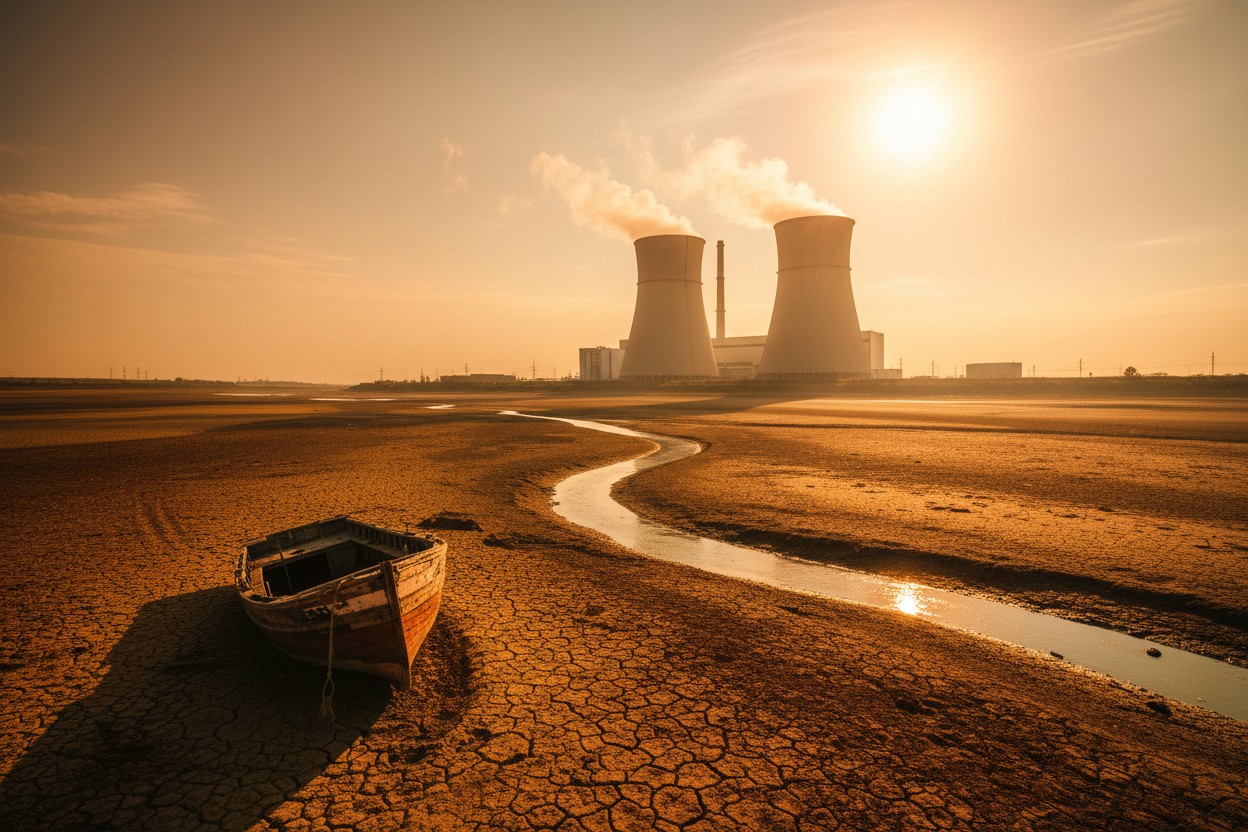
Romania’s only nuclear power plant has been completely shut down after the Danube River fell to record-low levels, state-owned energy company Nuclearelectrica announced Thursday. The Cernavoda plant, which produces about 20% of Romania’s electricity, was disconnected from the power grid after water levels dropped below the threshold required for operation, according to the company [1][2].
The shutdown affects two reactors, each with a capacity of 706 megawatts. BBC News reported that the facility is “not expected to be restarted within the next 10 days” [2]. The Danube is used for cooling the plant, and river water is essential for many European nuclear facilities, making low water levels an increasing constraint on power generation, according to [1].
Background: European Drought and River Levels
A prolonged heatwave and drought across Europe have pushed the Danube and Rhine to historic lows. In recent weeks, water levels in Cologne, Germany, and Lobith, where the Rhine crosses into the Netherlands, were lower than at any point since records began, according to BBC News [3]. The Danube has also fallen to record lows, disrupting river transport and reducing electricity output across several countries [3].
Nuclearelectrica shut down one of Cernavoda’s two reactors in late July as water levels fell, and a second reactor was disconnected this week, according to [1]. The Danube has long been an industrial corridor; factories alongside the river use its water in manufacturing processes [4]. The current drought has forced nuclear plants in Hungary and Romania to scale back operations in what NaturalNews described as a first in either country’s history [5]. Hungary’s Paks plant, also dependent on Danube water, was forced to shut down for the first time, with Prime Minister Péter Magyar warning that the country’s energy supply could become “critical” [6].
Unsuccessful Mitigation Measures
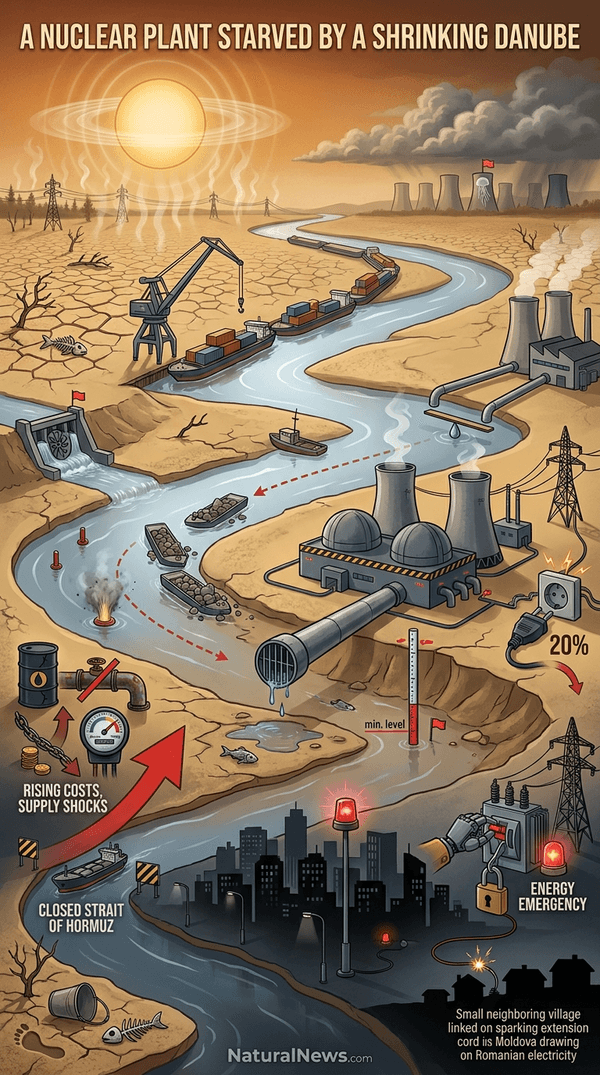
Romanian authorities attempted to increase water flow to the plant last week. Four rock-filled barges were sunk near the Danube’s Bala Canal in an effort to redirect water toward Cernavoda, after the military blasted a channel through the riverbed, according to [1]. The military used nearly 400 pounds of explosives during the operation, according to NTD [7].
Water levels ultimately remained below the threshold required for operation. Company officials said the reactor was disconnected from the power grid once levels fell below operating requirements [1]. BBC News reported that the plant was not expected to restart within the next 10 days [2].
Regional Energy Strain
Bucharest has declared a state of energy emergency for August, according to [1]. The government has asked businesses and households to voluntarily reduce consumption during evening peak hours and has prepared a system to cut power for industrial consumers in stages with prior notice, the report stated [1].
The shutdown has also affected neighboring Moldova, which relies on Romanian electricity for up to 60% of its shortfall [1]. Across the region, Hungary’s Paks plant has cut output, France has reduced nuclear generation because of high river temperatures and low water levels, and a swarm of jellyfish forced the operator of the Gravelines plant to shut down three reactors, according to [1]. The drought has also reduced hydropower output in Italy, and Norwegian reservoirs have fallen to their lowest level in three decades [1]. Renewable energy is not enough to cover the declining hydro and nuclear output across the continent, according to an April 2023 assessment [8].
Energy Security and Market Concerns
Analysts said the reactor cuts and outages could increase electricity import dependence among the bloc’s most vulnerable countries and drive up power prices across the European Union, according to [1]. The disruption deepens an energy crunch that began with the loss of cheap Russian gas following Ukraine-related sanctions on Moscow and has worsened amid the U.S. war on Iran and the de facto closure of the Strait of Hormuz, the report stated [1].
European industry has already been strained by high energy costs. The ongoing energy crisis has caused many of the bloc’s largest industries to cut back on production, increasing the risk of deindustrialization, according to an analysis by NaturalNews.com [9]. Geoeconomic regions are vulnerable to efforts by external powers seeking to sow divisions, and this supply shock compounds existing pressures on the European Union, according to Glenn Diesen [10].
Conclusion
BBC News reported that the Cernavoda plant is not expected to be restarted within the next 10 days [2]. The shutdown follows a summer in which drought has repeatedly disrupted European energy infrastructure.
The Danube, a vital commercial corridor and industrial water source, has fallen low enough to expose sunken warships and constrain nuclear generation [5][4]. The Cernavoda shutdown illustrates how record-low river levels, brought on by prolonged heat and drought, are now affecting the operation of Europe’s energy infrastructure.
References
- “Romania shuts down its only nuclear power plant”. RT. August 14, 2026.
- “Romania shuts its only nuclear plant as Danube water levels drop”. BBC News. August 13, 2026.
- “Rhine falls to record low levels as drought strains Europe’s rivers”. BBC News. August 3, 2026.
- David Cumming. “The Danube”.
- “Record drought drains the Danube, exposing Nazi warships and forcing first-ever nuclear shutdowns”. NaturalNews.com. August 3, 2026.
- “Danube’s record low levels force shutdown of Hungary’s only nuclear plant”. BBC News. July 30, 2026.
- “Romanian Military Uses Explosives in Attempt to Redirect Water Into the Danube”. NTD. August 4, 2026.
- “Renewables NOT ENOUGH to cover Europe’s energy needs”. NaturalNews.com. April 19, 2023.
- “Europe is in a DEINDUSTRIALIZATION SPIRAL due to ongoing energy crisis”. NaturalNews.com. November 8, 2022.
- Glenn Diesen. “Europe as the Western Peninsula of Greater Eurasia Geoeconomic Regions in a Multipolar World”.
Explainer Infographic









Please contact us for more information.