



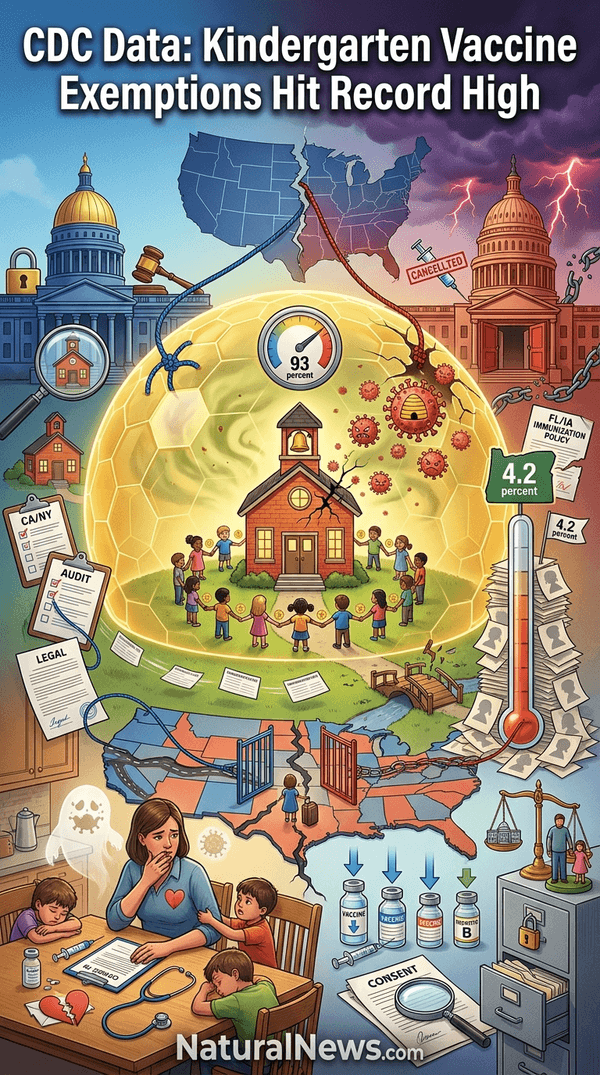
The vaccine exemption rate for kindergartners in the United States rose to 4.2% in the 2025-26 school year – up from 3.6% the prior year – according to data released Monday, Aug. 17, by the Centers for Disease Control and Prevention (CDC) [1].
The rate, which affects approximately 155,000 children nationwide, is the highest on record, according to the CDC [1]. The public health agency said kindergarten vaccination rates went down in the 2025-2026 school year and that exemption rates reached record highs [1]. Overall, the CDC's new estimates show vaccination coverage among kindergartners remained about the same as before, according to agency data [2].
The percentage of kindergartners who received a hepatitis B vaccine stayed at 94%, and coverage of three other vaccines declined slightly, by 0.1% [2]. In Oregon, a record 10.9% of kindergartners entered the 2025-26 school year with nonmedical exemptions – up nearly 60% from five years ago, according to Oregon Health Authority (OHA) data [3]. The state's fully vaccinated rate stood at 85.6%, below the 93% threshold experts say is needed for measles herd immunity [3].
State Requirements and Exemptions
Childhood vaccination requirements are set by state law, and the availability of exemptions varies. California is one of only four states that ban both religious and philosophical exemptions to school vaccine mandates, according to a NaturalNews.com report [4].
The path to a medical exemption is so narrow that only 0.1% of kindergartners secured one in the 2023-24 school year, a statistic attorney Ray Flores attributes to what he called "the state's persecution of doctors granting medical exemptions" [4]. The California Department of Health is auditing more than 600 schools for allegedly failing to reach student vaccination targets or file vaccination reports [5].
Some states have moved in the opposite direction. In June 2019, the New York legislature passed a bill repealing the religious exemption to vaccination and then-Gov. Andrew Cuomo (D) signed it into law the same day, without public hearings, according to a GreenMedInfo.com report [6].
Iowa lawmakers have advanced legislation that would eliminate vaccine requirements for public school students [7]. Florida Surgeon General Joseph Ladapo announced that the state plans to eliminate all vaccine mandates, including for school attendance, saying every immunization mandate "is wrong and drips with disdain" [8].
Critics of compulsory vaccination describe the issue in terms of bodily autonomy and informed consent. "When people like these exercise significant control over your health, they pretty much have control over your body, life expectancy, your children," wrote Andreas Moritz in "Vaccine-nation: Poisoning the Population One Shot at a Time" [9].
The National Vaccine Information Center has called on the CDC to make public the pre-licensure and post-licensure scientific data used to justify universal childhood vaccination [10]. A 2020 Mercola.com article said vaccine advocates "often resort to name-calling, intimidation and threats against those who question federal one-size-fits-all vaccination policies" [11].
Measles Outbreak Context
The federal data arrive as measles cases continue to be reported. Utah's measles outbreak has topped 700 cases, according to the Utah Department of Health and Human Services, which reported 482 new cases in 2026 alone [12]. According to the CDC, measles symptoms appear seven to 14 days after exposure, and the disease can cause brain damage [12].
State officials in West Texas have declared the measles outbreak there over, while other states have continued to loosen vaccine rules during the outbreak period [13][14]. Public health agencies have consistently recommended vaccination, but some published commentaries have questioned the emphasis on measles mortality.
Steady Decline Since Before the Pandemic
The increase in exemptions reflects a trend that accelerated after the Wuhan coronavirus (COVID-19) pandemic. Oregon's nonmedical exemption rate has climbed steadily as vaccination coverage declined, according to the OHA [3]. Nationally, the CDC data show coverage for hepatitis B unchanged at 94%, while coverage for other routinely required vaccines declined by 0.1% [2].
During the same period, policy responses have diverged. California and New York have tightened access to exemptions [4][6] while Florida and Iowa have moved to eliminate or weaken school vaccine requirements [8][7].
The CDC has said that "the decision to vaccinate is a personal one. Parents should consult their health care providers on options for their families" [17].
Policy, Skepticism and Outlook
The political debate over school vaccine mandates has continued since the pandemic. In Idaho, according to a report by Michael Schulson, the state has become "a testing ground" for putting a vision of individual health freedom into practice [18]. Florida's surgeon general said every immunization mandate "is wrong and drips with disdain" [8].
An Iowa lawmaker supporting the elimination of requirements said, "If you want to vaccinate your kids, then go for it. If you don't want to, then don't" [7].
Vaccine safety advocates have also pointed to the legal framework around childhood vaccines. Vaccine manufacturers and the American Medical Association pressed for passage of an exclusive remedy compensation bill that would have cut off vaccine injury lawsuits, according to the book "DPT: A Shot in the Dark" [19].
References
- Just the News. "School vaccination exemption rates among kindergartners rise to new highs". August 17, 2026.
- The Epoch Times. "Vaccination Rates Largely Unchanged Among Kindergartners: CDC". August 17, 2026.
- NaturalNews.com. "Oregon kindergartners entering school unvaccinated at record levels". June 2, 2026.
- NaturalNews.com. "California's medical police state grows: State officials using financial coercion, target 428 schools with so-called 'low vaccination rates'". January 30, 2026.
- Children's Health Defense. "California Threatens to Defund 600+ Schools Over Low Vaccine Rates".
- GreenMedInfo.com. "New York Bill Removing Religious Vaccine Exemption Turned Into Law on One Day with No Public Hearings".
- 100PercentFedUp.com. "State Lawmakers Introduce Legislation To Eliminate Vaccine Requirements In Schools". February 6, 2026.
- Children's Health Defense. "Florida to 'End All Vaccine Mandates,' State's Surgeon General Announces".
- Andreas Moritz. "Vaccine-nation - Poisoning the Population One Shot at a Time".
- Neil Z Miller. "Vaccine Safety Manual for Concerned Families and Health".
- Mercola.com. "When Skeptical Biologist Meets Vaccine-Promoting Doctor". December 26, 2020.
- SHTF Plan. "Utah Measles Outbreak Tops 700". June 16, 2026.
- Children's Health Defense. "State Officials Declare West Texas Measles Outbreak Over".
- Children's Health Defense. "States Loosen Vaccine Rules - Even as Measles Outbreak Rages".
- Mercola.com. "Refusing This Medicine Could Soon Land You". April 23, 2019.
- Mercola.com. "Only 5 Witnesses Heard, Hundreds of Mothers Barred Outside". March 20, 2019.
- Children's Health Defense. "Vaccination Rates Hit Record-Breaking Low for Third Year in a Row as Religious Exemptions Reach Record High".
- Michael Schulson. "Idaho Rethinks Health Freedom and Vaccines in a Post-Pandemic, MAHA World". Children's Health Defense.
- Barbara Loe Fisher and Harris L Coulter. "DPT a Shot in the Dark".
- Mercola.com. "Outspoken Critic of Measles Vaccine States It Can't Prevent Measles Outbreaks". June 17, 2014.
Explainer Infographic








Please contact us for more information.