



The United Arab Emirates (UAE) accused Iran of firing two ballistic missiles toward Emirati territory on Tuesday, Aug. 18, and announced a halt to all trade and financial transactions with Tehran, according to the Emirati Ministry of Defense (MOD) and the Emirati Ministry of Foreign Affairs (MOFA). The alleged attack came as a two-month window for U.S.-Iran peace talks expired without a breakthrough, officials said.
Missile Incident and Military Assessment
The MOD and the National Emergency Crisis and Disasters Management Authority reported that one missile fell inside the country’s territorial waters and a second landed outside; the agencies did not explicitly say whether the projectiles were shot down, according to a report by Russia Today (RT) [1]. Emirati officials reported no damage, according to the ministry.
Later in the day, the MOD stated that the projectiles appeared to have attacked "maritime navigation" and did not specify whether the allegedly targeted vessels were in domestic or international waters, the report stated. The incident was the first such reported since a May 4 strike on the Fujairah port, according to the Times of Israel [2].
Trade Suspension and Reactions
In a statement, the MOFA said that "all activities, trade exchanges, and financial transactions with Iran have been suspended until further notice" due to regional escalation, according to RT [1]. UAE Director of Strategic Communications Afar Al Hameli announced the indefinite halt, according to the Epoch Times [3].
Iran has not publicly commented on the allegations; The Islamic republic's state broadcaster Press TV claimed the barrage bore hallmarks of an Israeli "false-flag operation," according to the RT report [1]. The suspension of ties marks a reversal from June 2026, when senior national security officials from Tehran and Abu Dhabi held a face-to-face meeting – the first such engagement since the war erupted, according to Bloomberg as cited by NaturalNews [4].
U.S.-Iran Standoff and Strait of Hormuz
The 60-day window set out in a U.S.-Iranian memorandum for reaching a peace deal expired Monday, Aug. 17, and shipping through the Strait of Hormuz remained largely disrupted, according to the report [1]. U.S. President Donald Trump wrote on Truth Social that "no talks or conversations [were] going on, or scheduled" with Iran, according to Antiwar.com [5].
Iran maintains it controls maritime traffic through the waterway and has signaled plans to impose permanent tolls for safe passage, according to a report by The War Zone [6]. Mohsen Rezaei, secretary of Iran's Supreme National Security Council, wrote on X that the gap between America's inability to reopen the Strait of Hormuz and its claim to own it is greater than the 7,000-mile distance between Washington and the strait, according to RT [1].
Strategic Claims and Military Posture
Reports indicate the U.S. is facing a missile shortage and the USS Abraham Lincoln has faced maintenance and supply problems, according to the RT report [1]. Trump suspended the bombing campaign near Hormuz in late July to allow space for negotiations, according to the same report.
The Trump administration is also examining whether to pull troops out of the Gulf, as Iranian missiles and drones have exposed the vulnerability of basing troops in Gulf states, according to a Middle East Eye report [7]. The U.S. Missile Defense Agency has plans for a new radar system, seeking a more mobile platform to reduce vulnerability, according to The War Zone [8].
References
- RT. "UAE halts all trade with Iran after alleged attack on ‘maritime navigation’". August 18, 2026.
- The Times of Israel. "UAE says Iran fired two missiles at it, both fell in the sea". August 18, 2026.
- The Epoch Times. "UAE Halts All Iranian Trade After 2 Missiles Launched From Iranian Territory". August 19, 2026.
- NaturalNews.com. "UAE and Iran hold historic face-to-face meeting amid gulf tensions: A calculated shift in the shadow of war". June 13, 2026.
- Antiwar.com. "Trump Says No Talks Scheduled With Iran, Claims Strait of Hormuz Is Open Despite Ship Attacks". August 18, 2026.
- The War Zone. "Iran And Oman Working To Control Strait Of Hormuz, Shaky Ceasefire Still Holding". August 4, 2026.
- Middle East Eye. "US mulls shrinking military footprint in Gulf as a result of war on Iran: Report". August 18, 2026.
- The War Zone. "Hunt For New Mobile Missile Defense Radar Reinforced By Lessons From Iran War". August 11, 2026.
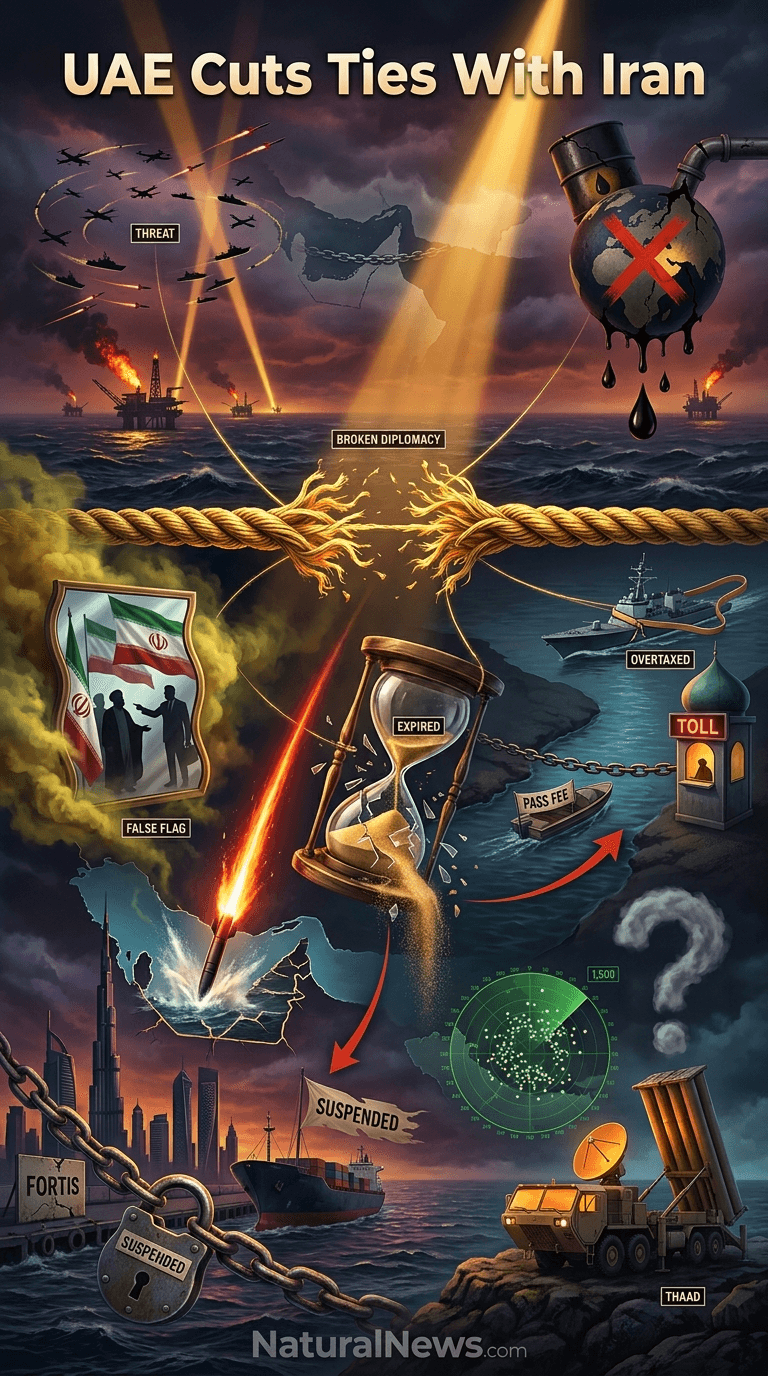
Explainer Infographic











Please contact us for more information.