


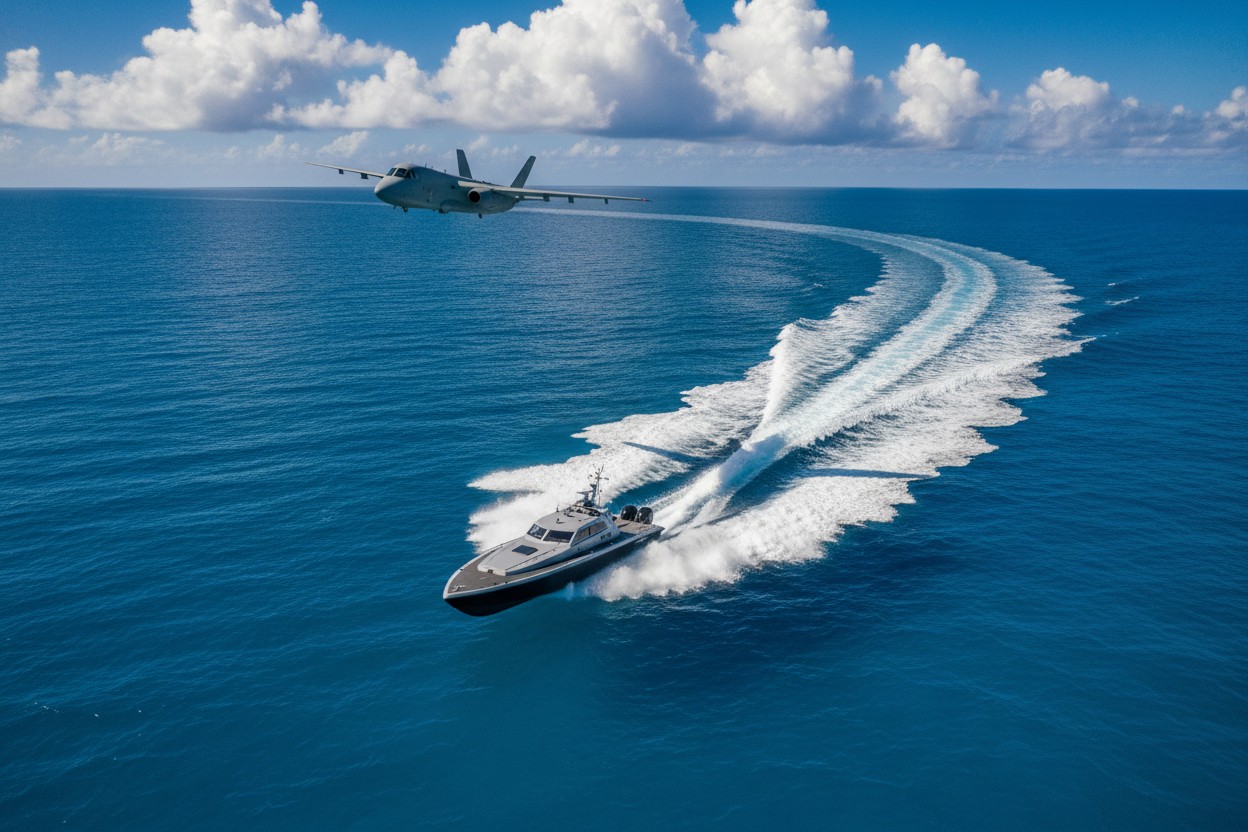
The Department of War (DOW) has released unclassified images of suspected drug-smuggling vessels under U.S. military surveillance and issued a direct warning to traffickers, nearly one year after the first strike in Operation Southern Spear.
The photos from 2025 – dated Oct. 27, Oct. 29 and Dec. 4 – show boats speeding through open water, including at least one vessel carrying apparent narcotics, according to the DOW. "Nearly one year after the first strike, the message to narco-terrorists remains unchanged: if you traffic deadly illicit narcotics and threaten the American people, we hunt you down, we will find you, and we will kill you," War Department Press Secretary Kingsley Wilson said in a statement.
The warning comes as the Trump administration continues to characterize the fight against Latin American cartels as an "armed conflict." The images were released as part of an effort to publicize the military's ongoing interdiction campaign, which has drawn both support and criticism over its legality and transparency.
Operation Southern Spear Statistics and Intent
According to the DOW, Operation Southern Spear has carried out 67 strikes, including the first on Sept. 2, 2025. Wilson said the operation has disrupted trafficking networks, forced traffickers to adapt their methods, and removed "dangerous narcoterrorists." The campaign was formally announced by Secretary of War Pete Hegseth in November 2025, following a series of engagements that had already begun in September [1].
"Operation Southern Spear has disrupted trafficking networks, forced trafficker adaptations, removed dangerous narcoterrorists and demonstrated that the U.S. will use every lawful tool available to defend our Homeland and protect our communities," Wilson said. Critics, however, have raised concerns about the operation's execution.
Human rights organizations have condemned the strikes, and the War Department admitted to Congress that it does not know the identities of at least 61 people killed in the operations [2]. The lack of identification has sparked bipartisan concerns over the legality and conduct of the maritime campaign.
Recent Strikes and Military Statements
On Aug. 25, U.S. Southern Command (SOUTHCOM) reported that four alleged drug smugglers were killed during a strike on a fast boat in the Caribbean. "Confirmed intelligence revealed the vessel's active involvement in narco-trafficking," SOUTHCOM wrote in a post on X, saying the operation was directed by Gen. Francis L. Donovan [3].
Days earlier, the U.S. military said two people were killed in a strike on a vessel in the Eastern Pacific, the first reported strike in more than two months. Donovan stated: "We will hunt, disrupt and defeat these narco-terrorist networks."
The strikes have drawn legal challenges, with the U.S. government moving to dismiss a lawsuit brought by families of two Trinidadian men killed in an Oct. 14, 2025 strike, arguing the federal court lacks jurisdiction [4]. The DOW has reported at least 200 people killed in 62 strikes against suspected drug boats since September 2025 [4]. Meanwhile, Congress has threatened to cut Hegseth's travel budget until the War Department releases full videos of the lethal strikes [5].
Administration's Broader Strategy and International Agreements
The Trump administration has described the fight as an "armed conflict" with cartels in Latin America, according to officials. Hegseth said during a visit to Panama that Colombia, Guatemala and Honduras had agreed to allow the U.S. to conduct joint operations against criminal groups on their soil, though Guatemala City denied an agreement had been reached [6]. The administration is also pursuing agreements that could extend its campaign onto land in multiple Latin American countries.
Ecuador began similar joint military operations with the U.S. in March, following high-level meetings between Donovan and Ecuadorian President Daniel Noboa [7]. The administration argues the strikes are necessary to stop drugs from reaching American communities and fueling fatal overdoses.
However, the United Kingdom has halted intelligence sharing with the U.S. over the strikes, citing concerns that they violate international law, straining a key alliance [8]. The escalation has also drawn accusations of militarization from critics who point to the deployment of aircraft carriers and bombers to the region [9].
Conclusion
Wilson reiterated that the message to narco-terrorists remains unchanged. The operation continues to demonstrate the Washington's use of "every lawful tool available" to defend the homeland, she said. As Operation Southern Spear expands, the balance between aggressive interdiction and legal accountability remains a central point of debate among lawmakers, allies and human rights organizations.
References
- Willow Tohi. "A New Front: U.S. Launches 'Operation Southern Spear' Against Cartels." NaturalNews.com. November 15, 2025.
- Belle Carter. "Pentagon Admits It Doesn't Know Identities of Those Killed in Latin American Drug Interdiction Strikes." NaturalNews.com. November 2, 2025.
- Antiwar.com. "US Kills Four on Suspected Drug Boat." August 27, 2026.
- JustTheNews. "U.S. seeks dismissal of lawsuit over deadly boat strikes." June 6, 2026.
- JustTheNews. "Senate threatens to cut Hegseth travel budget until Pentagon releases videos of lethal boat strikes." June 17, 2026.
- Kevin Hughes. "Trump Administration Escalates War on Drugs with Lethal Maritime Strikes, Signals Imminent Land Operations." NaturalNews.com. February 18, 2026.
- Willow Tohi. "U.S. and Ecuador Launch Joint Military Ops Against Narco-Terrorist Cartels." NaturalNews.com. March 5, 2026.
- Belle Carter. "U.K. Halts Intelligence Sharing with U.S. Over 'Illegal' Drug Boat Strikes, Straining Key Alliance." NaturalNews.com. November 12, 2025.
- The War Zone. "Supercarrier USS Ford Being Pulled From Europe And Ordered To Caribbean." October 24, 2025.
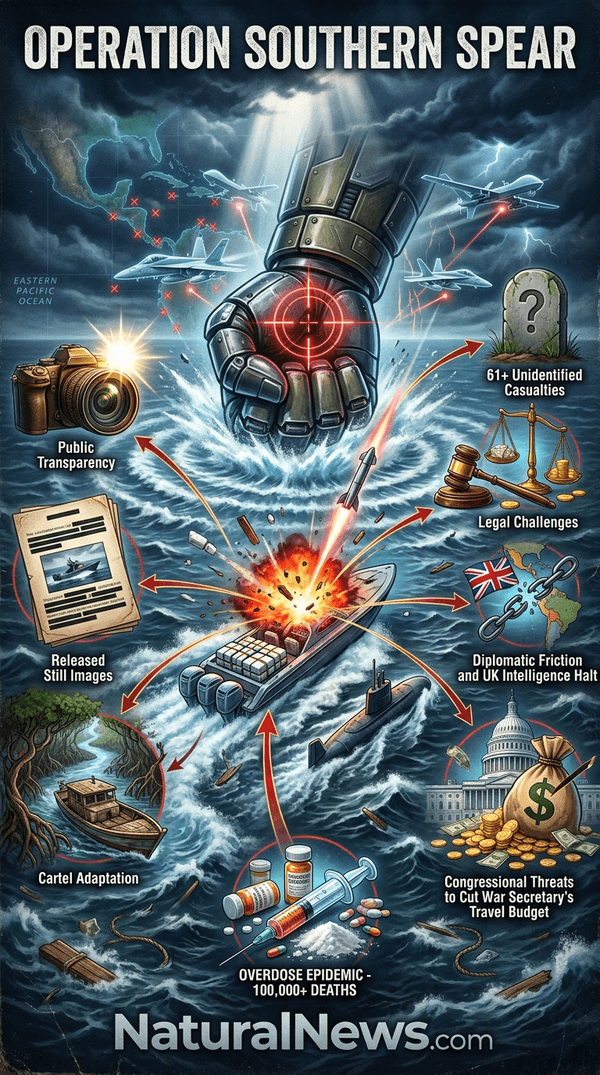
Explainer Infographic







Please contact us for more information.