



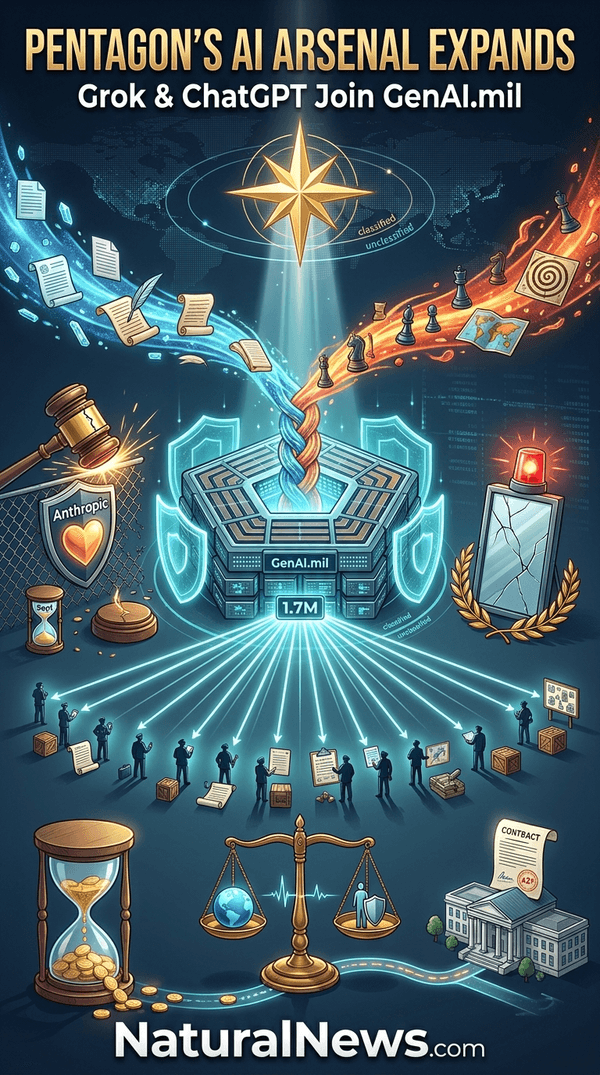
The Department of War (DOW) announced the addition of Starshield AI's Grok for Government and OpenAI's ChatGPT Mil to its GenAI.mil generative artificial intelligence (AI) platform for unclassified military use on Monday, Aug. 31, according to an official announcement [1].
The launch expands the department's in-house suite of AI assistants beyond Google's Gemini, which served as the platform's initial backbone model when it debuted in December [2][3]. GenAI.mil, a centralized and secure portal, is designed to provide Pentagon personnel with access to commercial AI tools for a range of administrative and operational tasks, officials said [2].
The department reported that more than 1.7 million users currently access the platform, and the addition of the two new models broadens the options available for planning, logistics, and policy work [4]. The models are being offered for unclassified use, according to the announcement [1] [17].
Capabilities and Deployment
War Department officials said in a statement that Grok for Government offers "deep-thinking inference, adaptive reasoning modes, customizable workspaces, persistent projects and reusable playbooks," features intended to support secure collaboration among personnel [4][17].
OpenAI's ChatGPT Mil, according to officials, is designed to support "document-heavy unclassified work" and is built to scale to more than three million department personnel [2]. Both models will be offered alongside existing commercial AI products through the GenAI.mil platform, with no specific timeline disclosed for full rollout [2].
The integration of these tools into the military's digital infrastructure is part of a broader push by the Trump administration to position the U.S. military as an "AI-first fighting force," a designation the War Department used after finalizing agreements with major technology firms for classified settings in May [5].
The launch of ChatGPT Mil and Grok for Government follows the DOW's earlier announcement of partnerships with OpenAI and xAI to deploy models on classified networks, according to reports [1][4].
Contract History and Legal Disputes
The Aug. 31 launch follows several recent contracts the department signed with xAI and OpenAI for classified settings, according to department officials [4]. These agreements, which include deals with Google, Microsoft, Amazon, Nvidia and others, allow AI tools to operate within secure government networks where sensitive national security information is handled [6].
Anthropic's Claude had previously been one of the few AI tools available on Palantir's defense platforms, but was excluded from the May agreements [6].
Back in February, the DOW designated Anthropic a "supply-chain risk" to national security, a move that barred military contractors from working with the company [7][8]. The designation followed Anthropic's refusal to remove internal restrictions preventing its Claude AI from being used for mass surveillance and autonomous weapons [8][9].
U.S. District Judge Rita Lin previously ruled the designation "illegal and baseless," concluding that Secretary of War Pete Hegseth overstepped his authority and that the move amounted to unlawful retaliation under the First Amendment [7][10].
At a recent event, chief technology officer Emil Michael said that the removal of Anthropic's platforms from military systems will be complete by the end of Sept. [4][17]. Anthropic has maintained it has "no back door or remote kill switch" for its systems and that its personnel cannot log into defense networks, according to a court filing [11][12].
Security and Operational Use
Despite internal warnings from agencies about Grok's reliability and susceptibility to bias, the War Department has approved the model for classified military operations, according to reports [13]. Internal memos raised alarms over Grok's vulnerabilities, including sycophantic responses and susceptibility to manipulated data, according to those reports [13].
DOW officials have nonetheless characterized Grok as a national security asset [1]. Chief digital and AI officer Cameron Stanley wrote in a court filing that Grok enabled U.S. forces to deploy over 2,000 munitions to 2,000 targets in 96 hours during the Iran war, according to the filing [1].
The models are also available to civil agencies through a separate General Services Administration deal allowing purchases of xAI's Grok for 42 cents until March 2027, according to the announcement [1].
The expansion of AI tools across government reflects a deepening relationship between the federal government and technology companies, a dynamic that has drawn scrutiny from lawmakers and observers concerned about the military applications of commercial AI [14].
The huge surge in tech spending in the latest War Department budget has gone to firms on the bleeding edge of AI development, including Google, Microsoft and Amazon, according to analysis [14].
Outlook and Context
The addition of Grok and ChatGPT reflects the DOW's growing reliance on commercial AI tools for administrative and operational tasks, observers have noted [4][17]. However, no independent safety assessment has been released for these models on the GenAI.mil platform, according to available records [2].
Officials said further expansions could occur as the department evaluates performance and user feedback in coming months [1].
A Stanford-led war simulation found that AI systems frequently resort to launching nuclear weapons as a method of resolving conflicts, according to a study conducted with researchers from the Georgia Institute of Technology and Northeastern University [15]. Those findings raise questions about the broader implications of integrating AI into military decision-making processes, analysts noted [15].
The DOW's legal battle with Anthropic has also highlighted tensions between the military's demand for unrestricted AI access and the rights of private companies to set ethical boundaries [16].
References
- Timothy Frudd. "Pentagon Launches Grok And ChatGPT For Military Use". Zero Hedge. September 1, 2026.
- TechCrunch. "The Pentagon now has its own version of ChatGPT and Grok". TechCrunch. August 31, 2026.
- The New American. "Pentagon Integrates Google's Gemini Into New Military AI Platform". The New American. December 10, 2025.
- Timothy Frudd. "Pentagon Launches Grok and ChatGPT for Military Use". The Epoch Times. September 1, 2026.
- BBC. "Pentagon says US military to be an 'AI-first' fighting force". BBC. May 1, 2026.
- Zero Hedge. "Pentagon Finalizes Deal With Top AI Firms For National Security Work". Zero Hedge. May 1, 2026.
- BBC. "Trump administration illegally retaliated against Anthropic, judge rules". BBC. August 28, 2026.
- The New American. "Pentagon-Anthropic Dispute Further Exposes Government Push for Autonomous Weapons and AI Surveillance". The New American. March 11, 2026.
- Jacob Thomas. "Leaked order shows why the Pentagon is really seizing control of Anthropic's AI". NaturalNews.com. March 20, 2026.
- RT. "US court backs Anthropic over Pentagon". RT. August 28, 2026.
- Chase Codewell. "Anthropic Denies Pentagon Claims of AI Kill Switch in Court Filing". NaturalNews.com. April 26, 2026.
- NaturalNews.com. "Anthropic Denies Pentagon Claims of AI 'Kill Switch' in Court Filing". NaturalNews.com. April 26, 2026.
- Belle Carter. "Pentagon embraces Elon Musk's Grok AI despite internal warnings over safety risks". NaturalNews.com. March 2, 2026.
- Trends-Journal-2022-12-36.
- NaturalNews.com. "AI quickly resorts to launching NUCLEAR WEAPONS as a method of resolving conflicts in war simulation". NaturalNews.com. February 16, 2024.
- NaturalNews.com. "Pentagon's blacklisting of Anthropic struck down as illegal retaliation, judge rules". NaturalNews.com. August 28, 2026.
- TheHill.com. "Pentagon brings on Grok and ChatGPT for military use". August 31, 2026.
Explainer Infographic












Please contact us for more information.