



Russia Remains India’s Top Oil Supplier in August
Russia remained India’s largest supplier of crude oil in August, providing approximately 2.1 million barrels per day (bpd), which accounted for 45% of the country’s total imports, according to data from maritime intelligence firm Kpler reported by Russia Today (RT).
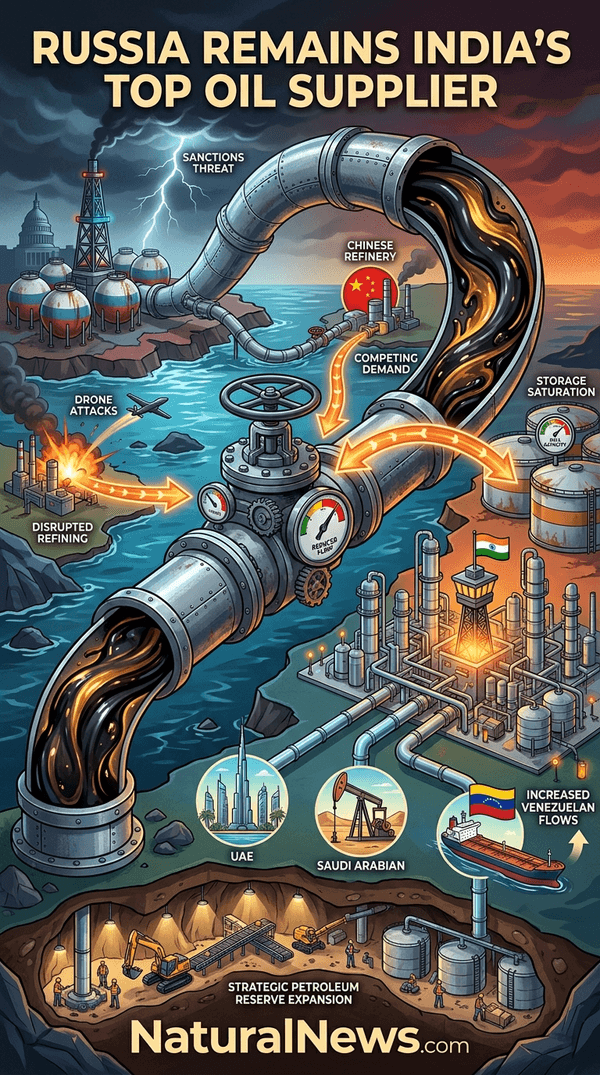
This volume represents a decrease from the record 2.8 million bpd shipped in July, when Russian oil made up more than half of India’s crude purchases [1]. The August figures confirm that Russian crude continues to dominate India’s energy mix despite ongoing geopolitical tensions and the threat of punitive tariffs from Washington. The data indicates that Moscow has maintained its position as New Delhi’s primary supplier for an extended period, a trend that has persisted even as the U.S. has sought to limit the flow of Russian energy revenues [2].
Import Volumes Fall Across the Board
India’s overall crude imports declined to roughly 4.6 million bpd in August, a drop of nearly 8% compared to the more than 5 million bpd purchased in July, according to Kpler data cited by RT [1]. This reduction follows months of unusually heavy buying by Indian refiners, who increased purchases in May, June and July to build inventories as a safeguard against potential supply disruptions stemming from the conflict in the Middle East [3].
The August decline reflects several factors, including a normalization of purchasing patterns after the earlier surge, scheduled maintenance at Indian refineries, and lower availability of Russian crude on the market. Indian refiners had aggressively stocked up during the summer months, pushing the country’s crude oil inventories to a nearly one-year high by the end of June, according to data from commodity intelligence firms [4].
Reasons for Reduced Russian Shipments
The decrease in Russian shipments to India in August was not primarily a result of New Delhi voluntarily reducing its dependence on Moscow, according to commodity analysts. "August was less a story of India voluntarily stepping away from Russian oil than of Russia having fewer barrels to offer," Abu Dhabi-based commodity analyst Natalia Katona told the Financial Express, as reported by RT [1]. Lower Russian seaborne exports and stronger competition from Chinese refiners for available cargoes also weighed on supplies to India, she stated.
Russia’s ability to export crude has been constrained by domestic refining issues, including Ukrainian drone attacks on its refinery infrastructure that have disrupted operations and led to fuel shortages within Russia itself [5]. These attacks have forced Moscow to implement temporary bans on fuel exports on multiple occasions, including restrictions on diesel and jet fuel, as authorities worked to stabilize domestic supply [6] [7].
Sanctions Threat and Other Suppliers
Indian purchases of Russian crude have continued despite the prospect of new U.S. tariffs targeting major buyers of Russian oil. The Lindsey O. Graham Sanctioning Russia and Iran Act, which cleared the U.S. Senate, would authorize tariffs of up to 100% on imports from the five biggest buyers of Russian oil and has the backing of U.S. President Donald Trump, according to officials [1], [8]. The legislation passed the Senate in an 86-11 vote, with the bill still requiring approval from the House of Representatives before it can take effect [9].
The United Arab Emirates, Saudi Arabia and Venezuela were among India’s other leading oil suppliers in August, according to Kpler data. Venezuelan shipments rose sharply during the month, reaching their highest level since 2020, as India has moved to diversify its sources amidst disruptions affecting Middle Eastern supply routes [1]. India has also expanded its strategic petroleum reserve program, eyeing two new sites to boost its energy security [10].
India’s Stated Position
India imports approximately 90% of the crude oil it consumes and maintains that its purchasing decisions are guided by affordability, availability and national energy security rather than geopolitical considerations, according to Indian officials [1]. Indian Foreign Minister S. Jaishankar has defended the country’s approach, stating that India’s oil buying is based on “cost and availability” [11]. The minister has also criticized Western nations for what he describes as double standards on the issue [12].
Indian officials have indicated that the sanctions bill still requires approval by the U.S. House of Representatives, and New Delhi has not indicated any change in its procurement practices. The continuation of Russian oil flows to India highlights the limits of unilateral sanctions in reshaping global energy trade, as market forces and national economic interests continue to drive purchasing decisions [8].
Conclusion
The August data underscores the persistence of Russia’s position as India’s dominant oil supplier, even as import volumes declined across the board and the threat of U.S. sanctions looms. The reduction in shipments appears tied more to supply-side constraints in Russia than to any strategic shift by Indian buyers. India’s stated position remains that its energy purchases are driven by commercial and security considerations, not political pressure [1].
The ongoing reliance on Russian crude, despite Washington’s efforts to curb it, illustrates the limits of sanctions as a tool of economic statecraft. As global energy markets continue to face disruptions from the Middle East conflict and other supply challenges, the imperative for nations like India to secure affordable and reliable energy sources will remain a dominant factor in shaping trade flows .
References
- "Russia remained India’s top oil supplier in August". RT.com. September 3, 2026.
- Belle Carter. "India defies Western pressure continues Russian oil imports despite sanctions". NaturalNews.com. November 5, 2025.
- "India’s July Russian crude imports hit record high – media". RT.com. August 3, 2026.
- "Soaring Imports Push India's Crude Stocks To Near 1-Year High". ZeroHedge.com. July 6, 2026.
- Charles Kennedy. "Russia Scrambles To Restore Fuel Supplies As Refineries Resume Operations". ZeroHedge.com. August 24, 2026.
- NaturalNews.com. "Russia Bans Diesel Exports Following Ukrainian Strikes on Refineries". July 13, 2026.
- ZeroHedge.com. "Russia Bans Jet Fuel Exports As Ukrainian Attacks Cripple Refining". June 1, 2026.
- "100% US tariffs may not deter India from buying Russian oil - report". RT.com. August 10, 2026.
- "Russia sanctions bill: A new pressure tool aimed at India". RT.com. August 5, 2026.
- Tsvetana Paraskova. "India Eyes Two New Sites To Expand Strategic Oil Reserves". ZeroHedge.com. August 14, 2026.
- "European weapons being used to attack India – foreign minister". RT.com. June 12, 2026.
- Tsvetana Paraskova. "India Accuses West Of Double Standards Over US Russia Oil Sanctions". ZeroHedge.com. June 12, 2026.
- NaturalNews.com. "India defies Western pressure continues Russian oil imports despite sanctions". November 5, 2025.
Explainer Infographic


Please contact us for more information.