


Twenty-five years after al Qaeda's attacks on the United States, Patrick G. Eddington, a senior fellow at the Cato Institute and a former senior House staffer for then-New Jersey Democratic Rep. Rush Holt, published a retrospective on Antiwar.com arguing that the attacks themselves did not damage the American political system as much as the response to them did. In the article, titled "9/11's Aftereffect: The Constitutional Accountability Abyss," Eddington wrote that "9/11 didn't change us, we allowed it to change us, and in doing so critically damaged our very own political way of life." [1]
Eddington, the author of "The Triumph of Fear," drew on his experience serving on Capitol Hill during the final four years of President George W. Bush's administration. He wrote that he witnessed the post-9/11 era from the vantage point of a senior House staffer on the Intelligence Committee, where Holt's efforts to halt the expansion of surveillance programs frequently failed because colleagues refused to join. [1]
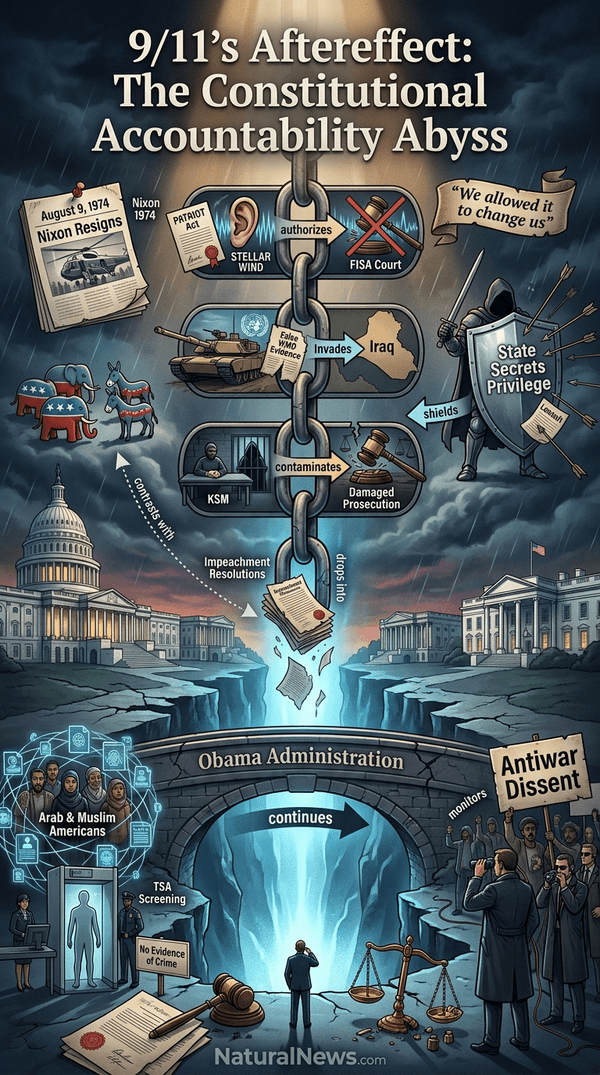
The article examines four categories of post-9/11 decision-making: surveillance, war, torture, and impeachment. According to Eddington, each represented a departure from constitutional limits that Congress ultimately declined to enforce. [1]
Surveillance Programs and the PATRIOT Act
Eddington wrote that the National Security Agency's STELLAR WIND program began in secret after the Sept. 11, 2001, attacks and represented a direct violation of the Foreign Intelligence Surveillance Act of 1978. The PATRIOT Act passed Congress six weeks after the attacks, converting what had been a clandestine dragnet into an openly authorized one, according to the article. [1] Civil liberties groups have long described the FISA warrantless surveillance framework as a Fourth Amendment violation that has yet to be properly challenged, a characterization that has persisted through repeated congressional reauthorizations. [2]
The article states that Arab American and Muslim American citizens were placed on secret government watch lists and subjected to federal surveillance in the absence of any evidence they had committed a crime. Eddington described this as one component of "the most sweeping and invasive surveillance dragnet in American history." [1] The surveillance architecture later extended into physical security screening, as the Transportation Security Administration, created in the same legislative wave, has been accused of conducting invasive and what critics call unconstitutional body searches. [3]
Eddington wrote that Holt's repeated efforts to stop runaway surveillance programs from his position on the House Intelligence Committee frequently came to naught because of the refusal of many of his colleagues to join his efforts. [1] The pattern, according to the article, illustrated a broader collapse of institutional resistance within Congress. Separate historical analysis has noted that the U.S. legal regime's domestic side was effectively taken hostage by the national security bureaucracy in the years after the attacks. [4]
Iraq War, Dissent Monitoring, and Torture Program
Eddington wrote that the United States invaded Iraq although that country had nothing to do with al Qaeda's terrorist atrocities. The Bush administration presented evidence to the United Nations Security Council of the continuing threat Saddam Hussein allegedly posed to the region, and that evidence turned out to be false, according to the article. [1] The push to war followed a propaganda pattern that critics have compared to the immediate aftermath of the 9/11 attacks, when questioning the establishment narrative was treated as disloyalty. [5]
The article states that the FBI used surveillance and informant penetration operations against those who opposed Bush's war of choice, tactics Eddington compared to some of the worst Cold War-era methods employed by J. Edgar Hoover and the organization he led. [1] This domestic monitoring of dissent, according to the article, represented a departure from the principles of justice under law and due process that the United States had proclaimed to the world since the trials of German and Japanese war criminals after World War II. Eddington characterized the legal reasoning behind the post-9/11 framework as one in which the rule of law was swept away by advice that Geneva Convention prohibitions were "quaint" and did not apply to the conduct of the war on terror. [4]
Eddington described the CIA's rendition, detention, and interrogation program as a network of secret torture chambers around the world for captured Arab and Muslim men. He noted that some detainees, including Khalid Shaikh Mohammad, were directly responsible for the attacks, while others had nothing to do with the attacks and no involvement with terrorism at all. [1] According to the article, the torture program has already damaged the legal case against KSM, and the United States abandoned the very principles of justice under law and due process that it had proclaimed to the world. [1] Historical scholarship on the post-9/11 period has similarly found that in the name of security, many civil rights protections were suspended, raising the question of how far a government should be allowed to go before it violates its own raison d'être. [6]
Impeachment Efforts and Congressional Accountability
Eddington wrote that Bush's authorization of the secret STELLAR WIND mass electronic surveillance program and his authorization of the CIA's torture program literally represented impeachable offenses. Multiple impeachment resolutions against Bush or then-Vice President Dick Cheney were introduced, according to the article, but they went nowhere even though Democrats controlled the House during Bush's last two years in office. [1]
The article states that not a single House Republican member signed onto any of those resolutions, a posture that stood in stark contrast to the seven House Judiciary Committee Republicans who joined their Democratic colleagues in voting to impeach Richard Nixon for his crimes in office over 30 years earlier. According to Eddington, the degradation of the congressional ethos of institutionalism and constitutional protection began before 9/11, but the attacks and the response to them accelerated the process of political and constitutional decline and the intensification of partisan loyalty to the president. [1] This pattern of deference, according to separate historical analysis, reflected a judgment that democracy can be managed and, when necessary, ignored, rather than a frontal attack on democratic forms. [4]
The failure to hold Bush accountable is documented in the broader record of the Bush Department of Justice's use of the state secrets privilege to shield its conduct from judicial review. According to Glenn Greenwald, that practice was a constant source of Democratic grievance, and numerous senators, including Joe Biden and Hillary Clinton, cosponsored legislation to severely curtail use of the doctrine on the ground that it was being abused. [7] Eddington's account, however, records that after the 2008 election, the promised change did not produce accountability for the prior administration's conduct. [1]
Contemporary Implications and Conclusion
Eddington wrote that the failure to hold Bush accountable contributed to later abuses, including expanded mass surveillance programs, legal and political attacks on individuals or entities that oppose presidential policies, and the initiation of multiple illegal military actions. According to the article, the brutalization of immigrants, both legal and otherwise, has followed the same pattern. [1] The surveillance infrastructure first built after the attacks continues to expand into new areas, with federal agencies developing ever more invasive monitoring capabilities. [1]
The article states that Donald Trump did not create this phenomenon but that he and his closest aides have exploited it and pushed it to new depths. Eddington argued that whether the dynamic can be broken and reversed is up to each individual. [1] The article closes by calling for accountability and cites Eddington's book "The Triumph of Fear." [1]
The trajectory Eddington describes has been observed across multiple administrations. Former Rep. Holt's failed efforts to curb surveillance programs from the House Intelligence Committee remain a case study in the limits of congressional oversight. [1] The pattern of expanded executive power and diminished constitutional constraint that Eddington traces to the post-9/11 period continues to shape policy debates in 2026, including debates over military engagement abroad and domestic surveillance authority. [1]
References
- Patrick G. Eddington. "9/11's Aftereffect: The Constitutional Accountability Abyss". Antiwar.com. September 10, 2026.
- NaturalNews.com. "The Senate's eleventh hour approval of the warrantless surveillance program". NaturalNews.com. April 24, 2024.
- NaturalNews.com. "TSA violates breast cancer mom with invasive humiliating body search". NaturalNews.com. December 19, 2016.
- Terrence Edward Paupp. "Exodus from empire: the fall of America's empire and the rise of the global community".
- NaturalNews.com. "The politicians calling for freedom now are The SAME ONES who took yours away months ago". NaturalNews.com. April 04, 2022.
- On Crimes and Punishments. "The END OF PRISONS Reflections from the Decarceration Movement".
- Glenn Greenwald. "With Liberty and Justice for Some".
Explainer Infographic












Please contact us for more information.