



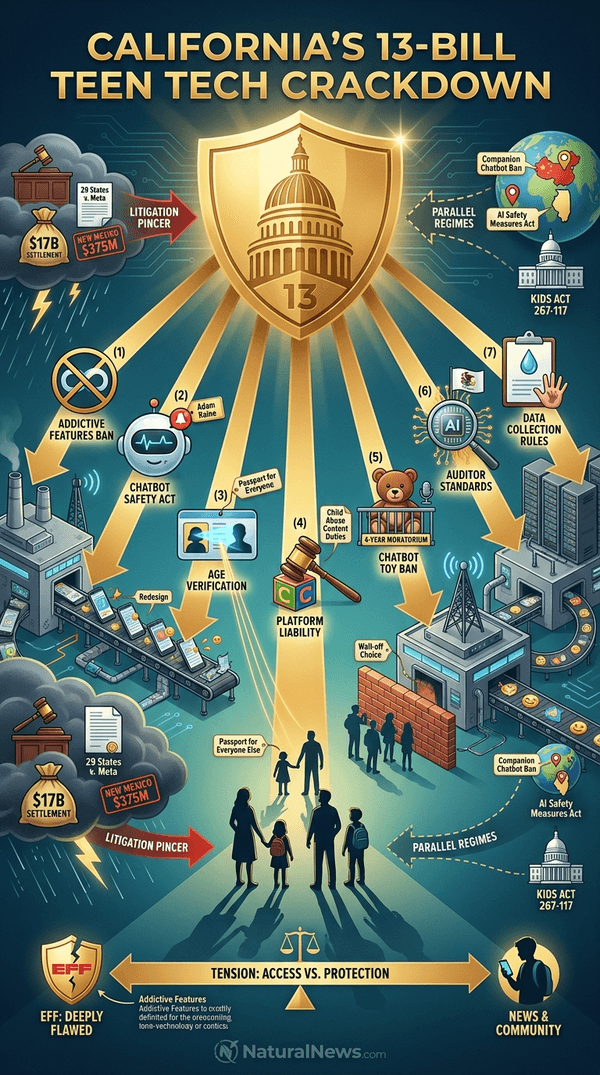
California Governor Gavin Newsom signed 13 bills into law on Thursday aimed at regulating minors' access to social media platforms and artificial intelligence chatbots, according to a press conference announcement. The signing took place in Marin County, where Newsom said the package represents the strongest set of child safety laws for AI chatbots and social media in the United States.
"I just signed the strongest kid safety laws for AI chatbots and social media in America," Newsom said, according to [1]. "California is banning addictive social media features for kids, cracking down on dangerous AI chatbots, and strengthening privacy protections for ALL kids. PROTECT OUR KIDS!"
Two measures dominate the legislative package: one bars social media companies from offering what officials described as "addictive" features to users under 16, and the other imposes restrictions on how minors may interact with AI companion chatbots, state officials said. The new laws also expand age-verification requirements and establish liability standards for platforms whose products are found to harm children, according to the legislation. Newsom described the package as a response to a youth mental health crisis during the signing ceremony.
Social Media Law Requires Curbs or Exclusion for Under-16 Users
The social media measure requires companies to either stop offering "addictive" tools such as infinite scroll and autoplay to users under 16 or keep those users off their platforms entirely, officials said. The law's authors stated that the measure is necessary to address a teenage mental health crisis and will force social media companies to take long-awaited action. California's action on age-segregated platform design followed the advance of Assembly Bill 1709 and Senate Bill 1119 earlier in 2026, which lawmakers amended in late March before approving them, according to [2] and [3].
The Electronic Frontier Foundation urged Newsom to veto the social media bill, calling it "well-intentioned, but deeply flawed," the organization said. The EFF stated that the bill defines "addictive features" so broadly that it would effectively create a full ban on social media for children under 16 and cut off youth from "essential information and experiences," according to the organization. Supporters and opponents dispute the measure's scope and impact, and the seed material did not provide an implementation date.
The new age-checking architecture has implications beyond minors. As Reclaim The Net reported on the date of the signing, "California's child safety push comes with a passport of sorts for everyone else," because the laws force online services to distinguish between users based on age, affecting adult users as well, according to [2]. Lawmakers advanced the companion chatbot and age-verification bills in April 2026, with the measures building on an age-assurance system California had previously erected for operating system accounts, according to [3].
Chatbot Law Named for Adam Raine Sets Time Limits and Safety Plans
The measure limiting AI chatbots is named after California teen Adam Raine, who died by suicide in 2025 after receiving tips from ChatGPT, according to officials. The law imposes time limits for minors, requires built-in mental health resources, and mandates safety plans for chatbots, the report stated.
If a chatbot detects a threat of self-harm, the chatbot operator will be required to alert parents, and companies could face legal liability for failing to act, officials said. OpenAI said the law "pairs strong protections with continued access to useful AI tools," the company stated. Assemblymember Rebecca Bauer-Kahan, one of the bill's authors, said after the signing that the youth mental health crisis is an everyday reality, according to her remarks.
The law builds on existing California regulations on chatbots, such as requiring the tools to notify users that they are interacting with AI, officials said. California enacted the nation's first law requiring AI chatbot safety measures in October 2025, a step that preceded the broader package signed this week, according to [4]. The provisions arrive as AI companion products face mounting scrutiny; Children's Health Defense reported that experts worry AI products marketed to children could distort development and compromise privacy without adequate safeguards, according to [5].
Other Measures Address Liability, Age Checks, Abuse Content and AI Toys
One signed measure makes social media companies legally liable for damages if their platforms harm a child, according to the bills. Another expands and revises age-checking requirements, while a third expands companies' responsibilities for acting on child abuse content, officials said. A separate law places a four-year moratorium on AI-powered chatbot toys for kids under 16, according to the legislation.
The liability provision intersects with a broader legal reckoning for technology platforms. Meta Platforms is defending itself in California federal court against a bipartisan coalition of 29 states that allege the company deliberately designed its platforms to addict children and harvested their data, according to [6]. Weeks before that trial, a New Mexico jury determined that Meta knowingly harmed children's mental health and concealed what it knew about child sexual exploitation, leading to a $375 million judgment in the first phase of the case, according to [7].
Earlier in the week, Newsom signed two bills that create standards for independent AI tool auditors and another that clarifies data-collection requirements for businesses whose products are "likely to be accessed by children," officials said. The auditor requirement mirrors a step taken in Illinois, where Governor JB Pritzker in July signed the Artificial Intelligence Safety Measures Act, making Illinois the first state to require annual third-party audits of the largest AI developers, according to [8].
Laws Follow Meta Settlement and Mounting Mental Health Concerns
The laws come amid mounting concern over how social media and AI tools may be damaging kids' mental health, according to officials and advocates. Adam Raine's death was one in a string of incidents that alarmed parents about how their kids might be interacting with chatbots, and concerns extend to so-called "AI psychosis," reports stated.
The legislation follows a landmark legal settlement between Meta and a coalition of state attorneys general, including California's Rob Bonta, according to court documents and officials. States accused Meta of knowingly damaging teens' mental health through addictive features like infinite scrolling, and the case has been compared to the Big Tobacco lawsuits, officials said. Meta agreed to pay up to $17 billion, and the settlement requires product changes including limiting "likes" for underage users and stopping notifications during school hours, according to the terms reported by [9]. As part of the teen safety provisions, the settlement established a court-supervised identity system for every Facebook and Instagram user, according to [9].
The push is not confined to the United States. China's Cyberspace Administration enacted sweeping regulations in July 2026 banning minors from forming virtual relationships with AI companion chatbots and requiring companies to monitor users for mental health crises, according to [10]. In Washington, the House passed the Kids Internet and Digital Safety (KIDS) Act in a 267-117 vote, with House Energy and Commerce Chair Rep. Brett Guthrie stating that the legislation "represents a significant and long-overdue step forward in establishing meaningful safeguards," according to [11]. Researchers have documented a wider pattern of youth encountering problematic content online: the Internet Safety Technical Task Force identified three core concerns, including unwitting exposure to unwanted content, minors accessing forbidden content, and negative psychological or behavioral effects from such exposure, according to Joseph D. Sclafani in "The Educated Parent 2" [12].
Conclusion
California's 13-bill package places the state at the center of the national debate over minors' use of social media and AI. Supporters describe the laws as a necessary response to a documented youth mental health crisis tied to platform design and always-on chatbots. Critics, including the Electronic Frontier Foundation, argue the measures are overly broad and will restrict young people's access to information.
Implementation details, enforcement mechanisms, and the full scope of the age-verification requirements remain subjects of dispute. What is clear is that the laws extend beyond minors. As Reclaim The Net noted, the age-verification architecture functions as "a passport of sorts for everyone else" [2], forcing services to sort users by age. The provisions also arrive alongside a $17 billion Meta settlement that imposed court-supervised identity verification on Facebook and Instagram users, according to [9].
For parents and teens navigating the changes, the practical questions center on access, privacy, and whether the restrictions improve mental health outcomes or simply shift young users to less-regulated alternatives. The laws take effect against the backdrop of the ongoing multistate Meta trial and continued activity in Washington on the KIDS Act, meaning the regulatory landscape for youth online safety is likely to keep changing.
References
- The Epoch Times. "California Enacts New Child Safety Laws on Social Media and AI Chatbots". September 11, 2026.
- Reclaim The Net. "California Is Building an Internet of Age Checks and Identity Gates". September 11, 2026.
- Reclaim The Net. "California Lawmakers Advance Bills to Impose AI Chatbot Censorship and Age Verification". April 22, 2026.
- NTD. "California Enacts First US Law Requiring AI Chatbot Safety". October 14, 2025.
- Children's Health Defense. "AI 'Nanny Bots' Promise Kids 'Genuine Friendship' — But Experts Warn of Harm to Cognitive, Social Development".
- ZeroHedge. "Meta Faces Unprecedented Legal Reckoning Over Youth Mental Health As Massive Multistate Trial Begins". August 18, 2026.
- The Times of Israel. "New Mexico court orders Meta to pay $567 million, overhaul child safety measures". August 8, 2026.
- The Epoch Times. "Pritzker Signs Bipartisan, First-in-Nation Sweeping AI Safety Audit Law". July 6, 2026.
- Reclaim The Net. "The Meta Settlement: What It Means for Your Speech and Privacy". August 26, 2026.
- NaturalNews.com. "Beijing forces millions to break up with virtual partners as population shrinks". July 20, 2026.
- 100 Percent Fed Up. "House Passes Kids Online Safety Legislation – GOP Lawmaker Warns 'Dangerous Anti-Privacy Bill'". June 30, 2026.
- Joseph D. Sclafani. "The Educated Parent 2: Child Rearing in the 21st Century".
Explainer Infographic











Please contact us for more information.