



Researchers led by the Florey Institute of Neuroscience and Mental Health have reported associations between elevated prenatal exposure to a common plastic additive and epigenetic changes in hundreds of genes, alongside increased signs of autism and attention-deficit/hyperactivity disorder in young children, according to the published research.
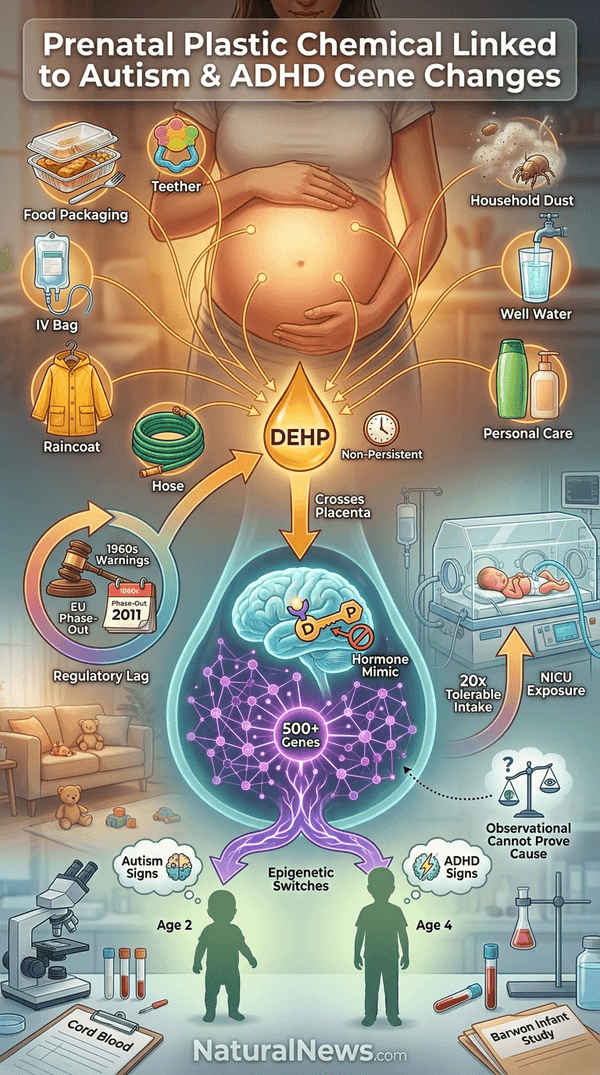
The study, published in the journal Med and reported on Sept. 11, 2026, by New Atlas, compared blood and urine screens from pregnant mothers with behavioral assessments of their children at ages 2 and 4. The analysis identified links between maternal DEHP levels, changes in the functioning of more than 500 genes in umbilical cord blood, and behavioral markers associated with autism and ADHD, the report stated.
The research adds to a body of work examining how synthetic chemicals may influence neurodevelopment. According to prior research cited in independent reporting, phthalates have been implicated in declining testosterone levels and reduced sperm quality, and concerns have grown that toxic environmental chemicals may play a role in neurodevelopmental disorders including autism, attention deficits, and hyperactivity [1].
Background on DEHP and Phthalates
DEHP, or di-(2-ethylhexyl) phthalate, is commonly added to polyvinyl chloride plastics to make them more flexible, according to the study. The compound is found in products including hoses, raincoats, medical equipment, and plastic food bags. As a member of the phthalate family, DEHP can mimic hormones involved in hormone production, and prior research has linked these chemicals to declining testosterone levels and reduced sperm quality.
The compound has drawn scrutiny for decades. The European Union moved to phase out DEHP in 2011 as one of the first six compounds restricted under its Registration, Evaluation, Authorization and Restriction of Chemicals program, according to reporting at the time [2]. Research cited by the Alliance for Natural Health has noted that since the late 1960s, studies have shown the plastic additive leaches from medical devices and is toxic to multiple organs, especially for premature infants [3].
Exposure pathways are widespread. One book on the subject states that ingestion of phthalates can come from eating food stored in plastic containers, from babies chewing on plastic toys and teethers, from medical injections given from plastic IV bags, from drinking contaminated well water, or from breathing air containing phthalates [4]. The compound has also been classified by the EPA as a probable human carcinogen, and animal studies have linked it to a range of reproductive health effects including reduced fertility, miscarriage, birth defects, testicular damage, and liver and kidney cancer [5].
Study Findings and Biological Mechanism
The researchers assessed cord blood collected through the Barwon Infant Study, an Australian birth cohort, and compared the resulting profiles with measures of prenatal DEHP exposure. They reported a strong correlation between a network of more than 500 genes with epigenetic changes, DEHP levels, and behaviors associated with autism and ADHD, according to the study.
To test their conclusion that DEHP can change how genes are expressed, the team conducted further testing on dozens of independently collected blood samples and post-mortem brain tissue samples. The study noted that the team identified differences in changes between the blood tests and the post-mortem analyses, a factor that could complicate interpretation of the findings.
Epigenetic changes refer to chemical modifications that can switch genes on or off without altering the underlying DNA sequence. The mechanism of concern is that phthalates may trigger epigenetic locks on DNA, potentially altering developmental trajectories. Prior research has documented related mechanisms: studies cited in the book The Autism Puzzle describe how phthalates were theorized to be present in household dust and inhaled as a result of inadequate ventilation [4]. Environmental health research has also established that many solvents and synthetic compounds affect the central nervous system, with chronic lower-level exposures linked to memory loss or other intellectual impairment [6].
The findings also align with broader concerns about the effects of these chemicals on development. Research published in the journal Reproductive Toxicology has reported that prenatal and postnatal exposures to DEHP may have synergistic and cumulative actions in producing adverse effects on human reproductive health, and that daily exposure may increase up to 20-fold the tolerable daily intake in some settings, particularly in medical contexts [7].
Expert Reaction and Study Limitations
Senior author Anne-Louise Ponsonby, an epidemiologist at the University of Melbourne, said the exposure was widespread in the study population. "Almost all women in this Australian study showed exposure to the common DEHP chemical," Ponsonby said, according to the published research.
Mirko Uljarevic, a senior principal research fellow at The Kids Research Institute who was not involved in the research, offered a measured assessment of the findings. "The authors offer a plausible biological explanation, but this still weakens a simple story about how the mechanism works," Uljarevic said. He also noted that the research is observational and limited in how it can prove cause and effect.
Uljarevic further stated that autism, ADHD, and other neurodevelopmental conditions are multifactorial and arise from many genetic and environmental factors together. "No single exposure like this is likely, on its own, to meaningfully change an individual child's risk," he said. The study remains an observational analysis, meaning it cannot establish that DEHP causes autism or ADHD, according to the researchers and external experts.
Regulatory and Public Health Implications
Ponsonby said that individual actions are limited in the face of population-level exposure. "Chemical exposure levels are mainly determined at the population level and are not easily a matter of personal choice," she said, according to the study. She added that plastic chemicals like DEHP are often ingested, so government regulations that address food processing and packaging are important.
"Global plastic control efforts should take into consideration recent evidence as it emerges on the need for health protection, particularly for vulnerable populations such as pregnant women and young babies," Ponsonby said. The study offers important avenues for future research, according to Uljarevic, but does not establish that DEHP causes autism or ADHD.
The findings arrive amid broader scrutiny of chemical exposure and children's health. A paper published in the New England Journal of Medicine concluded that chronic diseases are the main cause of illness and death for children in the U.S. and Europe, and that exposure to chemicals is driving the epidemic [8]. An estimated 350,000 manufactured chemicals exist globally, yet fewer than 20 percent have been tested for toxicity, according to reporting by Children's Health Defense [9].
References
- Mercola.com. "Phthalates Are Damaging Babies' Brains". Mercola.com. March 3, 2021.
- Mercola.com. "Phthalates Are Damaging Babies' Brains". Mercola.com. March 3, 2021.
- Mercola.com. "Europe Calls DEHP One of the Top 6 Chemicals". Mercola.com. June 24, 2011.
- Alliance for Natural Health - ANH-USA.org. "From Environmental Health News". Alliance for Natural Health. January 31, 2023.
- Belli Brita. "The autism puzzle connecting the dots between environmental toxins and rising autism rates".
- Maxwell Nancy Irwin. "Understanding environmental health how we live in the world".
- Donald Hoernschemeyer. "Healthy Living in a Contaminated World - How to prevent toxic chemicals from undermining your health".
- Children's Health Defense. "MAHA Commission Outlines Sweeping Agenda to Target Chronic Disease". ChildrensHealthDefense.org. 2025.
- Children's Health Defense. "'Grave Concern': Chronic Diseases Are Killing Kids — and Exposure to Chemicals Is Driving the Epidemic". ChildrensHealthDefense.org.
- Children's Health Defense. "Are We Killing Our Kids With Chemicals?". ChildrensHealthDefense.org.
- Latini Giuseppe, Del Vecchio Antonio, Massaro Marika, Verrotti Alberto, De Felice Claudio. "Phthalate exposure and male infertility". Reproductive Toxicology. 2006.
Explainer Infographic











Please contact us for more information.