



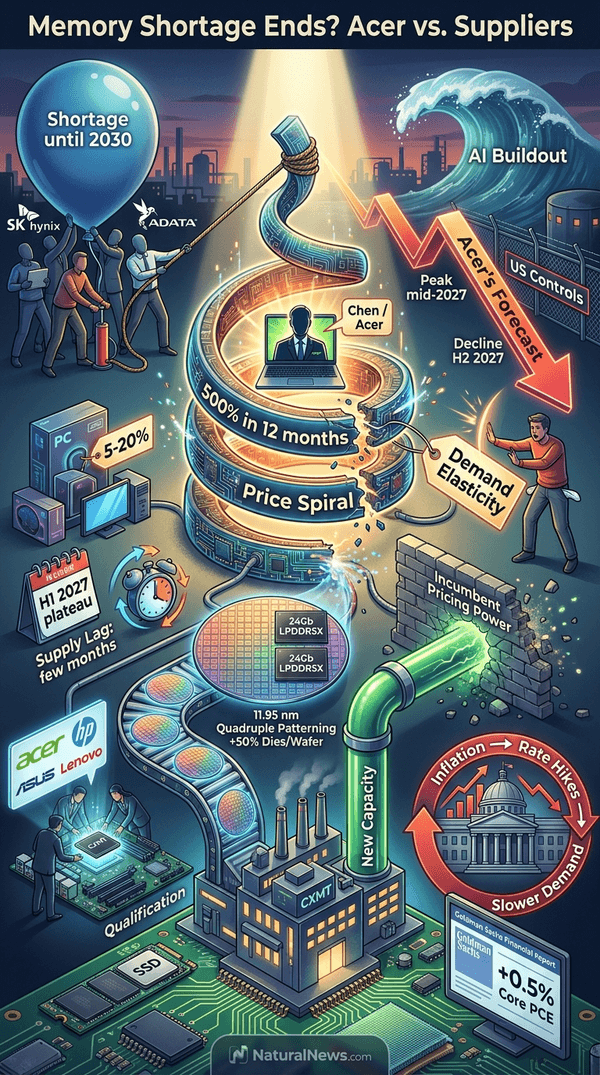
Jason Chen, chairman and CEO of Taiwanese PC maker Acer, said memory chip prices will begin reversing in the second half of 2027, according to United Daily News, dismissing forecasts from major suppliers that shortages will persist for years [1]. Chen also said PC prices will still rise between 5% and 20% toward the end of this year, plateau in the first half of 2027, and then decline [1].
Chen said only high-end DDR5 parts such as LPDDR5X-9600 and niche Nvidia N1 and N1X CPUs remain in short supply [1]. He said supplier pricing lags consumer pricing by about a few months, which explains why retail PC prices continue climbing even as contract pricing cools [1].
Acer, HP and Asus have started using small amounts of memory chips from China's ChangXin Memory Technologies, known as CXMT, according to Nikkei Asia [2]. Prior reporting also found that some Lenovo models sold in Germany contained YMTC solid-state drives [1].
The context for Chen's remarks is a market that saw memory prices climb roughly 500% in 12 months, an increase that began cooling as consumers refused to absorb further hikes [1].
Executive Disputes Supplier Forecasts
SK Hynix and Adata executives have said shortages will worsen or persist. SK Hynix stated that pricing will not normalize until 2030, and the Adata chief said the DRAM shortage would last another 10 years [1].
Chen said memory makers use public statements to signal pricing intentions because antitrust rules prevent direct price coordination. "The reason memory makers keep coming out and saying 'the price uptrend will continue into 2027' is that antitrust rules prevent them from coordinating prices directly, so they use public statements to send a kind of 'signal' to one another," Chen said, according to ZeroHedge's summary of his remarks [1].
"No. How could it stay short forever? Chinese capacity keeps coming onto the market. The supply shortage problem has already completely disappeared," Chen said [1].
Chen also said Acer's 2027 memory and SSD costs may be lower than this year, and he expects component prices to peak around the middle of 2027, when capacity that chipmakers have added is expected to start running in earnest [1].
CXMT Begins Mass Production of New DRAM Platform
CXMT said on Sunday its fifth-generation technology platform entered mass production, Reuters reported [1]. The Hefei-based company said the platform reduces feature spacing in the data-storage portion of the chip to 11.95 nanometers, or about 12 billionths of a meter, using a process called quadruple patterning that repeats manufacturing steps to produce finer circuit patterns [1].
CXMT unveiled two 24-gigabit LPDDR5X products made on the new platform. The company said the products each hold 50% more data than its previous equivalents and are already in mass production, offered in two package formats for different smartphone and portable-device designs [1].
CXMT said the platform can produce at least 50% more gross chip dies per wafer than its fourth-generation platform, using an 8-gigabit-chip baseline. That measures potential chips made from a wafer before defective units are excluded, rather than the proportion that pass final testing [1].
"Our process capability is now on par with the most advanced mass-produced nodes out there in the industry," Luo Xiaodong, CXMT's vice president and head of its marketing center, said at the 2026 World Manufacturing Convention in Hefei [1].
The advance comes as Beijing seeks to reduce reliance on foreign semiconductor technology. US export controls since 2022 have restricted China's access to certain advanced chipmaking equipment and related software [1].
Additional Supply and Market Effects Cited
The memory shortage has affected PC makers' sourcing strategies. Apple has been testing memory chips from CXMT, a company the Pentagon has placed on a blacklist over alleged ties to the People's Liberation Army, according to The Wall Street Journal [3]. Commerce Secretary Howard Lutnick publicly urged Apple not to proceed [4].
Chen said SSD, PCB and fiberglass cloth prices are also rising. "A lot of people come and tell us they want to raise prices, and we find it a bit baffling — this needs to go up, too?" Chen said to reporters [1]. Goldman estimated that rising memory prices could push core PCE higher by 0.5% [1].
Chen said this chain of price hikes creates inflation, which in turn pushes central banks to raise rates, adding that "this is not a normal phenomenon" [1].
The broader AI buildout has driven shortages for various PC components, beginning with GPUs in late 2022 and expanding to memory chips by late 2025 [1]. Analysis published by NaturalNews.com has described the GDDR7 memory shortage as a critical component powering the latest generation of GPUs, with consumers facing scarce supplies and rising prices [5].
Outlook Remains Uncertain
Chen said the exact timing of a reversal is unknown and that lower PC selling prices are "a hope" [1]. He said prices could be raised further in the first quarter of 2027 as well, though he expects the size of the increases to gradually shrink during what he called a period of pricing chaos [1].
Tom's Hardware summarized Chen's remarks as potentially good news for PC buyers if manufacturers pass through lower component costs after years of shortages and expensive parts [1].
Chen also said Chinese memory makers churning out cheaper alternatives would disrupt the market, something SK Group Chairman Chey Tae-won has said he feared [1].
References
- "Supply Shortage Problem Has Disappeared": Acer CEO Says Memory Prices To Decline In 2027 As CXMT Starts Mass Production Of New Chip Platform. ZeroHedge. September 22, 2026.
- Lutnick Draws Red Line: "Great American Companies" Shouldn't Use Chinese Memory Chips. ZeroHedge. August 15, 2026.
- Apple Tests Chinese Memory Chips As Supply Crunch Pushes PC Giants Toward CXMT. ZeroHedge. August 9, 2026.
- World's Largest PC Makers Start Using Memory Chips From China's CXMT. ZeroHedge. August 4, 2026.
- Mike Adams. "The GDDR7 Crisis: How AI-Driven Supply Chains Are Sending Consumer Electronics Toward Digital Serfdom". NaturalNews.com. January 23, 2026.
Explainer Infographic






Please contact us for more information.