



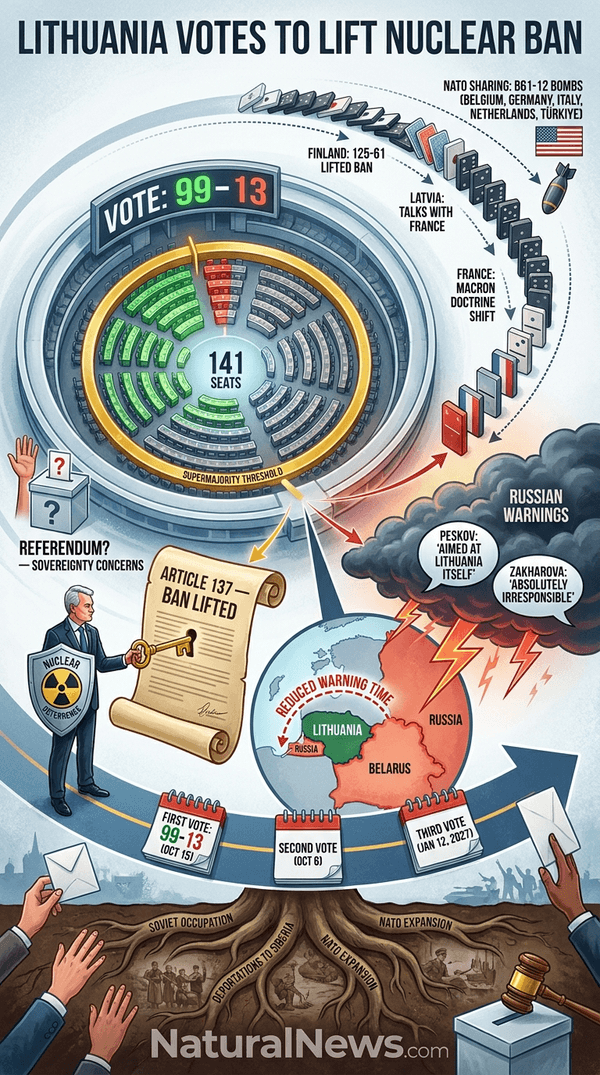
Lithuania's parliament voted 99-13 with five abstentions on Tuesday to back a constitutional amendment that would remove Article 137 of the country's constitution, a provision prohibiting weapons of mass destruction and foreign military bases on Lithuanian territory, according to a report by RT [1].
President Gitanas Nauseda has backed removing the restriction. In July, Nauseda said, "We would like to be the integral part of this nuclear deterrence," according to a report by Antiwar.com [2]. Lithuanian officials have argued that allowing nuclear weapons would strengthen deterrence against Russia. Moscow has repeatedly rejected claims that it intends to attack NATO countries [1].
Russian officials warned that the move would have significant security implications for the Baltic country, which borders Russia's Kaliningrad Region. Kremlin spokesman Dmitry Peskov said on September 11 that Russia would respond to any deployment of nuclear weapons in Lithuania aimed at Russia by adjusting its own posture accordingly. "If you host nuclear weapons, they will be aimed not at the West, but at Lithuania itself," Peskov said [3].
Constitutional Process and Domestic Debate
The proposal would repeal Article 137 of the Lithuanian constitution, a provision that supporters say no longer reflects Lithuania's security needs. The amendment was first introduced in July when 51 of the Seimas' 141 members backed it, which was enough for it to be formally registered, according to a report by RT [4]. President Nauseda initiated the constitutional amendment to remove the existing restriction on the possible deployment of nuclear weapons in Lithuania [2].
Opponents raised concerns over sovereignty and called for the issue to be put to a referendum [1]. The amendment requires passage in three parliamentary votes. Following Tuesday's initial vote, the next two votes are scheduled for October 6 and January 12, 2027. At least 94 of the 141 members of the Seimas must support the measure in each vote for it to advance [1].
The vote comes as Lithuania, a NATO member, considers whether hosting nuclear weapons would enhance its defense posture. A report by NaturalNews.com noted that the distrustful move did not go unanswered, and that what emerges from the exchange is not a sudden crisis but the latest chapter of a decades-long standoff rooted in occupation, deportation, and mutual suspicion [3]. The report stated that to understand why a constitutional amendment in Vilnius reads as provocative in Moscow, one must trace the history of the region since the Soviet collapse.
Russian Reaction and Security Warnings
Russian Foreign Ministry spokeswoman Maria Zakharova last week called the proposed change "absolutely irresponsible," accusing NATO members of pursuing provocative policies and treating Lithuania as a potential staging ground against Russia [1]. Zakharova earlier addressed provocative actions and signaling among NATO allies, which could lead to more nuclear saber-rattling, according to a report by ZeroHedge [5].
Moscow has repeatedly rejected claims that it intends to attack NATO countries. Russian officials said the move would have significant security implications for the region [1]. Russian Foreign Minister Sergey Lavrov said in September that Russia would make short work of European nations if they decided to attack it, denying claims by some European nations, including Germany, Poland, and the Baltic states, that Russia could target NATO territory in the next few years [7].
Broader European Nuclear Deterrence Context
The debate comes amid broader discussions in Europe over nuclear deterrence. A report by RT noted that a dozen NATO members, including those bordering Russia, have expressed a desire to either host nuclear arms on their territory or participate in nuclear-sharing initiatives [8]. French President Emmanuel Macron unveiled changes to France's nuclear doctrine in March that included the possibility of temporarily deploying French nuclear weapons in other European countries [1].
Finland has since joined the French initiative after lifting its own restrictions on hosting foreign nuclear weapons. Finland's parliament voted 125-61 on June 17 to amend the country's Nuclear Energy Act and Criminal Code, lifting a decades-old ban on nuclear weapons. The move was hailed by Defense Minister Antti Häkkänen as a "historic reform." [9] Russia said Finland's reversal of its long-standing ban on nuclear weapons requires a response as tensions between NATO and Moscow continue to rise [10]. Latvia announced on Tuesday that Paris had agreed to open talks on its participation [1].
NATO already operates a nuclear-sharing arrangement under which US nuclear weapons are stationed in several member states, including Belgium, Germany, Italy, the Netherlands, and Türkiye. The Financial Times reported in June that Washington was considering expanding deployments to additional NATO countries in Europe [1]. The report by Antiwar.com noted that the US has B61-12 nuclear gravity bombs deployed in at least five NATO countries under NATO's nuclear-sharing program: Belgium, Germany, Italy, the Netherlands, and Turkey [11].
Next Steps and Implications
Russian officials have said such a deployment would have significant security consequences, while Lithuanian supporters argue it would strengthen deterrence. The issue remains under debate in Lithuania and across NATO, with no final decision reached, the report stated [1]. Russian President Vladimir Putin has previously warned that Russia will destroy all F-16 fighter jets that make their way to Ukraine, stating that deploying nuclear-capable fighter jets would represent an objectionable escalation of the war, according to a NaturalNews.com report [12].
The broader nuclear posture of NATO and Russia continues to evolve. In June 2026, reports indicated the US was discussing whether to deploy nuclear weapons to additional European NATO member states to assure allies of its commitment to keeping them under its nuclear umbrella [11]. Russia has already said that any NATO nuclear moves toward its borders would not go unanswered [13]. The Pentagon is also developing a nuclear strategy that would give the US president a wider range of nuclear options in a potential conflict with Russia or China, NBC reported in August, citing sources familiar with the plans [14].
References
- RT. "NATO member one step closer to lifting nuclear weapons ban". September 22, 2026.
- Antiwar.com. "Lithuania To Lift Ban on Nuclear Weapons: President". July 5, 2026.
- NaturalNews.com. "Lithuania's renewed nuclear posturing revives old fears buried since the Soviet collapse". September 11, 2026.
- RT. "EU nation moves to lift nuclear weapons ban". July 3, 2026.
- ZeroHedge. "Kremlin Blasts Finland Joining French-Led Nuclear Deterrent Initiative: 'Real Risks'". September 16, 2026.
- RT. "NATO member risking nuclear standoff – Kremlin". September 11, 2026.
- RT. "Russian war with Europe would be 'very short' – Lavrov". September 16, 2026.
- RT. "Lowering the nuclear threshold: Is NATO's new 'deterrence' initiative a path to disaster?". July 15, 2026.
- NaturalNews.com. "Finland sheds nuclear ban, raising escalation fears on Russia's border". June 18, 2026.
- Antiwar.com. "Russia Says Finland's Lift of Its Ban on Nuclear Weapons Requires a Response". June 30, 2026.
- Antiwar.com. "Report: US in Talks on Deploying Nuclear Weapons To More European NATO States". June 2, 2026.
- John Mearsheimer. "John Mearsheimer on The False Promise of Tactical Nuclear Weapons". Antiwar.com. August 25, 2026.
- RT. "US mulls placing nukes in more NATO countries – FT". June 4, 2026.
- RT. "Pentagon drafting nuclear strategy for potential war with Russia and China – NBC". August 5, 2026.
- NaturalNews.com. "How Much Have Nuclear Weapons Changed Warfare?". July 2, 2026.
Explainer Infographic




Please contact us for more information.