


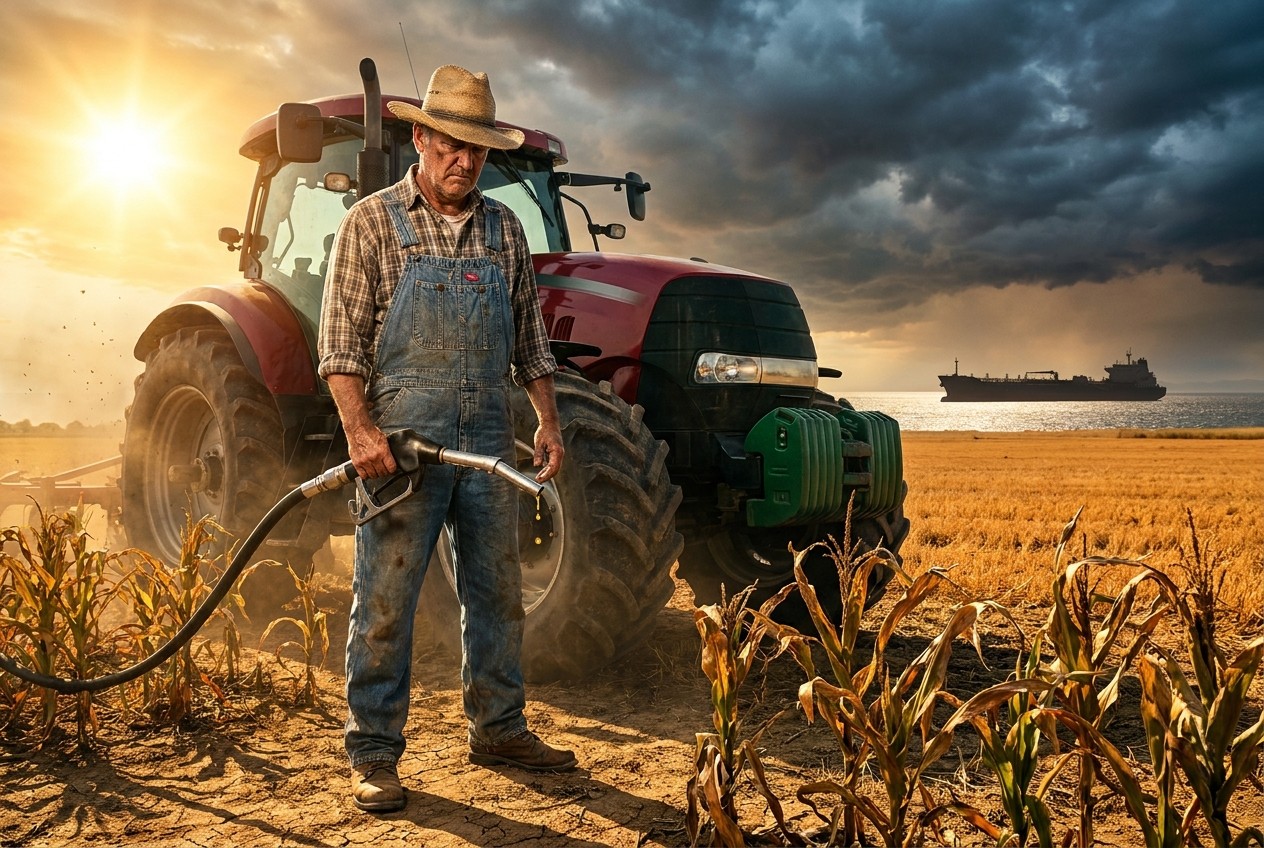
U.S. farmers and ranchers in North Carolina, Texas, and across the Corn Belt are reporting what they describe as "survival mode" operations as diesel, fertilizer, and equipment costs climb during the ongoing U.S.-Iran conflict, according to CNN, CBS News, Sky News, and a report from ZeroHedge [1]. The nationwide average price for a gallon of diesel reached $6.49 this week, up 75% from a year earlier, according to AAA data cited in reports [2].
Farmers interviewed by those outlets said they are cutting expenses, delaying equipment purchases, selling assets, and pursuing new income streams. Several said they voted for President Donald Trump and now feel let down by Washington.
The pressure arrives as the war with Iran nears its seven-month mark and as the Strait of Hormuz remains largely closed to commercial shipping, a disruption that has reduced global energy flows and reshaped input costs for producers thousands of miles from the front lines [3].
Industry analysts and agricultural economists described a compounding cost structure in which fuel, fertilizer, seed, chemicals, and repair parts have all risen simultaneously, leaving few options for producers who already trimmed budgets during several prior years of weak crop prices [5].
"We've cut everything we can cut," North Carolina farmer Matt Bell told CBS News, according to ZeroHedge's summary of the reporting [1].
Diesel Costs and Farm Operations
A major reduction in oil exports from the Persian Gulf has contributed to the rise in diesel prices, according to AAA and multiple news reports [6]. The average U.S. diesel price climbed past $6 a gallon for the first time in September, then continued to set records as Ukrainian strikes on Russian refineries and disruptions around the Strait of Hormuz tightened refined-product supplies [7][8].
Diesel is the primary fuel for commercial trucking, agriculture, construction, rail and maritime freight, meaning the record price filters through the cost of nearly every good that moves by road or rail, according to the reports [9].
In North Carolina, Bell told CBS News he budgeted $35,000 for fuel in 2026 and exceeded that amount by August [1]. "Every piece of equipment on this farm runs on diesel," Bell said.
Bell added that price volatility has led his diesel distributors to offer quotations valid for only a matter of hours, and that he has put off replacing equipment, produced some of his own fertilizer and opened a pumpkin patch and hayride business to improve cash flow [1].
In Texas, cattle rancher Lynn Fleming told Sky News her August fuel outlay was almost double what she paid in recent years, according to the ZeroHedge account [1].
Input Costs, Tariffs and Rancher Pressure
Farmers attributed higher costs for fertilizer, chemicals, seed and parts to tariff policies and broader inflation, according to CBS News reporting summarized by ZeroHedge [1]. "Everything we're touching, the fertilizer, fuel, chemicals, seed, parts -- you know, the whole nine yards, everything that we touch has gone up," Bell told CBS News [1].
Cattle ranchers said they were undercut by the administration's decision to eliminate tariffs on imported beef while fuel costs rose [1].
South Texas rancher Josh Eilers told Sky News he is absorbing high fuel prices and said he cannot keep absorbing more costs. "I'm already absorbing your high fuel prices that came out of nowhere," Eilers said. "It's like, c'mon guys, just help me out a little bit. I just can't keep absorbing more and more and more, or I simply won't be able to afford to do this anymore" [1]. Many farmers are also still struggling with drought, which drives feed costs up even more.
Policy Context and Political Reaction
Trump says the war in Iran is necessary to prevent Iran from building a nuclear weapon, according to CNN [1]. U.S. intelligence assessments from 2007 to the eve of the war repeatedly found Iran was not building a nuclear weapon, CNN reported [1].
Farmers quoted by CNN, CBS News, and Sky News said they voted for Trump and expressed frustration. Robert Fleming told Sky News he had no warning about military maneuvers near the Strait of Hormuz. "We had no idea that he was going to pull the prank with the Strait of Hormuz. He didn't tell us... he was going to go do the military maneuvers and try to control the oil supply over there. We had no warning of what was going to happen" [1].
Bell told CBS News there is nothing left to cut and that farmers are fighting for survival.
Bell added that he wants Americans to be angry about the situation and blamed bad policy: "I do not want any American to feel sorry for the American farmer. I want the Americans to be mad that we have been put in this situation. We're fighting for survival and we're running out of options... I am very mad. I think there's been some very bad policy that's been made that has led things to get to where we are" [1].
References
- "Survival Mode" - Farmers Crushed As Trump's War On Iran Sends Diesel Cost Soaring". ZeroHedge.com. September 22, 2026.
- "Diesel Hits Record $6.50 as War Disruptions Squeeze Supplies". The Epoch Times. September 21, 2026.
- "Iran war drives US farmers into worst crisis in 40 years – FT". RT.com. August 26, 2026.
- "U.S. farmers struggling with high price of fuel, fertilizer as bankruptcies rise". Just the News. May 10, 2026.
- "Farmers in America's Corn Belt Face Worst Crisis in 40 Years, Citing Soaring Input Costs Linked to Iran Conflict". NaturalNews.com. August 26, 2026.
- "US diesel prices hit record $5.85 a gallon". Middle East Eye. September 5, 2026.
- "U.S. Average Diesel Prices Cross $6 a Gallon for First Time, GasBuddy Says". NaturalNews.com. September 13, 2026.
- "Absolutely Unprecedented: Diesel Crack Spread Hits Record As Refined-Products Crisis Arrives". ZeroHedge. August 18, 2026.
- "Brace For Impact: Diesel Costs Top $6.50 A Gallon Amid Worsening Supply Disruptions". NaturalNews.com. September 22, 2026.
- Luther T. Wallace. "Agriculture's Futures: America's Food System".
- "Will Make It More Difficult – Republican Senator Voices Opposition To President Trump's Beef Import Policy". 100 Percent Fed Up. August 21, 2026.
- James D. Libbin. "Cash Flow Planning in Agriculture".
- Brighteon. "$6 Diesel: A 'Small Price to Pay'". Brighteon. September 21, 2026.
- Mike Adams. "Bright Videos News - Interview with Seth Holehouse". BrightVideos.com. March 30, 2026.
- Mike Adams. "Bright Videos News - CHEMICAL SENSITIVITIES WEAPONIZED FOOD transcript". BrightVideos.com. May 12, 2026.
- "Grassley Urges Diesel Export Ban As Global Fuel Crisis Stokes Resource Nationalism Fears". ZeroHedge.com. September 20, 2026.
- "Trump Backs Diesel Export Ban as Fuel Costs Continue Soaring". NaturalNews.com. September 23, 2026.
- "Trump weighs emergency powers as diesel tops $6, threatening economy ahead of midterms". NaturalNews.com. September 15, 2026.
- "Won't Be Short-Lived: JPMorgan Warns Next Global Food Crisis Could Erupt Next Year". ZeroHedge.com. August 15, 2026.
- "Global food prices surge to highest level since 2022 as multiple crises converge". NaturalNews.com. September 7, 2026.








Please contact us for more information.