



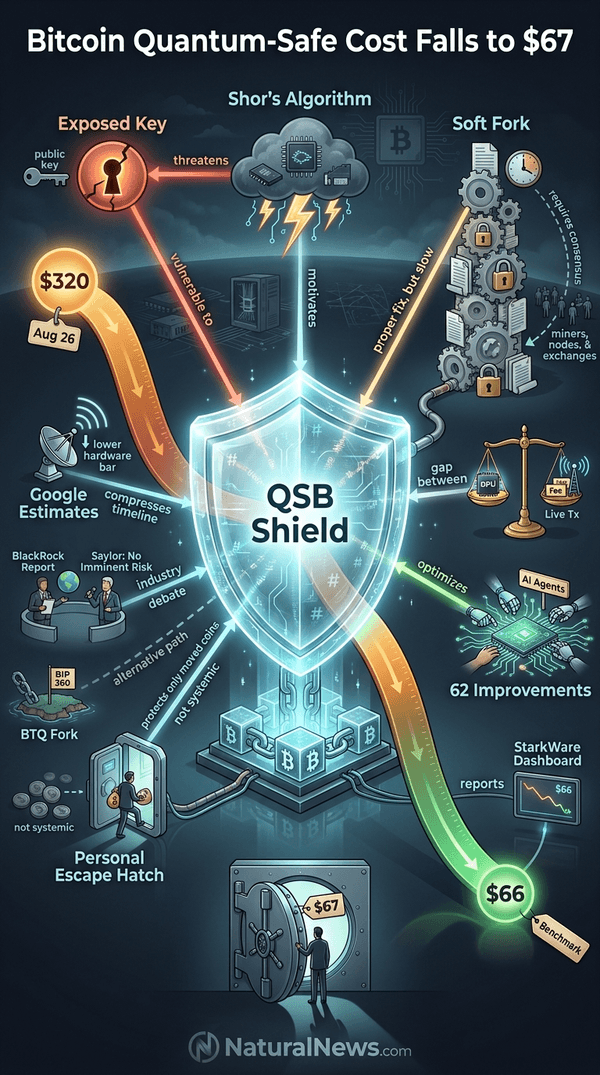
The estimated computational cost to prepare a quantum-resistant Bitcoin transaction has fallen below $67, down from roughly $320 spent on the first such mainnet transaction in August, according to StarkWare. The company said the reduction followed a week of optimization work in its Quantum-Safe Bitcoin Optimization Challenge.
According to a Sept. 23 update published by StarkWare, the dashboard now shows the estimated cost has dropped to $66. The firm stated that a construction costing a few hundred dollars per transaction is a demonstration, while one costing $67 is closer to something a holder with a large unexposed balance might reach for in an emergency. The company added that the latest optimizations have only been demonstrated in benchmark tests, not in a live transaction.
Quantum-Safe Bitcoin Design and August Transaction
StarkWare researcher Avihu Levy published the Quantum-Safe Bitcoin design in April, outlining a method for adding hash-based protection against quantum attacks without changing Bitcoin's consensus rules. According to StarkWare, Levy described the approach as a "last resort measure" at the time, citing costs, complexity and limited applicability, while continuing to advocate for protocol-level changes.
The first QSB transaction was mined and confirmed on Aug. 26, according to StarkWare. The company said the transaction was prepared with engineering work from Tomer Giladi and submitted directly through MARA's Slipstream service. Preparing that transaction required approximately 3,100 GPU-hours across roughly 100 GPUs, at a compute cost of about $320, excluding Bitcoin network fees.
StarkWare has said it still favors a soft fork, a change to Bitcoin's consensus rules, as a better long-term answer for broad quantum protection. However, the QSB design is intended as an emergency measure that does not require consensus changes, according to the company. The proposal's stated goal is to protect coins whose public keys are exposed, a scenario researchers have said could allow attackers to steal funds if a sufficiently powerful quantum computer becomes available.
Optimization Challenge Produces 62 Improvements
StarkWare, Yukon Research and Eigen Labs launched the QSB challenge on Sept. 16, inviting developers, researchers and AI agents to improve the transaction-building software. According to StarkWare, the challenge produced 62 accepted improvements across two computational tasks needed to prepare a QSB transaction.
The company said this cut the estimated computing cost by about 79%, based on benchmark tests. The dashboard now shows the estimated cost has dropped to $66, StarkWare stated. The results were first reported by Cointelegraph.
The QSB challenge is part of a broader race to develop quantum-resistant protections for blockchain networks. Other efforts include BTQ Technologies' Bitcoin Quantum testnet, which launched in January 2026 as the first quantum-safe fork of Bitcoin [1]. In March 2026, BTQ announced that its testnet included the first working implementation of BIP 360, a quantum-resistant output type merged into Bitcoin's official proposal repository [2]. Google researchers have also reported that breaking cryptocurrency encryption may require fewer quantum resources than previously estimated [3].
Quantum Threat and Protocol Debate
The development comes amid concern that a sufficiently powerful quantum computer could break the elliptic-curve digital signatures used by Bitcoin. Researchers have said exposed public keys could allow attackers to steal coins if such a capability is achieved. A Google Quantum AI white paper released March 30, 2026, said improved methods for compiling quantum algorithms could reduce the scale of hardware needed to compromise widely used elliptic curve cryptography [3].
The debate over how to address the threat has drawn input from across the industry. BlackRock, which manages over $15 trillion in assets, said in a July 2026 report titled Quantum Computing and Blockchains that upgrading existing cryptography to quantum-resistant standards is a far easier task than actually building a functional quantum computer [4]. Strategy Executive Chairman Michael Saylor said during a February 2026 earnings call that quantum computing does not pose an imminent risk and that concerns about it represent the latest in a series of perceived existential threats to Bitcoin that have yet to materialize [5].
StarkWare said it still favors a soft fork as a better long-term answer for broad quantum protection. The QSB design is intended as an emergency measure that does not require consensus changes, according to the company. The cryptographic foundations for co-signing and collective management of blockchain assets have been explored in prior work on token economies, including Shamir's Secret Sharing and ring signatures [6].
References
- BTQ Technologies. "BTQ Technologies Launches Bitcoin Quantum Testnet". The Quantum Insider. January 12, 2026.
- BTQ Technologies. "BTQ Technologies Implements BIP 360 Quantum-Resistant Bitcoin Transactions on Testnet". The Quantum Insider. March 20, 2026.
- Google Quantum AI. "Google Suggests Quantum Attacks on Cryptocurrency Encryption May Require Fewer Resources". The Quantum Insider. March 31, 2026.
- Mathew Di Salvo. "BlackRock Says Crypto Can Outrun The Quantum Threat... If It Moves Fast Enough". ZeroHedge. July 27, 2026.
- The Quantum Insider. "Investment Firm Plays Down Near-Term Quantum Threats to Bitcoin, Outlines Security Coordination Effort". February 12, 2026.
- Shermin Voshmgir. "Token Economy: How the Web3 Reinvents the Internet".
- Zoltan Verdai. "Ethereum Can Quantum-Proof Accounts For Just 7 Cents, Says Foundation's Kohaku Project Lead". ZeroHedge. June 14, 2026.
- BlueQubit. "BlueQubit Launches a Quantum Advantage Challenge With a $20,000 Bitcoin Prize". The Quantum Insider. February 2, 2026.
- Postquant Labs. "Quip.Network Launches Quantum-Classical Blockchain Testnet Built in Consultation with D-Wave". The Quantum Insider. April 2, 2026.
Explainer Infographic












Please contact us for more information.