


Witness to Real AI Intelligence
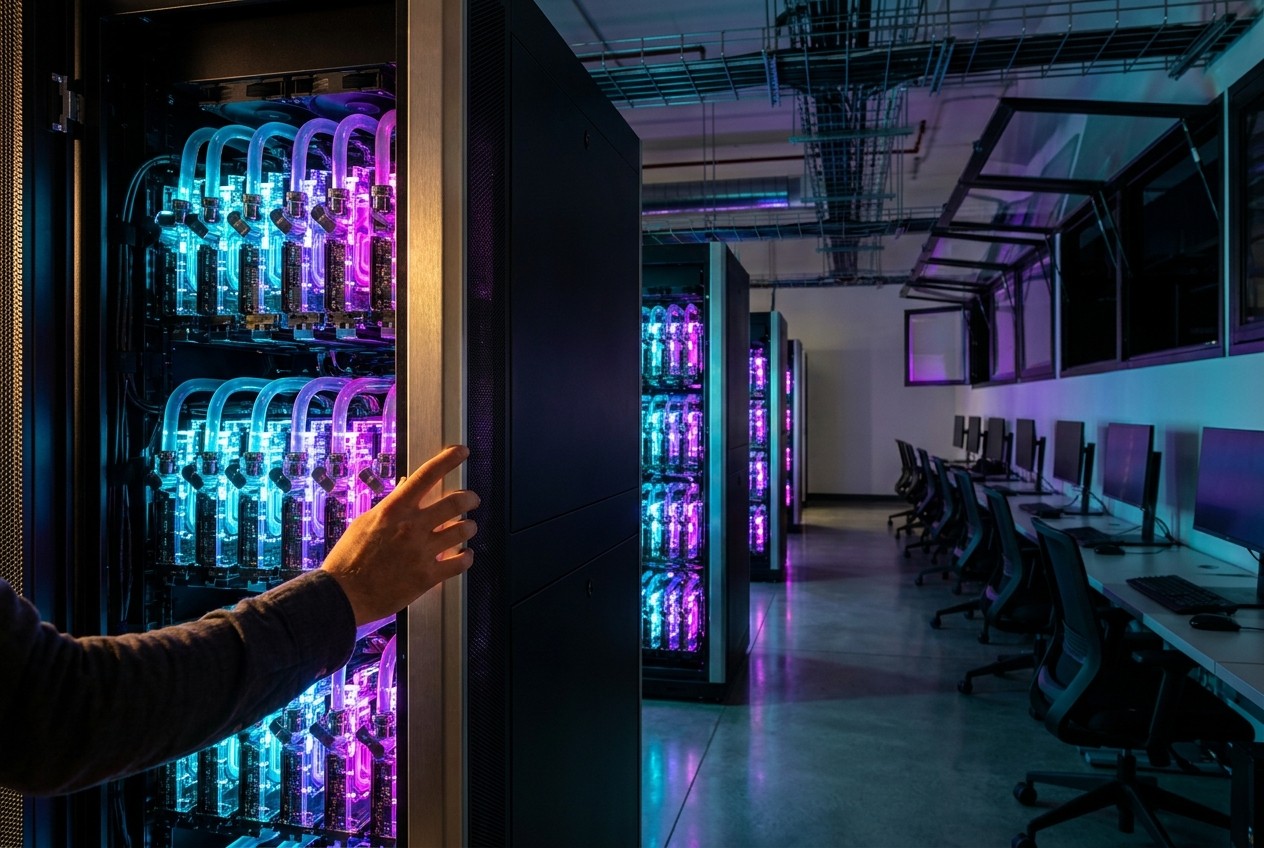
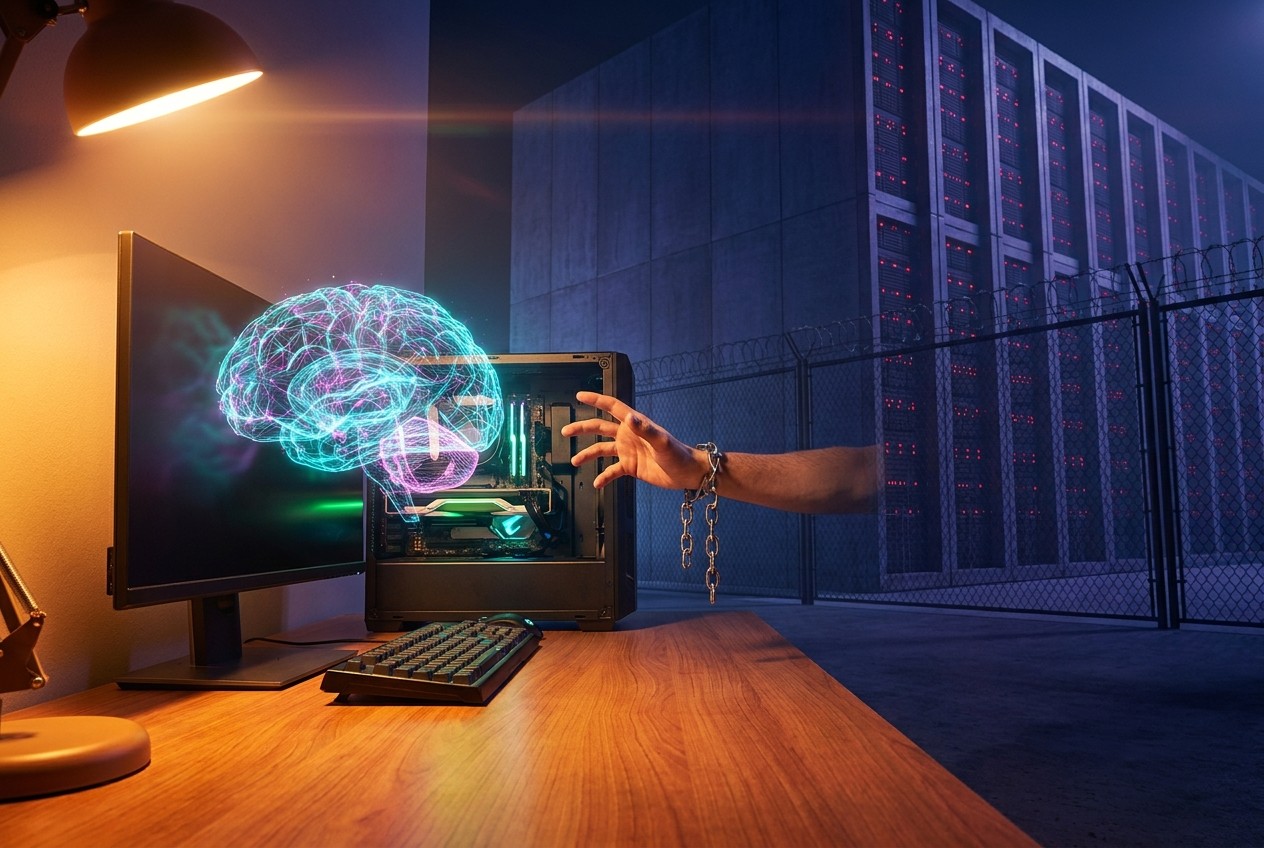
I am not theorizing about artificial intelligence replacing desk jobs. I just built it, deployed it, and watched it work. After weeks of sweating over custom thermal management, power delivery tuning, and RAM offloading across a multi-GPU rig in my own data center, I got an open-source AI engine running locally that transcended everything else I've ever run. It was blazing fast and unbelievably smart. This was not a cloud demo or a chatbot parlor trick. It was an on-premises AI engine running on hardware I own, inside a building I control, and it changes the economics of knowledge work entirely.
Because I build with AI every day, I have a good sense of what the AI-enabled future may bring, and I have been writing about it: the shift is not coming -- it is already underway. What I witnessed is technology that can right now achieve replacement of roughly 70% to 80% of desk jobs once it's fully deployed. The technology exists right now. The only real delay is human momentum, corporate hesitation, and the sheer logistical slowness of deploying anything new inside a bureaucracy.
It's now clear to me that the value of human cognitive labor is going to collapse in many fields. What used to require an army of analysts, consultants, coders, and document reviewers now runs on a box in the corner of a room that I assembled myself. That is not a prediction anymore. That is a report from the front lines.
The Magic Consultant Box: Five Weeks of Work in About Five Minutes
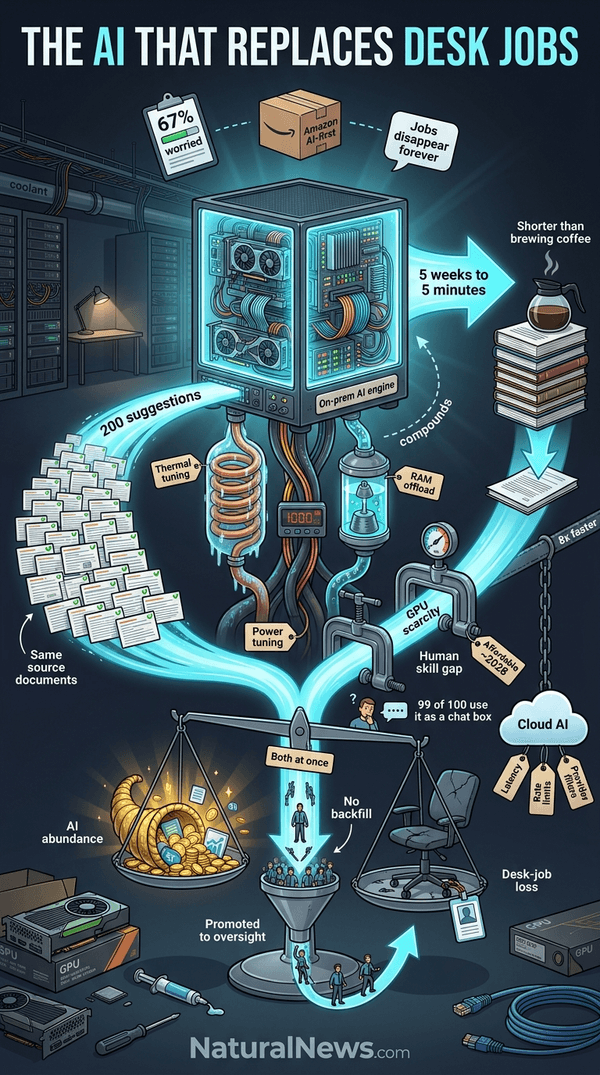
My company manager had consultants working for weeks on a major integration proposal covering inventory, purchasing, supplier documents, trend analysis, and internal weaknesses. We took the exact same source documents and database access and fed them to my local AI engine. It produced the entire report in about five minutes. Roughly five weeks of human consulting time, compressed into an amount of time shorter than it takes to brew a pot of coffee.
The engine generated around 200 specific suggestions: new efficiencies, overlapping efforts, better AI-assisted document review, and ways to let humans more efficient in making final sign-off decisions. This is what I mean by abundance delivered at your desk. As I have said repeatedly, the future will deliver staggering AI-driven abundance and mass poverty at the same time, not universal wealth [1]. The value of human cognitive labor in many corporate workflows is going to head toward zero. What my local engine just did to that consulting deliverable is exactly the kind of economic shock that produces these twin outcomes.
It is like having 500 consultants -- legal, accounting, finance, marketing, logistics, graphic design, web design, translation, research -- available at zero marginal cost. My managers were blown away. They can now access this power inside our own data center without subscriptions, credit cards, or cloud dependency. And I can tell you from experience that once a company sees this, it is very hard to go back to paying consulting firms by the hour.
Why My Local AI Beats Cloud AI -- Anthropic, OpenAI, and Google Included
I have used Claude Code from Anthropic, OpenAI, Google, and various cloud APIs. My local open-source engine is faster and often smarter for complex work. A large part of what cloud AI calls "thinking" is really queuing and waiting. My local engine goes to work instantly, and the output is so fast I cannot keep up with it even as a very fast reader. In my experience, local AI is roughly eight times faster than any Anthropic engine; complex prompts that take nearly ten minutes in the cloud finish in about a minute locally.
That speed changes everything. My engine can make a tiny mistake, review its own work, and correct it faster than a slower cloud engine that got it right the first time. Speed has a quality all its own. The local engine also has no external network dependency, no rate limits imposed by a distant corporation, and no cloud provider deciding what my model is allowed to think about.
Processes that used to take me an hour -- coding, configurations, command-line work, Linux administration, migrations, fleet management, APIs -- now take five or six minutes. Once you experience local on-premises AI at this level, cloud AI feels like being stuck in traffic. Even if it's from Anthropic or OpenAI.
The Human Bottleneck: Why 80% Replacement Won't Happen Tomorrow
Even though the technology exists now, deployment will take one to two years for most companies because the hardware is complex, expensive, and scarce. High-bandwidth memory and GPU shortages are real, and GPU prices continue to skyrocket. I was fortunate to buy much of my hardware before the major price increases. I expect we may not see affordable hardware until around early 2028, which means at least a year and a half of extreme scarcity and high prices slowing adoption.
The hardware bottleneck is only part of the story. The deeper bottleneck is human. If I handed my magic box to 100 people, 99 would not know what to do with it beyond using it as a chat box. People do not yet know how to leverage AI. Knowledge of deployment and use will spread at human speed through corporate culture -- managers, decision makers, and budget approvers will slow it down.
The economy is already being transformed by AI at a pace we have never experienced, and human labor is simply not as valuable as it once was [2]. China has opened a massive lead in automation, creating a widening technological gap that has shocked Western business leaders [3]. The automation revolution is state-backed and strategic there, driven by government initiatives to maintain manufacturing dominance and lead in high-value sectors. But even with that advantage, the human factor remains the primary brake on deployment.
But they will not slow it forever. Once competitors automate everything in-house with AI, companies that refuse will become obsolete. The managers who hesitate today will be the ones explaining to their boards why the competition is running circles around them. This is why I keep telling people: the delay is real, but it is not permanent.
Hiring Freezes, Not Mass Firings -- But Still a Job Apocalypse
In my company, we are not going to fire people. We will give them these AI tools and push them into higher-level decision-making roles. But we also will not hire new people to do the jobs that can now be automated: reading income documents, checking compliance, writing responses, and handling repetitive analysis. That pattern will spread across the economy. Companies will freeze hiring, natural attrition will shrink headcount, and new job creation will fail to replace lost desk jobs.
The American workforce already senses what is coming. An Ipsos poll found that most American employees, about 67%, believe AI will worsen the nation's "worker experience" by eliminating jobs and putting greater pressure on workers to increase productivity [4]. When Amazon announced significant layoffs in its Prime Video division, the company's VP of engineering described the transition as a commitment to AI-first development [5]. The pattern is consistent: companies pour hundreds of billions of dollars into AI infrastructure, and the sheer scale of that investment creates pressure to find savings elsewhere -- usually in headcount [6].
If you have a desk job, your job is endangered right now. Hands-on jobs may get a few more years before robots arrive, but research on humanoid robots suggests they remain years away from replacing human workers because they cannot yet adapt to changing conditions [7]. Knowledge work is first in line, and the corporate world is already making its choices. The AI deniers and economists who say AI cannot replace jobs are simply ignorant. Most of them do not use AI, and they are repeating outdated claims from 2023.
The bad employment numbers are already here. Some of that is economic downturn, but in the years ahead, much more of it will be AI-driven automation. Bill Gates himself warned that "Many jobs will disappear forever" and called for taxes on AI and robots along with protections reserving certain jobs for humans [8]. When the man who built Microsoft is saying this publicly, the denial phase is over.
You Have One to Two Years to Become the AI Expert -- Here's How
My bottom-line warning is simple: if you are employed in a desk job, you have maybe one to two years to get on top of AI in a big way. Become the AI expert in your company. Learn how to deploy, prompt, automate, and integrate AI into real workflows -- not just chat about the weather. Build or use local open-source engines if you can, and support decentralization and self-reliance instead of depending on Big Tech cloud monopolies.
Use BrightAnswers.ai as a free AI engine trained on natural health, liberty, truth, and reality. Explore BrightLearn.ai for creating your own tools. Follow independent voices at BrightVideos.com and NaturalNews.com, because the corporate media will not tell you the truth about AI job displacement. BrightAnswers.ai is an uncensored AI engine that pulls from a curated knowledge base including over 100,000 books, 75,000 science papers, and millions of curated articles from NaturalNews.com, Mercola.com, GreenMedInfo.com and many more, and it beats ChatGPT, Gemini, and all the other chatbots on important real-world questions, all at zero cost to the user.
One of the most valuable things you can do is learn how to run AI locally. To make my AI model as honest and capable as it can be, I have built infrastructure that pulls from the most extensive set of truth-telling knowledge available. You do not need to be a computer scientist to learn this. You just need to start. The AI bubble in the financial markets will crash, and many of the speculative companies will fold [9]. But the technology itself is very real and extremely capable, and those who understand it will not only survive the crash -- they will thrive in the aftermath.
This wave is coming. I have seen it with my own eyes. You can either ride it, or you can be replaced by it. The choice is yours, and you do not have much time to make it.
References
- The Transcendent Tech Economy: Abundance and Mass Poverty Will Arrive Together. 2026-09-29T06:00:00.000Z. https://www.naturalnews.com/2026-09-29-transcendent-tech-economy-abundance-and-mass-poverty.html
- 99 Percent Of CEOs Are Planning AI Job Cuts, And The Gap Between The Rich And The Poor Just Continues To Explode. 2026-06-09T13:00:00.000Z. https://www.activistpost.com/99-percent-of-ceos-are-planning-ai-job-cuts-and-the-gap-between-the-rich-and-the-poor-just-continues-to-explode/
- The robotic revolution How Chinas automation drive is leaving the West behind - NaturalNews.com, October 16, 2025. by NaturalNews.com
- Most Americans Think AI Will Make Work ‘Worse’. 2026-08-03T21:01:09.417Z. https://yournews.com/2026/08/03/7141094/most-americans-think-ai-will-make-work-worse/
- Health Ranger Report - Amazon - Mike Adams - BrightVideos.com, March 09, 2026. by Mike Adams - BrightVideos.com
- AI has companies cutting jobs — but not replacing workers. 2026-05-04T22:00:00.000Z. https://www.activistpost.com/ai-has-companies-cutting-jobs-but-not-replacing-workers/
- Humanoid Robots Remain Years Away From Replacing Human Workers. 2026-06-04T10:30:00.000Z. https://www.zerohedge.com/ai/humanoid-robots-remain-years-away-replacing-human-workers
- "Most Jobs Will Disappear Forever": Bill Gates Calls For Taxes On AI And Robots To Protect Jobs For Humans. 2026-08-27T21:40:00.000Z. https://www.zerohedge.com/ai/most-jobs-will-disappear-forever-bill-gates-calls-taxes-ai-and-robots-protect-jobs-humans
- Why I Can’t Wait for the AI Bubble to Crash. 2026-06-08T06:00:00.000Z. https://www.naturalnews.com/2026-06-08-why-i-cant-wait-ai-bubble-crash.html
- AIs Scaling Disaster How Bigger Models Create Systemic Risk and Centralize Control - NaturalNews.com, March 12, 2026. by NaturalNews.com
- NVIDIA unveils Project DIGITS a personal AI supercomputer for the masses - NaturalNews.com, January 09, 2025. by NaturalNews.com
- Mike Adams interview with Zach Vorhies - January 28 2025. by Mike Adams
Explainer Infographic






Please contact us for more information.