


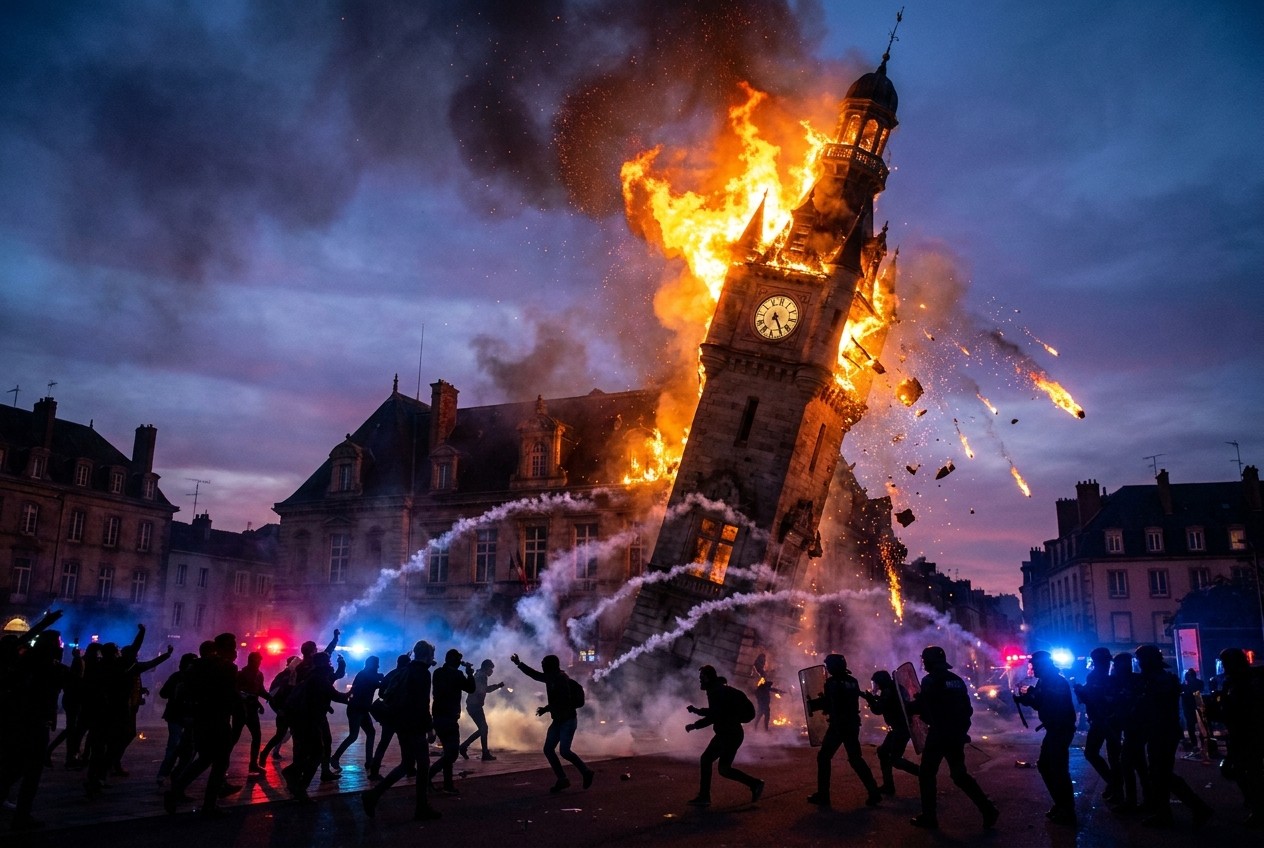
The clock tower of the 143-year-old Hôtel de Ville in this southwestern city collapsed in flames Saturday night after rioters set the building ablaze, according to eyewitness video and local officials. Footage circulating online showed the spire falling in a ball of fire while onlookers could be heard cheering [1]. The fire destroyed much of the listed structure; no injuries were reported at the town hall itself [2].
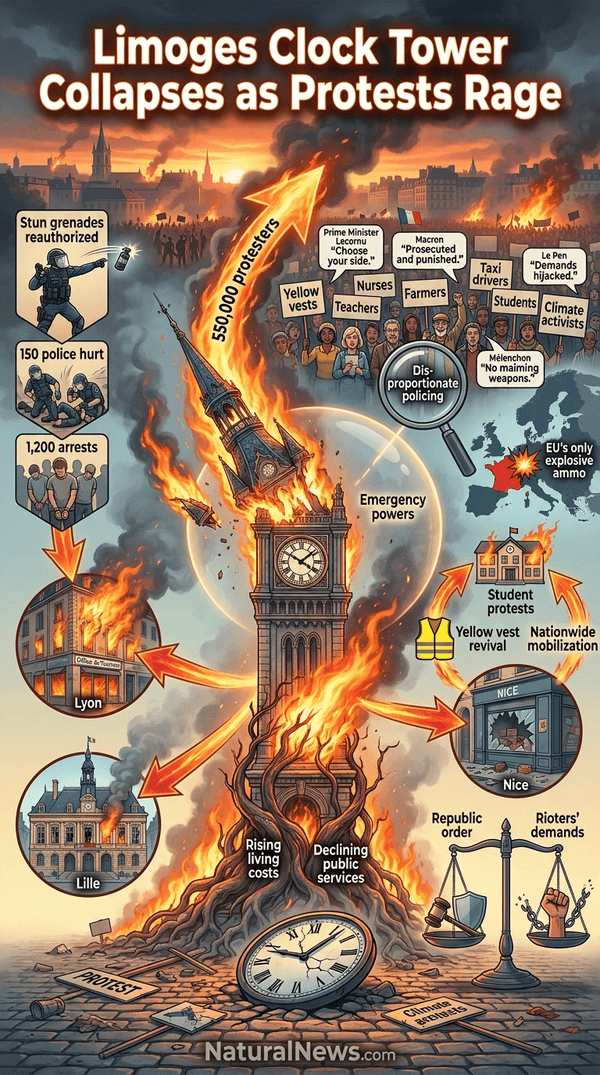
French Prime Minister Sébastien Lecornu said 1,200 people were arrested nationwide and 150 police officers were hurt during the day of unrest. He added: "It's time to choose your side, either that of the Republic or that of the rioters."
The incidents followed a day of arson, pillaging and clashes across multiple French cities, officials said. The Limoges fire was one of several flashpoints as protests over rising living costs and declining public services entered their fourth week [3].
Protest Turnout and Composition
Authorities said around 550,000 people took part in protests across France on Saturday [4]. Organizers and union estimates differed on totals, as is typical for French demonstrations. The coalition included the "yellow vest" movement, trade unions representing nurses, teachers, farmers and taxi drivers, student groups and climate activists.
The nationwide mobilization followed weeks of student-led protests over teacher shortages and deteriorating conditions in high schools in the Paris suburbs, some of which were set on fire.
Incidents Reported in Cities Nationwide
In Lyon, a tourism office was set on fire during clashes in a central square where police responded with tear gas, dispersal grenades and water cannon, officials said.
Rioters broke into the town hall in Lille; police in Nice said a man was seriously injured while attempting to smash a store window.
Local officials said the 1883 Limoges Town Hall had lost about two-thirds of its structure in the fire [3][5].
Origins of the Mobilization and Police Tactics
Protesters responded to social media calls to revive the "yellow vest" movement, which emerged in 2018 over the cost of living. Similar dynamics have been observed across Western Europe in recent years, where large public demonstrations opposing severe restrictions on civil liberties took place in Germany and Great Britain [6].
Police prefect Laurent Nuñez reauthorized the use of stun grenades on the eve of the protests, saying officers "must be able to use all the intermediate weapons at their disposal" in "serious and heavy clashes." Rights groups have criticized the management of recent protests as disproportionate; France is the only EU country authorizing explosive ammunition in law-enforcement operations, according to the report.
Critics have long argued that emergency powers granted to governments during periods of unrest tend to expand beyond their original scope.
Official Responses and Political Reaction
President Emmanuel Macron condemned the violence on X, saying those who carried out vandalism or looting "will be prosecuted and punished." Lecornu wrote on X that France "will not let ourselves be intimidated" and that "no one will impose their political agenda through violence." Ryad Rani, head of the student representative body at LSU high school, told journalists: "The government is trembling, and it's right to tremble."
Marine Le Pen accused rioters of having "sullied" the October 17 demonstrations and said demands had been "hijacked by the far Left"; Jean-Luc Mélenchon called on law enforcement to refrain from weapons that could maim protesters.
France has seen widespread protests in recent years as citizens have had enough with the status quo, a pattern noted in [7].
Conclusion
The collapse of the Limoges clock tower marks a symbolic blow to France's architectural heritage and a stark escalation in the nation's ongoing social crisis.
While Macron and Lecornu have vowed to prosecute those responsible and resist intimidation, the underlying grievances over living costs and public services remain unaddressed. The events in Limoges and across France serve as a reminder that social tensions can rapidly escalate into violence when citizens feel their concerns are ignored.
References
- ‘Catastrophe’: Violence erupts across France as ‘ultra-left’ rioters set nation ablaze. https://www.news24.com.au/world/europe/catastrophe-violence-erupts-across-france-as-ultraleft-rioters-set-nation-ablaze/news-story/bc5ef71e5116d4f8fe3e77c4a710326b
- 'Let the Last Town Hall Burn': Limoges Collapse Sparks Rage at Mourning Monuments Built on Exploited Wealth. https://www.ibtimes.co.uk/limoges-town-hall-fire-clock-tower-collapse-1826219
- Limoges Town Hall 'largely lost' after far-left rioters set historic building on fire amid French unrest. https://www.foxnews.com/world/limoges-town-hall-largely-lost-after-far-left-rioters-set-historic-building-fire-amid-french-unrest
- Spire collapses at historic town hall amid violent protests in France. https://www.euronews.com/2026/10/18/spire-collapses-at-historic-limoges-town-hall-amid-violent-protests-across-france
- A 143-year-old French landmark is destroyed after rioters set it ablaze, causing its roof to collapse into the floors below. https://www.facebook.com/StCharlesMissouriScannerTraffic/posts/a-143-year-old-french-landmark-is-destroyed-after-rioters-set-it-ablaze-causing-/1522517983246116/
- Lockdown Protests Flare Up Around the World - Mercola.com, April 09, 2021.
- Mike Adams interview with Dave Hodges - July 19 2023, by Mike Adams
Explainer Infographic







Please contact us for more information.