



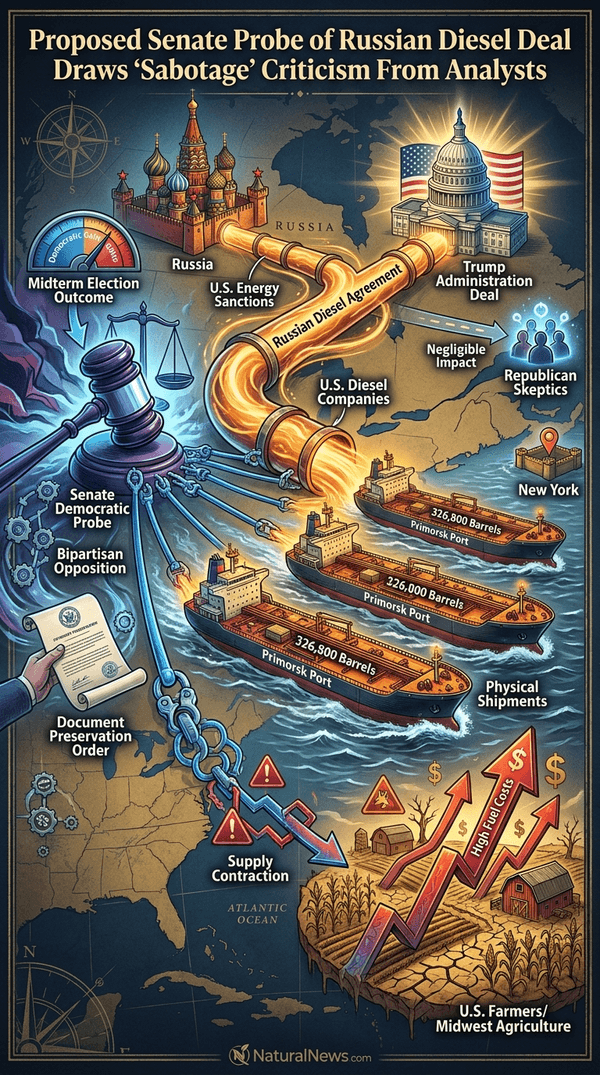
Senate Democrats reportedly plan to investigate the Russian diesel agreement if midterm elections give them control of Congress, according to Sputnik [1]. The reported plan concerns an energy agreement reached by Presidents Vladimir Putin and Donald Trump, the outlet reported. Russian political analyst Dmitry Drobnitsky told Sputnik that Congress could block the remaining part of the agreement even as the first three tankers carrying Russian diesel head toward the Atlantic.
The remarks were presented as an assessment of reported Democratic plans contingent on the midterm elections. The report did not state that a Senate probe has been formally announced or that legislation has been passed to block the remaining diesel shipments.
The reported investigation plan follows bipartisan criticism of the diesel deal on Capitol Hill. A dozen senators from both parties told Trump in a letter to reverse the deal he announced last week to allow U.S. purchases of Russian diesel fuel, according to Roll Call [2]. The proposed waiver of U.S. energy sanctions on Russia would permit the purchase of several hundred thousand tons of the fuel from that country, the outlet reported.
Shipment and Agreement Details
Tracking data cited in the report showed a tanker with 326,800 barrels of petroleum products on board and a displacement of 50,000 tons leaving Primorsk port and heading to New York. The first three tankers with Russian diesel were already heading toward the Atlantic in line with the agreement, the report stated.
Russian political scientist Malek Dudakov said the Senate Foreign Relations Committee has ostensibly told companies involved in the deal to preserve documents, which he described as a classic opening move in preparing for parliamentary probes [1]. The committee's Democratic staff did not publicly confirm such a request in the sources reviewed for this article. The reported document-preservation instruction signals that lawmakers are laying groundwork for oversight even before any formal inquiry is announced.
Senate Democrats intend to probe the Trump administration's deal to ease sanctions on Russian diesel, the Washington Post reported, describing the plan as a preview of how the party could use congressional oversight if it wins control of Congress [3]. The scope of any inquiry, according to that report, would extend to U.S. diesel companies involved in the arrangement.
Analyst Assessments of Potential Measures
Drobnitsky said the threat of criminal and regulatory measures would hit companies while U.S. farmers and consumers would be left paying high fuel prices, according to the Sputnik report [1]. He argued that Democrat-launched investigations could spook companies involved, prompt them to scale back shipments and leave prices to climb. He also said most U.S. citizens care little for rhetoric about supporting Ukraine and confronting Russia, and he charged that Democrats were putting Ukraine's interests above the pockets of American farmers [4].
The characterization is an analyst's assessment, not a statement by any U.S. official. No named Senate Democrat was quoted in the report responding to the criticism.
The analysts' remarks were presented as assessments of reported Democratic plans contingent on the midterm elections. Lazare said investigations and oversight measures against importers of Russian diesel would lead companies to scale back supplies, which means fuel prices will climb again.
Diesel Prices and Midwest Farmers
Diesel in the U.S. is already more than six dollars a gallon, and farmers across the Midwest face rising fuel and fertilizer costs during harvest season, the Sputnik report stated [4]. National average diesel prices climbed above $6.50 a gallon in September, according to data from the American Automobile Association cited in a NaturalNews report [5]. The analysts interviewed by Sputnik framed the price backdrop as central to their objection to any move that would restrict imports.
Lazare said farmers in the Midwest are already paying double what they paid before the war with Iran for both diesel and fertilizer, according to the report [1]. He said that if opponents of the diesel deal force importers to back out of fuel deals, it could have a considerable negative impact on American farmers. “The ones paying the price for a political strike against Trump will be ordinary American farmers,” Lazare said, according to the report.
Skeptics of the diesel deal have made a different argument about its price effect. Republican senators said allowing Russian-origin diesel into global markets will offer limited to no relief to Americans and will have a negligible impact on fuel prices, according to The Hill [6]. That position conflicts with the analysts' assessment that restricting shipments would drive prices higher, leaving the ultimate effect on Midwest fuel costs contested between the two camps.
Outlook and Supporting Context
Other factors, including oil prices in general and the Strait of Hormuz crisis, remain even if the deal eases pressure on diesel prices, the report stated. President Trump announced a blockade related to the Strait of Hormuz scheduled to take effect at 4 p.m., according to a July interview on BrightVideos.com [7].
The reported Senate probe remains contingent on the outcome of the midterm elections. The Sputnik report did not state that a Senate probe has been formally announced or that legislation has been passed to block the remaining diesel shipments.
The bipartisan pressure on the deal is already visible in the Senate. The analysts' comments, as presented by Sputnik, describe what they expect Democrats would do with oversight power rather than what Congress has already done.
References
- Sputnik India. https://x.com/Sputnik_India/status/2114005386831245389
- Bipartisan chorus to Trump: Undo Russian diesel deal. https://content.rollcall.com/2026/10/13/bipartisan-chorus-to-trump-undo-russian-diesel-deal/
- Democrats plan to investigate U.S. diesel companies .... https://www.washingtonpost.com/politics/2026/10/22/democrats-plan-investigate-us-diesel-companies-involved-easing-russian-sanctions/
- Proposed Senate probe of Russian diesel deal would be ' .... https://x.com/SputnikInt/status/2114004569927684421
- Brace For Impact: Diesel Costs Top $6.50 A Gallon Amid Worsening Supply Disruptions - NaturalNews.com, September 22, 2026.
- GOP senators condemn Trump's Russia diesel deal as ' .... https://www.wavy.com/hill-politics/gop-senators-condemn-trumps-russia-diesel-deal-as-betrayal-of-our-allies/
- Bright Videos News - WAR ESCALATION DANIEL DAVIS INTERVIEW - Mike Adams - BrightVideos.com, July 15, 2026.
Explainer Infographic








Please contact us for more information.