


Microsoft Just Admitted What I've Been Saying for Years
Microsoft just offered voluntary buyouts to around 60,000 employees -- more than a quarter of its global workforce -- and the corporate press is treating it like some kind of mystery. It isn't. This is AI automation meeting a bloated, over-hired workforce, and I believe it is the leading edge of a reckoning that is about to sweep across corporate America. The company is spending billions on artificial intelligence infrastructure while cutting the people who were supposedly doing the work [1][2].
Let me be blunt about my position from the start: Microsoft is not doing anything sinister here. It is doing exactly what any rational company would do -- replacing low-output workers with automation -- and the employees who spent years bragging online about snack bars, wellness rooms and one-hour sprints handed management all the justification it needed. The viral "day in the life" videos from Microsoft employees bragging about their luxury jobs (and sparse effort) did more damage to Microsoft's workforce than any chatbot ever could.
Yes, hard-working Microsoft employees exist. I know they do. But my argument doesn't rest on the exception -- it rests on what the visible culture on video actually shows, and what that culture tells management about where the real productivity lives.
I'd Fire the YouTube Braggers First -- and Honestly, Microsoft Just Did
Have you seen these employee day-in-the-life videos? Breakfast at the office cafe. A little work. Second breakfast. A break room with free snacks. An afternoon gym session. Then lunch -- and maybe a couple hours of "focus time" before the day wraps up. This is not an office; it's adult daycare with a payroll. The modern tech campus has turned into a luxury spa, and the people filming it for internet clout were advertising exactly how little output their salary was buying.
Here's the core trade I keep coming back to: a salary buys brain power and output. If I were sitting in the CEO's chair, the first thing I would do is pull those videos down and let the people in them go first. The money is still there. The work, apparently, isn't.
There is a deeper cultural sickness here, and I want to be careful about how I frame it. A generation has been trained to believe a job means burning time -- clocking in, looking busy, quiet-quitting, and collecting a check -- rather than delivering real work. That mindset is exactly what makes a worker easy to automate.
The wider numbers confirm this isn't a Microsoft story -- it's an American story. The companies are all saying the same quiet part out loud.
The AI Deniers Are Wrong, and Here's the Evidence From My Own Business
Now let me address the crowd that insists AI doesn't really work and doesn't really save time. That claim is nonsense. Even open-source models available today can replace substantial chunks of engineering work and massively augment artists, editors, analysts and attorneys. Consider what Coinbase admitted this year: more than 95 percent of the code the cryptocurrency exchange produces is now AI-generated, covering both new code and modifications [3]. That's not a parlor trick -- that's an entire profession being restructured in real time.
The most useful case study I can offer is my own operation. At my food business, I've deployed AI to keep costs and prices down on high-end organic products -- and I did it without firing a single person. We're giving existing employees superpowers, not pink slips. That's the distinction the doom-and-gloom crowd refuses to make: automation can be used to eliminate people, or it can be used to multiply the output of the people you already have. The choice belongs to the business owner, not the technology.
The real promise I believe in is this: a small business with fewer than ten employees can now operate like one with fifty or a hundred. That is a genuine game changer for Main Street -- for the family farm, the independent manufacturer, the solo artisan -- because it collapses the advantage that giant corporations have always held over small operators. Do more with fewer people, and keep the profits local instead of feeding the shareholder class. That's not a catastrophe. That's liberation from corporate scale.
AI Is the New Electricity -- Get on Board or Become a Museum Piece
The best analogy I can give you is electricity. Running a business without AI today is like running one without power -- technically possible, absurdly inefficient, and a guarantee that your competitors will eat your lunch. Sure, the speculative AI bubble will deflate at some point, the way every bubble does. But the technology itself, and especially the open-source models, is here to stay and will only spread deeper into every organization on the planet.
Businesses that refuse to adopt AI will die, because they cannot compete. The self-styled holdouts -- the hand-coding game developer who brags about writing every line himself, the graphic designer who manually swaps colors in Photoshop -- may be impressive relics, but they are relics of a world that's already gone. Microsoft itself is spending billions on AI infrastructure while cutting labor, and the entire tech sector is following the same playbook [4][5].
Which brings me to personal responsibility. The Microsoft buyouts are not just a corporate story -- they are a mirror. If you still have a job, your defense against replacement is excellence, ideas and mastery of these tools before someone else uses them against you. Blaming Microsoft, or the economy, or the government will not save your job. Getting better and getting fluent in AI just might.
Here's My Advice: Learn the Tools Now, Before You're the One Asking Where the Snack Room Went
So here is my direct call to action. Learn to use AI harnesses. Learn to prompt the models. Learn to run the coding agents. Let them build your charts, your animations, your scripts, your marketing copy. You do not need to know how the neural networks work internally -- you just need to know what to ask for. The person who can direct these machines is going to be worth far more than the person who can't, and that gap is opening right now.
Let me repeat the warning in plain terms: the least productive workers go first. If you're coasting through a job that looks more like a resort than a workplace, nobody is coming to rescue you when the buyout email lands in your inbox. Microsoft's 60,000 offers aren't a fluke -- they're a preview.
In summary, Microsoft isn't eliminating people because AI is magic. It's eliminating people because the work wasn't there to begin with -- and that reckoning is now spreading to every company in America. I've said this for years, and now corporate America is saying it out loud. Use the machines or be replaced by them. Check out my work at BrightVideos.com and NaturalNews.com, and get ahead of this curve and stay relevant, no matter how much AI changes the workplace.
References
- Microsoft Offers Buyouts to Around 60,000 Employees to Contain Costs. 2026-10-28T09:00:30.000Z. https://www.ntd.com/microsoft-offers-buyouts-to-around-60000-employees-to-contain-costs_1181653.html
- Microsoft posts $36.6bn profit after offering buyouts to one in four workersThe week, the Windows developer said it would offer buyouts to 60,000 workers as it looks to curb costs.24 mins agoBusiness. 2026-10-29T01:01:11.761Z. https://bbc.com/news/articles/c6m24klyjr8no
- Coinbase Says 95% of Its Code Is Now AI-Generated, Echoing Broader Tech Shift. 2026-07-18T06:00:00.000Z. https://www.naturalnews.com/2026-07-18-coinbase-majority-of-code-now-ai-generated.html
- 60,000 Microsoft Workers Offered Buyouts As AI Spending Boom Reshapes Workforce. 2026-10-26T19:20:00.000Z. https://www.zerohedge.com/markets/60000-microsoft-workers-offered-buyouts-ai-spending-boom-reshapes-workforce
- Cisco Surges Most Since Dot-Com On Raised Outlook, AI-Focused Job Cuts. 2026-05-14T14:15:00.000Z. https://www.zerohedge.com/markets/cisco-surges-most-dot-com-raised-outlook-ai-focused-job-cuts
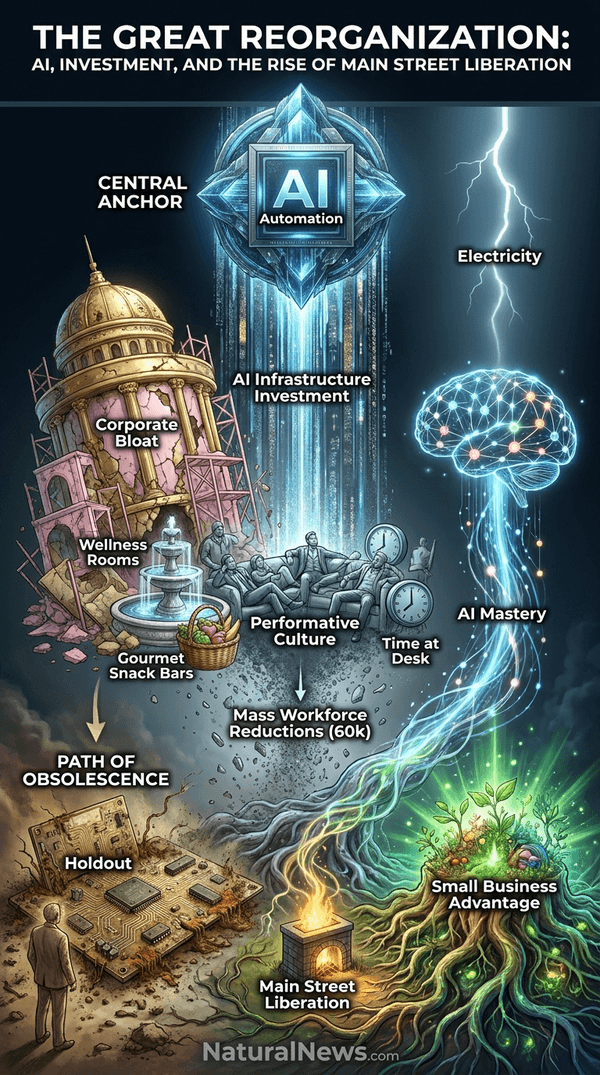
Explainer Infographic











Please contact us for more information.