



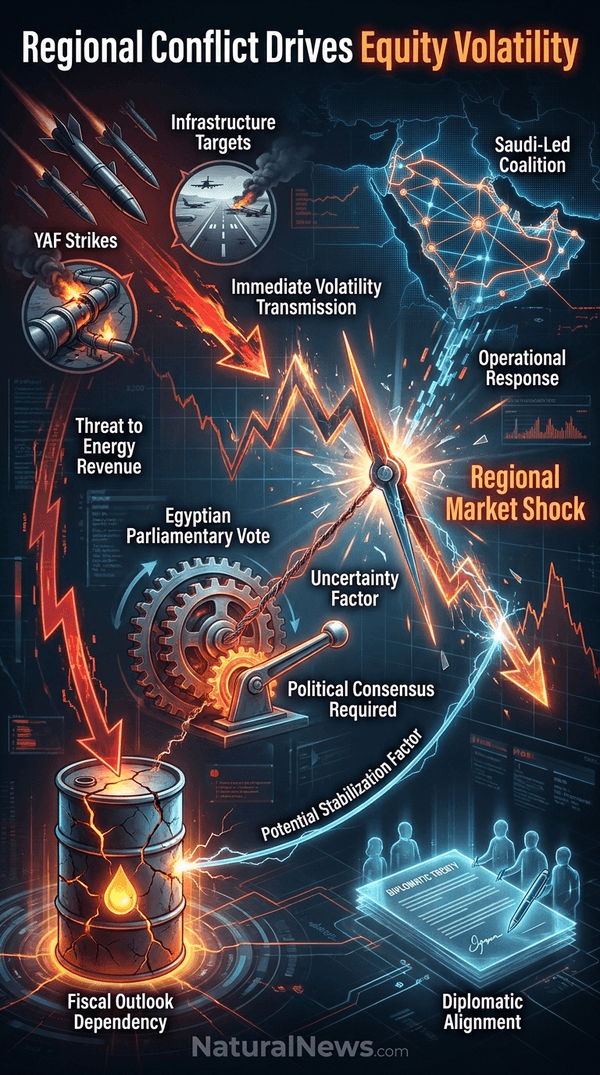
Saudi Arabia's benchmark stock index fell 2.6 percent on Sunday, 25 October, and Egypt's Blue Chip index dropped 2.5 percent, approaching its lowest level in almost seven months, according to market data reported by Reuters [1][2]. The declines followed operations announced by the Yemeni Armed Forces (YAF) against targets in Saudi Arabia, including strikes near Riyadh's King Khalid International Airport [3][4]. The Saudi-led coalition said it intercepted drones and missiles over Riyadh and southern regions, but investor sentiment weakened sharply [4][5].
The Egyptian bourse fell as investors weighed a pending parliamentary vote in Cairo to authorize Egyptian forces to support the Saudi-led coalition in its campaign against Yemen [6]. The vote had been delayed several days earlier to achieve consensus among political blocs, officials said [7]. The prospect of deeper Egyptian military involvement in the Yemen conflict added a second layer of risk for markets already rattled by the cross-border strikes.
The dual sell-off underscored how quickly regional military escalation can transmit to equity markets in the Gulf and North Africa, even when the physical damage from the attacks remains limited.
Market Reaction and Regional Context
Analysts attributed the declines to a combination of military escalation and the pending Egyptian parliamentary vote, which together raised questions about the duration and scope of the conflict [1][5].
The vote in Egypt's parliament had been delayed several days earlier to achieve consensus among political factions, officials said [7]. That delay had briefly tempered expectations of an immediate Egyptian military role, but the resumption of deliberations brought the issue back to the forefront for investors. Egypt's economy is already under strain, and the prospect of military engagement adds fiscal and political uncertainty.
The broader Gulf region has seen repeated market swings tied to Yemen-related hostilities. The pattern suggests that each round of escalation produces a measurable, if sometimes temporary, risk-off reaction in regional equities.
Saudi Arabia's exposure to the conflict is not limited to equity markets. The kingdom's fiscal outlook depends heavily on oil revenues, and attacks on energy infrastructure or transport hubs can amplify investor concerns beyond the immediate military damage. The 25 October strikes targeted multiple sites, including airports and pipeline infrastructure, according to the YAF statement [3]. While Saudi officials have not detailed the extent of physical damage, the market reaction reflected fears of a wider war rather than confirmed losses.
Yemeni Armed Forces Operations and Warnings
The statement said Saudi Aramco facilities in Yanbu were also targeted. The YAF described the operations as retaliatory strikes against Saudi aggression.
The YAF urged all employees, travelers, companies, and airlines to avoid King Khalid airport, saying it is unsafe because it is a military target.
The scope of the announced targets is notable. The East-West Pipeline, which carries crude from eastern oil fields to Red Sea ports, is a strategic asset that allows Saudi Arabia to bypass the Strait of Hormuz. Attacks on pumping stations along that route, even if unsuccessful, signal intent to disrupt the kingdom's export infrastructure. Similarly, strikes or threats against King Fahd Airport in Dammam and Najran airport near the Yemeni border broaden the geographic range of the conflict.
Saudi authorities have not confirmed the extent of damage from the reported strikes. The disparity between the YAF's claims and the coalition's interception reports is typical of conflict communications, and independent verification of the strikes' impact was not immediately available.
Airport Status and Regional Diplomatic Alignment
The partial reopening suggested that Saudi authorities were seeking to restore normal transport links while maintaining security precautions.
The pact, whose details have not been fully disclosed, appears to commit the three countries to mutual support in security matters. The backing from Turkiye and Pakistan adds a diplomatic dimension to the conflict, potentially widening the array of actors involved.
The partial reopening of airports and the diplomatic alignment come as regional powers weigh their responses to the Yemen strikes. Egypt's pending parliamentary vote is one indicator of how the conflict could draw in additional military participants. The Mecca pact is another. For markets, these developments represent both potential escalation and potential stabilization, depending on how the signatories interpret their obligations.
Casualties from Saudi Strikes and Outlook
The casualty figures were released by the Yemeni Health Ministry, which operates in territory controlled by the Houthi movement.
The Saudi-led coalition has previously acknowledged conducting airstrikes in Yemen but has generally not commented on specific incidents involving civilian casualties. The reported strike on the cement factory workers' housing adds a humanitarian dimension to the exchange of hostilities.
The market and diplomatic outlook remains tied to the Egyptian parliamentary vote and continued military operations. If Egypt's parliament authorizes the deployment of forces to support the Saudi-led coalition, the conflict could expand, potentially drawing more regional actors into the fighting. Conversely, a decision to delay or reject authorization might reduce immediate escalation risks. The YAF has said its operations will continue, suggesting that further strikes on Saudi targets are possible.
Investors are likely to monitor several indicators in the coming days: the outcome of the Egyptian vote, the extent of damage to Saudi infrastructure, and any signals of de-escalation from the parties involved. The 25 October sell-off was significant but not unprecedented; Gulf markets have repeatedly rebounded after previous rounds of Yemen-related strikes. Whether this episode follows the same pattern or marks a more sustained downturn depends on whether the conflict widens or stabilizes.
References
- Saudi and Egyptian Stocks Fall on Conflict Fears. https://nexuswild.com/news/saudi-and-egyptian-stocks-slide-as-houthi-conflict-raises-regional-risk/
- Saudi and Egyptian Stock Markets Fall 2.6% and 2.5% on Sunday Amid Escalated Yemen Conflict. https://www.gate.com/news/detail/saudi-and-egyptian-stock-markets-fall-26-and-25-on-sunday-amid-escalated-25186969
- Saudi, Egyptian stocks plummet as Yemen intensifies retaliatory strikes on KSA. https://thecradle.co/articles/saudi-egyptian-stocks-plummet-as-yemen-intensifies-retaliatory-strikes-on-ksa
- MIDEAST STOCKS-Saudi, Egyptian stocks sink as Yemen conflict intensifies. https://www.marketscreener.com/news/mideast-stocks-saudi-egyptian-stocks-sink-as-yemen-conflict-intensifies-ce785cdfd18bf621
- Saudi, Egyptian stocks sink as Yemen conflict intensifies. https://www.tradingview.com/news/reuters.com,2026:newsml_L6N46B025:0-saudi-egyptian-stocks-sink-as-yemen-conflict-intensifies/
- Saudi, Egyptian stocks plummet as Yemen intensifies retaliatory strikes on KSA. https://thecradle.co/articles-id/40719
- Houthis, Saudi-led coalition trade fresh strikes as Egypt pledges support for S. Arabia. https://www.chinadailyasia.com/article/641317
Explainer Infographic










Please contact us for more information.